ISRO‘s LVM3-M6 rocket is scheduled to launch on December 24, 2025, at 8:54 AM IST from Sriharikota, carrying the 6,100 kg BlueBird Block-2 satellite for US-based AST SpaceMobile. This marks India’s heaviest-ever commercial satellite launch and features the largest communication arrays ever deployed in Low Earth Orbit.
Table of Contents

ISRO LVM3 M6 Launch: Mission Details
Launch Specifications
| Feature | Details |
|---|---|
| Launch Date | December 24, 2025 |
| Launch Time | 8:54 AM IST |
| Launch Site | Second Launch Pad, SDSC SHAR, Sriharikota |
| Payload | BlueBird Block-2 satellite |
| Payload Mass | 6,100 kg (heaviest from Indian soil) |
| Client | AST SpaceMobile Inc., USA |
| Orbit | Low Earth Orbit (~500 km altitude) |
| Array Size | 2,400 square feet (largest commercial phased arrays in LEO) |
| Public Viewing | Available via lvg.shar.gov.in registration |
Record-Breaking Commercial Mission
The LVM3-M6 mission represents a significant commercial milestone as ISRO’s heaviest payload launch from Indian soil, surpassing the previous record of 4,400 kg CMS-03 satellite launched to geostationary transfer orbit. The BlueBird Block-2 satellite, facilitated through NewSpace India Limited (NSIL), will deliver 24/7 high-speed cellular broadband directly to standard smartphones worldwide.
The satellite features phased arrays spanning nearly 2,400 square feet—more than three times larger than the first-generation BlueBird arrays at 693 square feet. When deployed, the communication arrays will cover approximately 223 square meters, making this the largest commercial communications satellite ever placed in Low Earth Orbit.
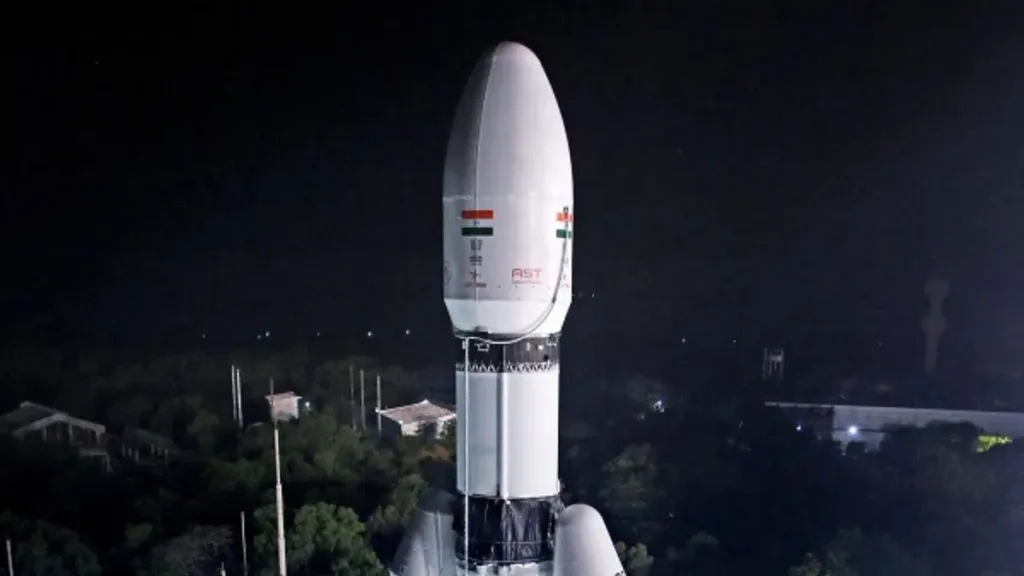
LVM3: India’s Bahubali Rocket
The LVM3 (Launch Vehicle Mark-III), affectionately called “Bahubali,” stands 43.5 meters tall with a lift-off mass of 640 tonnes. This three-stage heavy-lift launch vehicle features two massive solid strap-on boosters (S200), a liquid core stage, and a cryogenic upper stage capable of placing payloads up to 8,000 kg into Low Earth Orbit.
Formerly known as GSLV Mk III and Gaganyaan Launch Vehicle, the LVM3 serves as ISRO’s most powerful operational rocket and cornerstone for India’s human spaceflight ambitions. The vehicle has maintained a perfect success record with all 8 launches successful, including landmark missions like Chandrayaan-2, Chandrayaan-3, and two OneWeb missions carrying 72 satellites.
Public Engagement Opportunity
In a move to foster scientific temper and public engagement, ISRO invites citizens to witness the historic launch live from the Launch View Gallery at SDSC SHAR. Online registration is mandatory through the official portal at lvg.shar.gov.in, allowing space enthusiasts to experience India’s space prowess firsthand.
This public viewing initiative reflects ISRO’s commitment to transparency and inspiring the next generation of scientists and engineers. The spaceport is also developing a comprehensive Space Theme Park to provide immersive experiences for visitors.

Strategic Commercial Significance
The LVM3-M6 mission demonstrates India’s growing capabilities in the global commercial launch market. Following agreements with OneWeb in 2022 after Russian launch services were disrupted, ISRO has positioned itself as a reliable, cost-effective alternative for international satellite operators.
NewSpace India Limited, ISRO’s commercial arm, has been actively pursuing public-private partnerships for large-scale LVM3 production. Plans call for private partners to produce four to six LVM3 rockets annually, with a 14-year partnership framework aimed at scaling India’s launch capabilities while reducing costs.
For updates on ISRO missions and Indian space developments, explore our coverage.
FAQs
When is the ISRO LVM3 M6 launch scheduled?
The LVM3-M6 mission launches on December 24, 2025, at 8:54 AM IST from the Second Launch Pad at SDSC SHAR, Sriharikota, carrying the 6,100 kg BlueBird Block-2 satellite.
What makes the BlueBird Block-2 satellite special?
It features 2,400 square feet phased arrays—the largest commercial arrays in LEO—delivering 24/7 high-speed cellular broadband directly to standard smartphones worldwide.