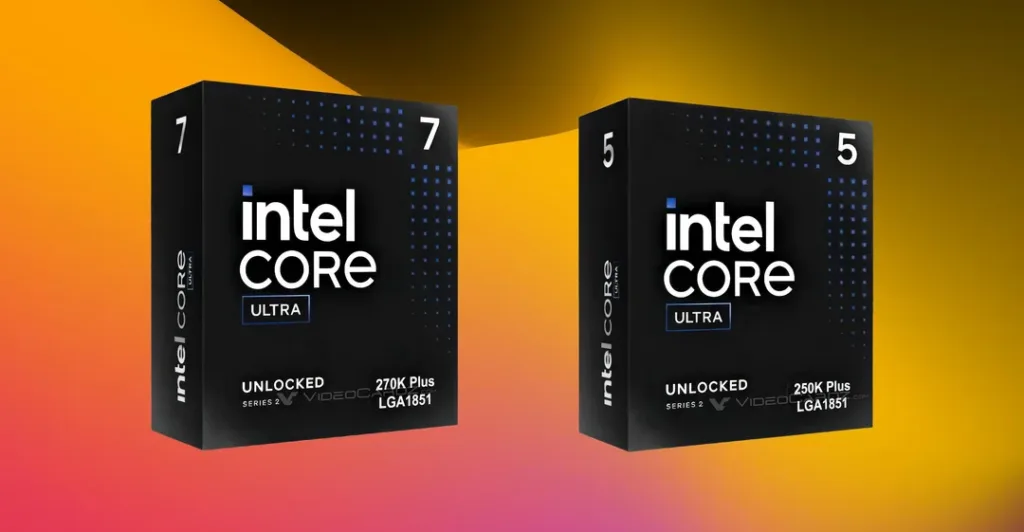
Intel is making a bold claim with its latest desktop processors. The Core Ultra 7 270K Plus and Core Ultra 5 250K Plus are officially the company’s fastest gaming desktop CPUs ever — and with aggressive pricing that undercuts their predecessors by over $100, they’re also Intel’s most compelling desktop value proposition in years. Both go on sale March 26.

Core Ultra 200S Plus: Specs vs Predecessors
| Spec | Core Ultra 7 270K Plus | Core Ultra 5 250K Plus |
|---|---|---|
| Cores | 24 (8P + 16E) | 18 (6P + 12E) |
| P-Core Boost | 5.5 GHz | 5.3 GHz |
| P-Core Base | 4.1 GHz | 3.9 GHz |
| E-Core Base | 3.4 GHz (+100MHz) | 3.2 GHz (+100MHz) |
| Die-to-Die Frequency | +900 MHz over 265K | +900 MHz over 245K |
| DDR5 Support | 7200 MT/s (up from 6400) | 7200 MT/s |
| Smart Cache (L3) | 36MB | 24MB |
| TDP | 125W | 125W |
| Gaming Uplift | ~15% avg (up to 39%) | ~13% avg (up to 24%) |
| Price | $299 (was $400 for 265K) | $199 (was $300+ for 245K) |
What’s Actually New — and What Matters
The headline hardware change is straightforward: four additional Efficiency cores. That brings the 270K Plus to 24 cores, matching the configuration of the flagship Core Ultra 9 285K, but at $299 instead of $589. The 250K Plus reaches 18 cores for $199.
The bigger story might be the 900 MHz improvement to the die-to-die interconnect frequency. Arrow Lake’s original weak point was memory latency — the internal link between the CPU’s compute tile and memory controller was slow enough to drag down gaming performance in ways that frustrated reviewers. That gap is now substantially narrowed, and combined with native DDR5-7200 support, memory-sensitive workloads should improve noticeably.
The other new tool is the Intel Binary Optimization Tool (iBOT) — a software-based binary translation layer that improves instructions per clock in select games, even if they were optimised for AMD, older Intel architectures, or console targets. It’s doing meaningful work in some titles: Shadow of the Tomb Raider shows a 39% uplift for the 270K Plus with iBOT enabled, and Hitman 3 clocks a 22% gain. In non-iBOT titles like F1 25 and Star Wars Outlaws, gains are more modest at 9–12%.
The Price Cut Is the Real Story
Intel’s most aggressive move here isn’t the specs — it’s the pricing. The Core Ultra 5 245K originally launched for over $300, while the Core Ultra 7 265K launched at $400. The Plus equivalents come in at $199 and $299 respectively, putting them directly against AMD’s Ryzen 5 9600X and Ryzen 7 9700X. In multi-threaded workloads, the core count advantage is significant — 24 cores versus 8 is a different class of machine for content creators and streamers.
For gaming specifically, AMD’s Ryzen X3D processors will still hold an edge in many titles. But for builders who want a strong combined gaming and productivity chip at this price, the 270K Plus makes a compelling case. Both CPUs are fully compatible with existing Intel 800-series motherboards.
For our full benchmark review once retail units land, check our Intel CPU coverage on Technosports. And for the best CPU picks for your next PC build, see our processor buying guide on Technosports.