NED
NED OMA
OMA NZ
NZ IND
IND NAM
NAM IRE
IRE PAK
PAK SL
SL SA
SA AUS
AUS Abha
Abha Al Faisaly
 AFG
AFG ZIM
ZIM Sassuolo
 Lazio
Lazio SEV2
SEV2 OSA0
OSA0 PSG2
PSG2 LYON0
LYON0 MBSG1
MBSG1 CFC0
CFC0 Barcelona1
 Real Madrid2
 BRB123/5 (14.3/20 ov, target 148)
 MIS147
 NZ-A317 & 8/2 (4 ov, target 313)
 IND-A113 & 516
 SYL575/4 (167.3 ov)
 KHU
KHU MYMS465/7d
 CHATT424/6 (121 ov)
 DHA521
 RAJ162 & 215/5 (59.1 ov) (f/o)
 RAN402 & 5/0 (2.3 ov)
 BAR443/9d
 SIKM30/1 (15 ov)
 NAGA187
 JHK
JHK DELHI309/5 (90 ov)
 ODSA194
 SVCS13/0 (5 ov)
 BRODA259/6 (86 ov)
 J & K
J & K CHD363/2 (87 ov)
 HP
HP CGR35/1 (14 ov)
 AP231
AP231 BAN
BAN WI
WI IND-W
IND-W ZIM-W
ZIM-W MEX-W51 (12.5/20 ov, target 187)
 ARG-W186/7
 NGA148
 UGA147/9 (20 ov, target 149)
 MOW107/9
 TOK111/5 (18.4/20 ov, target 108)
 LUL88/3 (9.5/20 ov, target 88)
 SPR87
SPR87 VAG169/4
 TUA3
TUA3 MUS0
MUS0 U. de Chile3
 EVE0
EVE0 USF0
USF0 EST0
EST0 BRN0
BRN0 DEF0
DEF0 POT0
POT0 GUA0
GUA0 AS Roma
 Cagliari
 Torino
 Como
Como CFC
CFC GRE
GRE FLA
FLA CAM
CAM Daejeon
 Vissel Kobe
 Darul Ta'zim
 Port FC
 Udinese0
 Milan2
 Real Sociedad2
 Levante1
If you’re a gamer, fantasy sports enthusiast, or someone who ever played real-money games on platforms like Dream11 or Gameskraft — this verdict is a game-changer. Literally.
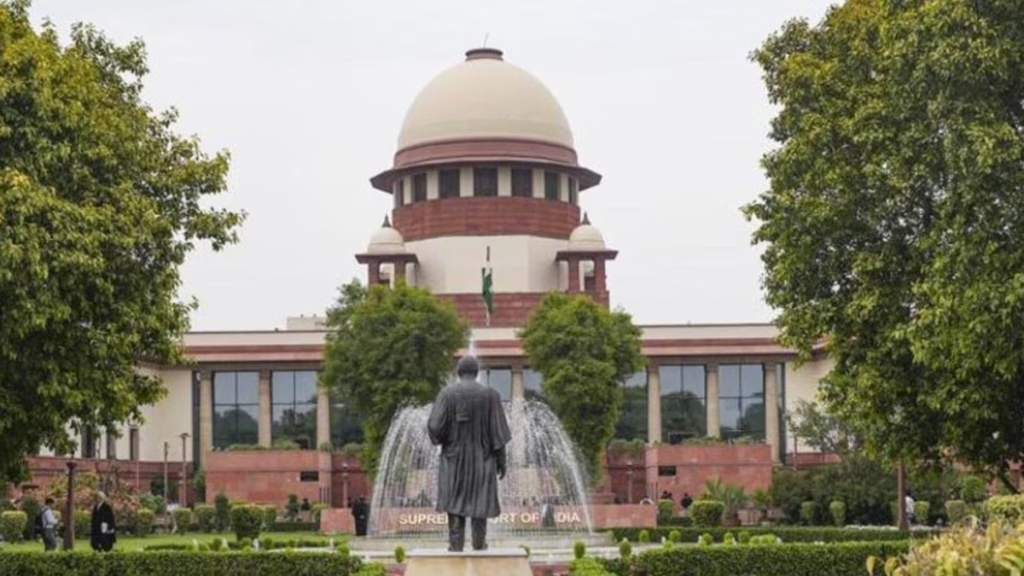
On May 27, 2026, India’s Supreme Court delivered one of its most consequential rulings for the tech and gaming sector in recent memory.
India’s Supreme Court: Overview
| Key Point | Detail |
|---|---|
| Court | Supreme Court of India |
| Bench | Justice J.B. Pardiwala & Justice R. Mahadevan |
| Ruling Date | May 27, 2026 |
| GST Rate Upheld | 28% on full face value of bets |
| Nature of Tax | Retrospective (from pre-Oct 2023) |
| Total Tax Demands | ~₹1.12 lakh crore across 71 companies |
| State Bans Upheld | Tamil Nadu & Karnataka laws validated |
What Did the Court Actually Rule?
The Supreme Court upheld the retrospective levy of 28% GST on online gaming companies, with the bench holding that online gaming platforms fall within the GST framework as taxable actionable claims the moment a stake is placed.
Crucially, the Court rejected the long-standing distinction between a game of skill and a game of chance for GST purposes when a monetary stake is involved — a distinction the industry had relied on for years to avoid the higher tax bracket.
States like Tamil Nadu and Karnataka also had their online gaming ban laws validated, with the court ruling that betting and wagering activities do not receive constitutional protection as legitimate trade or business activities. Focus GN
What Does This Mean for the Industry?
Parliament had already passed the Promotion and Regulation of Online Gaming Act in August 2025, banning online money gaming, which came into force in May 2026 — hitting platforms including Dream11, Gameskraft and Games24x7, most of which have since shut down or pivoted.
This ruling, under Goods and Services Tax law, now adds massive retrospective tax liability on top of an already battered industry. Legal experts estimate total liabilities including penalties and interest could rise to nearly ₹2.3 lakh crore. Focus GN
For the gaming community and investors, this signals a definitive end to the real-money gaming era in India as we knew it.
👉 Stay updated with the latest gaming and esports policy news at TechnoSports.
Also read our coverage of how India’s online gaming regulations are impacting esports on TechnoSports for the full picture.