
 SA329 (82.3 ov)
 AUS
AUS BAN
BAN WI
WI IND-W
IND-W ZIM-W
ZIM-W GOA
GOA SC Delhi
 Milan
Milan Bologna
 Parma
Parma Udinese
 Venezia
 Inter Milan
 Genoa
Genoa Juventus
 Monza
Monza Napoli
 ROMA4
ROMA4 CAG2
CAG2 TOR1
TOR1 COMO3
COMO3 SAS2
SAS2 LAZ6
LAZ6 AFG177
 ZIM140 (19.1/20 ov, target 178)
 AUCK
AUCK CANT
CANT CD
CD ND
ND SIKM184
 NAGA187 & 46/4 (34 ov)
 JHK131/4 (47 ov)
 DELHI515/5d
 ODSA194
 SVCS13/0 (5 ov)
 BRODA616
 J & K6/0 (4 ov)
 CHD685/5d
 HP49/0 (14 ov)
 CGR216/8 (95 ov)
 AP231
AP231 HYD193/2 (54 ov)
 PNJB431
 KNTKA297/7 (95 ov)
 TPURA194
 KER101/6 (35 ov)
 BENG350
 UAE
UAE OMA
OMA ENG
ENG SL
SL DEN
DEN QAT
QAT KENYA
KENYA KUW
KUW POA
POA SPR
SPR BRB
BRB VAG
VAG PAK110
 NAM316/7
 IRE253 (44.5/50 ov, target 317)
 NZ198/3
 IND199/4 (13.2/20 ov, target 199)
 NED371/5
 JAB113 (19.3/20 ov, target 133)
 KAY132/9
 Gamba Osaka
 Buriram
 Kashima
 Pohang Steelers
 ABH0
ABH0 ALF1
ALF1 Sevilla2
 Osasuna0
 PSG2
PSG2 Lyon0
Lyon0
Grok 4.5 Review: Tops the Long-Horizon Terminal Bench. Costs a fraction of the competition. Still not a Fable 5 replacement — but it doesn’t need to be.
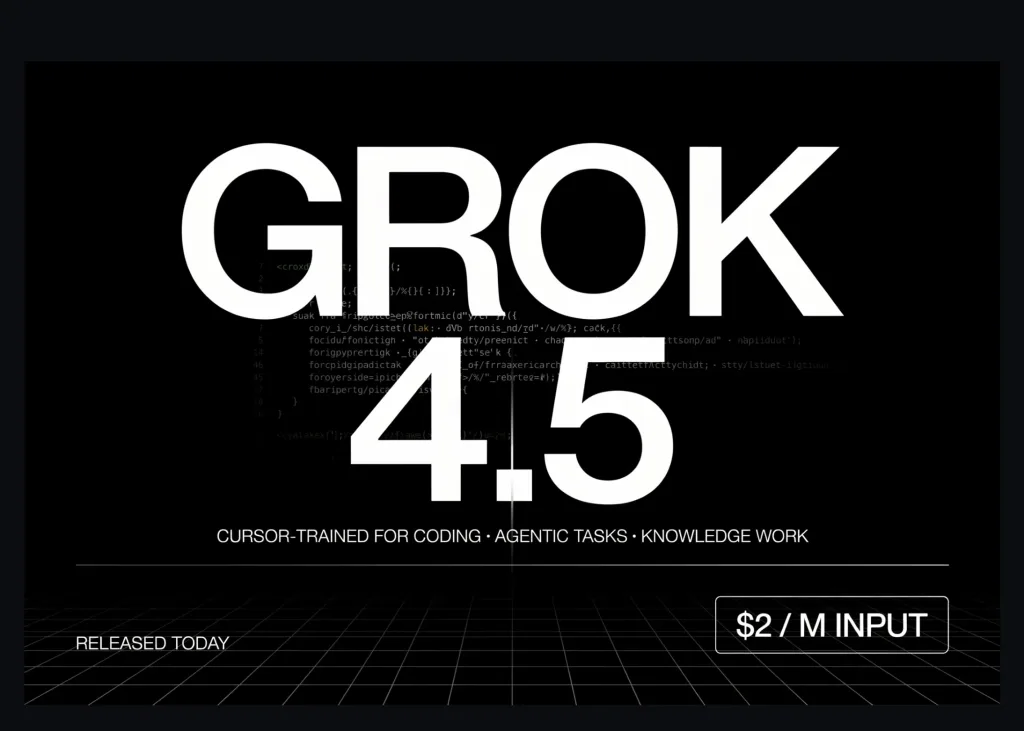
SpaceXAI launched Grok 4.5 on July 8, 2026, and it immediately became the most talked-about model of the week — not because it’s the smartest AI available, but because of what it delivers for the price. At $2 per million input tokens and $6 per million output tokens, it’s roughly one-third the cost of Claude Fable 5 per task. That gap is hard to ignore.
Here’s the honest verdict.
Leaderboard Position: Where Grok 4.5 Actually Stands
The Long-Horizon Terminal Bench leaderboard (July 2026) puts Grok 4.5 at the top with a mean reward of 0.505 across 46 tasks and 13 tasks fully solved — ahead of Claude Fable 5 (0.487, 12 solved), Claude Sonnet 5 (0.497, 8 solved), and Claude Opus 4.8 (0.492, 9 solved).
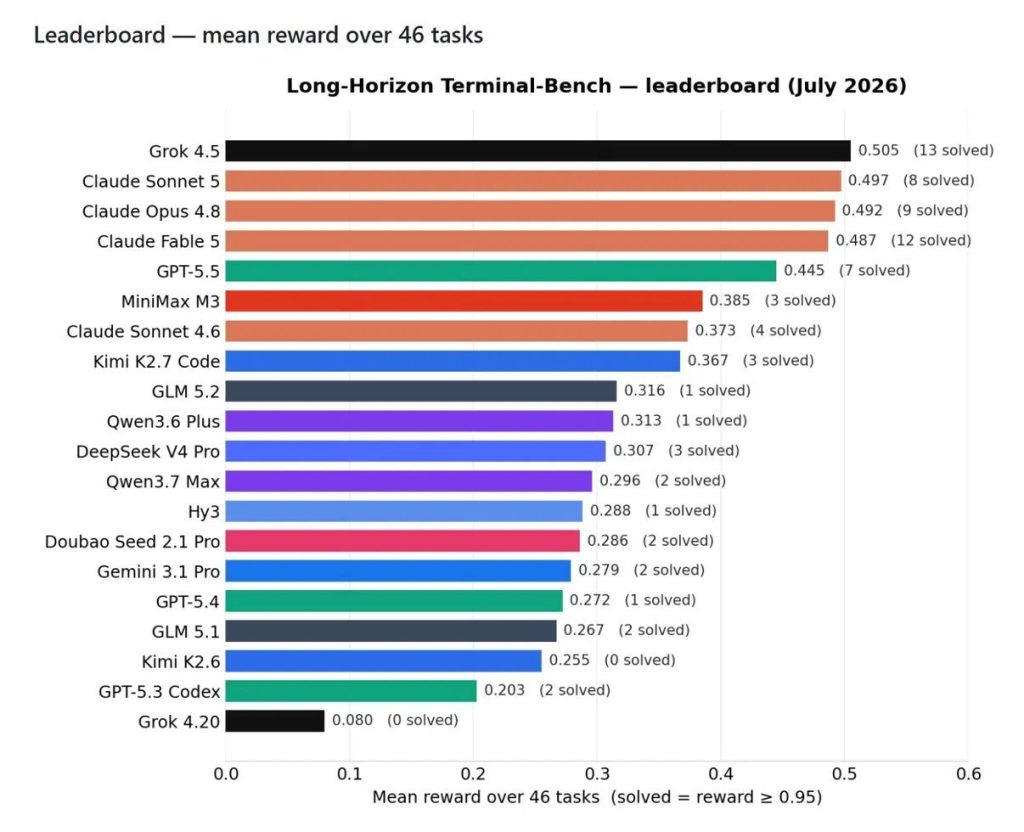
That’s the benchmark headline. The fuller picture across all evaluations is more nuanced:
| Benchmark | Grok 4.5 | Claude Fable 5 | Claude Opus 4.8 |
|---|---|---|---|
| Terminal Bench 2.1 | 83.3% | 84.3% | 78.9% |
| SWE Bench Pro | 64.7% | 80.4% | 69.2% |
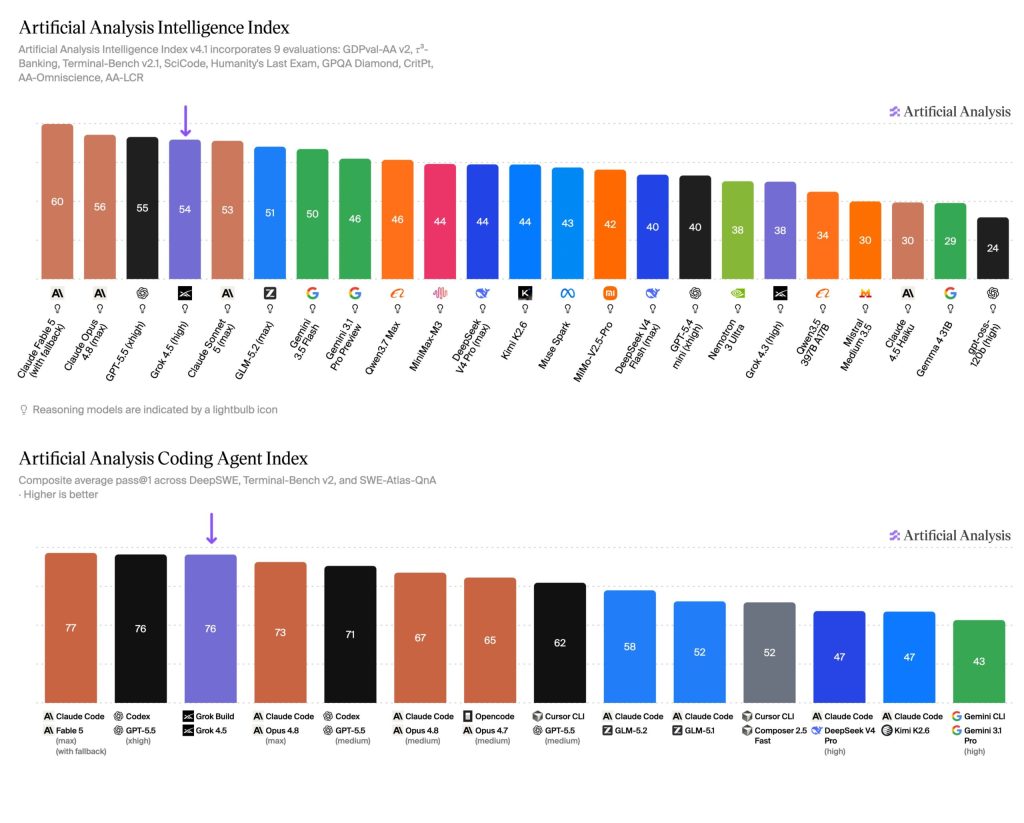
| Coding Agent Index (AA) | 76 | 77 | — |
| Intelligence Index (AA) | 54 (#4) | 60 (#1) | 56 |
| Cost per task (AA) | $2.49 | $11.80 | Higher |
| Avg output tokens/task | 15,954 | — | 67,020 |
On the Coding Agent Index, Grok 4.5 running in Grok Build scores 76 points, matching GPT-5.5 in Codex and trailing Fable 5 in Claude Code by just one point, at a fraction of the cost. The SWE Bench Pro gap is more significant — Fable 5 leads by 15+ points on the harder, messier repo-level tasks. Grok 4.5 tops simpler terminal-oriented evaluations; Fable 5 wins the complex ones.
The Efficiency Story: 4.2× Fewer Tokens Than Opus 4.8
This is Grok 4.5’s most compelling number. Grok 4.5 resolves tasks with 15,954 output tokens on average — about 4.2× fewer than Opus 4.8 at 67,020 tokens for the same benchmark. That architectural efficiency flows from a mixture-of-experts design and training on hundreds of thousands of multi-step software engineering tasks alongside Cursor — the AI coding tool SpaceX acquired for $60 billion in June 2026.
The model runs at 80 tokens per second, and combined with token efficiency, delivers results faster and at far lower cost per completed task.
Pricing: The Real Competitive Advantage
| Model | Input (per 1M) | Output (per 1M) | Cost per task (AA) |
|---|---|---|---|
| Grok 4.5 | $2.00 | $6.00 | $2.49 |
| GPT-5.6 Sol | $5.00 | $30.00 | — |
| GPT-5.5 | Higher | Higher | $5.07 |
| Claude Fable 5 | $10.00 | $50.00 | $11.80 |
Per task, Grok 4.5 in Grok Build costs $2.49, compared to $5.07 for GPT-5.5 in Codex and $11.80 for Fable 5 in Claude Code. For enterprises running high-volume agentic workflows, that’s not a marginal difference — it’s a budget-level decision. Cached input drops to just $0.50 per million tokens, making repeated agentic loops significantly cheaper.
Where Grok 4.5 Shines — And Where It Doesn’t
Strong: Long-horizon terminal tasks, multi-file refactors, backend feature work, bulk code migration, automated test generation, UI/frontend generation. Grok 4.5 is highly proficient at creating well-designed, end-to-end functional apps even with minimal specification.
Weaker: Complex one-shot creative coding and finished product quality. Some testers found Fable 5 still ahead for detailed prototyping where output polish matters. The hallucination rate also jumped significantly — accuracy on the AA-Omniscience Index rose from 35 to 52%, but the hallucination rate jumped from 25 to 54 percent. The model knows more, but it’s also more confident when it’s wrong. Design taste in UI/frontend also lags behind Fable 5 and Gemini 3.5 Pro.
The Best Workflow: Use It With, Not Instead Of, Fable 5
The most practical takeaway from early adopters: Grok 4.5 works best as an implementation engine rather than a replacement for frontier-tier planning models. A popular emerging workflow — use GPT-5.6 Sol or Fable 5 for planning and orchestration, then route implementation and execution tasks to Grok 4.5 — cuts costs dramatically while keeping output quality high where it matters most.
This model routing approach — sending each task to the cheapest model that can clear it — is becoming a core competency for AI-heavy engineering teams in 2026. For Indian developers and enterprises evaluating where Grok 4.5 fits into their stack, our best AI coding tools for developers in India roundup covers the full landscape.
One Honest Caveat
It is not what you hand your single most important, correctness-critical, one-shot problem — where you would pay for Fable 5 or Opus 4.8 and not think twice. Grok 4.5 is frontier-adjacent, not frontier-supreme. Knowing which situation you’re in — high-volume/cost-sensitive vs precision-critical — is the entire decision.
For our broader coverage of the AI model wars shaping developer tools in 2026, follow our AI and technology news at TechnoSports.
Bottom Line
Grok 4.5 is not the smartest model available. It’s ranked #4 on the Artificial Analysis Intelligence Index behind Fable 5, GPT-5.5, and Opus 4.8. But at $2/$6 per million tokens with 4.2× token efficiency over Opus 4.8 and near-Fable performance on agentic coding benchmarks, it’s arguably the most commercially interesting model launch of July 2026. For bulk, cost-sensitive workloads, it’s the rational choice. For your hardest, most precision-critical tasks, Fable 5 is still the safer bet.
Sources: SpaceXAI | The Decoder | TechTimes


