Imagine trying to read a critical notification or check a weather update on your govee ceiling light, only to be met with a blurry, indistinct pattern. This is the core tension surrounding Govee’s latest announcement: a multicolor LED illumination system that also doubles as a low-resolution display.
Officially unveiled on April 25, 2026, with a planned launch for May 15, 2026, at $129.99, this device promises to blend ambient lighting with functional — albeit basic — visual feedback. But does this innovative combination genuinely enhance the smart home experience, or is it merely a novelty destined to be overlooked? We delve into the practicalities.
Govee ceiling: Govee’s Bold Move: Lighting Meets Low-Res Display
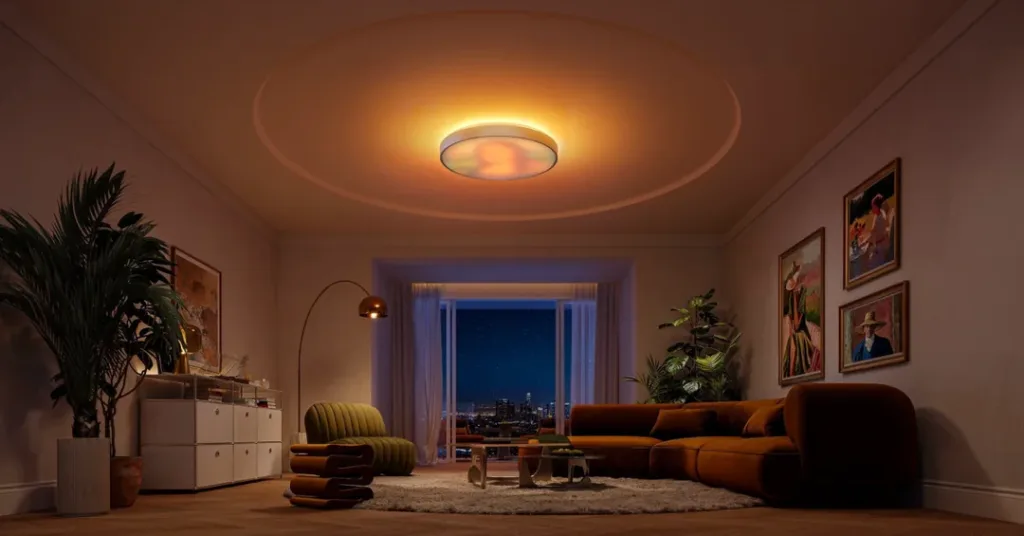
Govee, a company known for its smart lighting solutions, has taken a significant leap by integrating a display panel into its new ceiling light. This isn’t just about mood lighting; it’s an attempt to make the ceiling itself a passive information hub. The device was officially announced on April 25, 2026, and will be available on May 15, 2026, for $129.99. The concept is intriguing: imagine a subtle display showing the time, weather icons, or even simple notifications without needing a dedicated screen in every room. This integration aims to blend technology seamlessly into the home environment, moving beyond mere illumination to offer a layer of ambient information. The Verge first reported on this unique product, highlighting its dual functionality.
The Practicality Puzzle: Reading Between the Pixels
The most striking specification is the display’s resolution: a mere 64×32 pixels. While this is more than enough for basic icons and text, its real-world readability remains a significant question. For context, early smartphone displays, like those on the iPhone Pro Display, offered vastly higher resolutions, allowing for detailed images and sharp text. Even rudimentary smartwatches today boast superior pixel density. The critical question is whether this low-resolution screen can effectively convey useful information from a distance, or if it will be limited to decorative patterns and status indicators. Govee suggests it can display time, weather, and notifications, but the practical usability in everyday scenarios—like glancing up to see if it’s raining without needing to pull out your phone—needs rigorous testing.
Under the Hood: Powering the Ambient Display
Beneath the surface, the Govee Ceiling Light is equipped with a quad-core ARM Cortex-A53 processor clocked at 1.2 GHz, supported by 512MB of RAM and 4GB of internal storage. This hardware configuration is modest, typical for a device focused on ambient display and smart home connectivity rather than demanding computational tasks.
It’s designed for continuous ceiling installation, drawing power directly from AC mains, meaning there’s no battery to worry about charging. This setup is ideal for a fixture that’s meant to be a permanent part of a room’s infrastructure, like any standard ceiling light. The inclusion of Wi-Fi and Bluetooth connectivity is implied for smart home integration and app control, essential for managing the multicolor LEDs and the display’s output.
Market Positioning and User Expectation
Priced at $129.99, the Govee Ceiling Light positions itself as a premium smart home accessory. It competes in a market segment where users expect both aesthetic appeal and functional utility. While Govee has a strong reputation for its vibrant LED lighting, the addition of a low-resolution display introduces a new dimension. Not everyone is convinced — some tech enthusiasts argue that the limited resolution makes the display a mere gimmick, offering little practical value over a standard smart light. But Wired suggests that for users prioritizing ambiance and subtle information delivery, this unique combination could indeed carve out a niche. The success will hinge on the software’s intuitiveness and the display’s actual utility beyond decorative patterns.