Globalquantumcomputing — As of June 2026, breakthroughs in quantum computing are significantly changing the global tech scene, leading to a huge influx of funding from sovereign funds and private venture capitalists.
Google’s Willow quantum chip, introduced in December 2024, has set the standard for performance. It managed to perform a complex computation in under five minutes—a task that would take classical supercomputers 10 septillion years. This impressive processing power has moved from the realm of theoretical physics into practical industrial strategies, pushing nations to fast-track their own research programs to keep up.
The competition to achieve scalable quantum advantage has heated up since Microsoft unveiled its Majorana 1 chip in February 2025. This chip uses topological qubit architecture, paving the way for a million-qubit system on a single chip.
On another front, D-Wave has launched its Advantage2 system commercially, featuring over 4,400 qubits through its specialized annealing architecture. These advancements have shifted the industry from mere academic interest to a high-stakes battleground for geopolitical and economic power.
Globalquantumcomputing: Hardware Milestones and Technical Projections
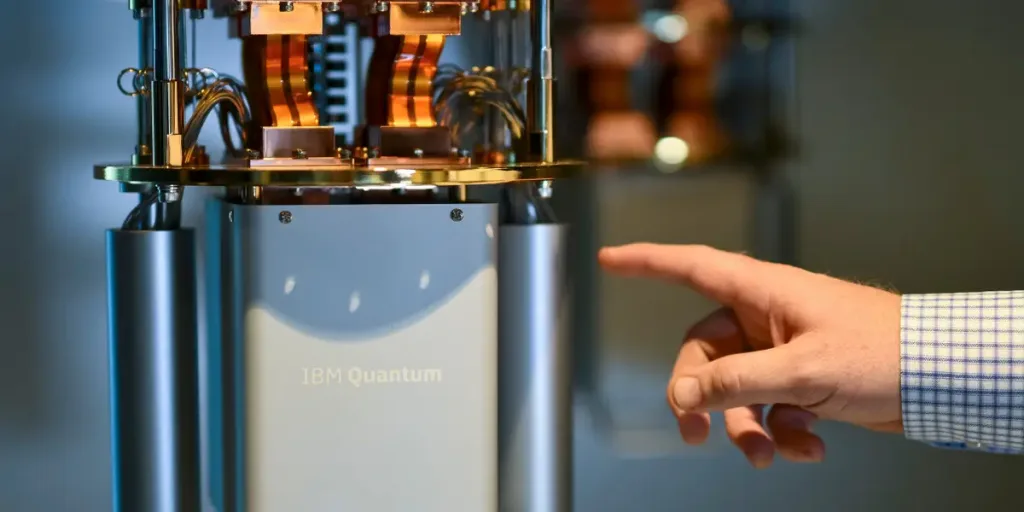
Technical progress drives this investment wave as companies seek stable, error-correcting systems. IBM is sticking to a strict engineering timeline, aiming for a 100,000-qubit system by 2033.
This plan builds on the groundwork laid by their 133-qubit Heron processor, released in December 2023. While the number of qubits is a popular benchmark, the industry is increasingly prioritizing gate fidelity and coherence times, areas where IBM’s modular approach has consistently improved.
The competitive landscape is broad, with various strategies competing to reach fault-tolerant systems. China’s USTC research team has made a mark, showcasing the Jiuzhang 3.0 photonic quantum computer in 2023, claiming a clear quantum advantage over classical benchmarks.
For developers eager to experiment without creating their own hardware, Amazon Web Services offers access to systems from IonQ, Rigetti, and D-Wave through its Braket service.
| System/Chip | Developer | Key Metric |
|---|---|---|
| Willow | Under 5-minute computation time | |
| Advantage2 | D-Wave | 4,400+ qubits (annealing) |
| Heron | IBM | 133 qubits |
| Majorana 1 | Microsoft | Path to 1 million qubits |
Globalquantumcomputing: Strategic Shifts and Economic Impact
Governments see these advancements as crucial for national security and economic independence. In the U.S., lawmakers have been pushing for an $800 million allocation for research initiatives under the National Quantum Initiative Act. This funding aims to bridge the gap between lab research and commercial deployment, ensuring that private sector innovations have the necessary infrastructure to scale, as highlighted by recent coverage from The Verge.
Right now, we’re seeing a shift from mere experimentation to full integration. As Global Quantum Computing research evolves, the focus is moving towards hybrid systems that blend classical high-performance computing with quantum co-processors. The real takeaway here is that the winner of this competition won’t just have the fastest computer; they’ll likely control the future of cryptography, materials science, and drug discovery. Investors are betting that whichever firm or nation achieves true fault tolerance first will set the tone for scientific advancements in the next century.
FAQs
How does a quantum computer differ from a classical one?
Quantum computers utilize qubits, which can exist in multiple states at once due to superposition and entanglement. In contrast, classical computers use binary bits (0 or 1).
Is quantum computing available for commercial use today?
Yes, systems like D-Wave’s Advantage2 are already on the market, and cloud platforms such as AWS Braket enable companies to run workloads on various quantum hardware.
Why is investment in quantum computing initiatives increasing globally?
Governments and businesses are heavily investing because quantum technology has the potential to address issues in materials science, logistics, and cryptography that are currently insurmountable for classical systems. Global Quantum Computing
How does the Willow chip influence the global quantum computing market in 2026?
The Willow chip acts as a key catalyst for the surge in investments in 2026 by showcasing exceptional error correction and processing stability. This technological achievement encourages venture capitalists and government bodies to ramp up funding for scalable quantum architectures, effectively speeding up the shift from experimental prototypes to commercially viable systems, as reported by TechCrunch.
Why are major corporations like Google, IBM, and Microsoft competing to develop 1M-qubit chips?
These tech giants are striving for 1M-qubit chips because reaching this milestone is vital for achieving fault-tolerant quantum computing. This capability can tackle complex problems in cryptography, material science, and drug discovery. By securing a lead in qubit density and coherence, these companies aim to build the essential infrastructure for the next generation of global computational power.