NAM321/6 (50 ov)
 IRE
IRE AVL
AVL MNC
MNC RAY
RAY ELC
ELC GMB
GMB ZMB
ZMB NGA
NGA LES
LES CAG
CAG BOL
BOL COMO
COMO SAS
SAS FCA
FCA FCU
FCU KOE
KOE S04
S04 MOZ19
MOZ19 UGA23/0 (0.5/20 ov, target 20)
 NZ180/5
 IND181/6 (19.5/20 ov, target 181)
 Ipswich1
 Nottm Forest1
 Alavés1
 Málaga1
 WA105/3 (18.5/50 ov, target 372)
 NSW371/8
 DEN
DEN KUW
KUW KENYA
KENYA QAT
QAT SWD-W
SWD-W EPR-W
EPR-W TTN-W
TTN-W WPR-W
WPR-W BOR
BOR WAR15/1 (2.5/20 ov)
 LIONS
LIONS Limpo21/1 (2.5/20 ov)
 NZ-A135/3 (41 ov)
 IND-A113
 DHA293/3 (84.1 ov)
 RAJ
RAJ MYMS
MYMS CHATT
CHATT RAN320/5 (80 ov)
 BAR
BAR MEX-W
MEX-W ARG-W
ARG-W UAE
UAE NED
NED PAK
PAK ENG
ENG IND-W
IND-W ZIM-W
ZIM-W AFG170/3 (34.3/50 ov, target 170)
 ZIM169
 CHE0
CHE0 DYI0
DYI0 CHO1
CHO1 QIN0
QIN0 HEN1
HEN1 BEI0
BEI0 LIA1
LIA1 ZHE0
ZHE0 QWC1
QWC1 YUN0
YUN0 SHX0
SHX0 Shanghai Shenh0
 TIG0
TIG0 SHP0
SHP0 WTT1
WTT1 SHT3
SHT3 M05
M05 SVW
SVW RBL
RBL ELV
ELV Torino3
 Monza2
 Brest1
 Nice2
Nice2 Stuttgart2
 Gladbach3
 Al Ahli4
 Al Khaleej1
Sweden had a dreadful 2026 World Cup qualifying campaign, finishing bottom of UEFA Group B with no wins and just two draws (L4). Their group did not even include any of Europe’s main powerhouses — games against Switzerland, Kosovo, and Slovenia proved too difficult.
They scored just four goals — as many as Belarus and Malta. With two matches remaining in the regular campaign, the Swedish FA sacked head coach Jon Dahl Tomasson, appointed only in February 2024. His replacement was Graham Potter, brought in during October 2025 for the final qualifying fixtures, albeit in vain.
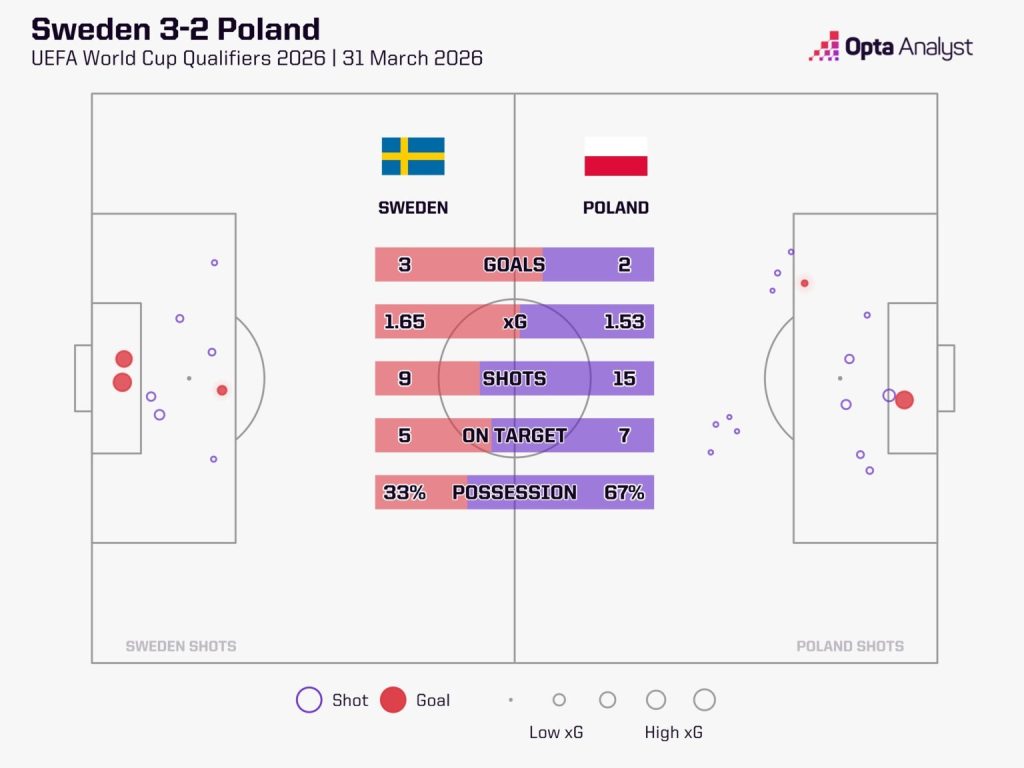
Sweden’s survival came through their UEFA Nations League performance. They earned a place in the World Cup play-offs through that route — and when the opportunity came, they took it. Their 20th major competition (13 World Cups, 7 European Championships) and first World Cup since 2018 was secured, but only after a five-goal thriller.
Graham Potter: The Englishman at Home in Sweden
Potter’s appointment may have surprised outsiders, but the logic is clear. The Englishman made his name at Swedish side Östersunds, spending seven and a half years guiding the club from the fourth tier to a Swedish Cup win and the Europa League group stage. He speaks fluent Swedish. He knows the football culture.
His broader managerial CV spans almost 500 professional games. He will be the first Englishman to lead another European nation at the World Cup since Roy Hodgson (Switzerland) and Jack Charlton (Republic of Ireland) in 1994, and the first foreign manager for Sweden at the World Cup since fellow Englishman George Raynor in 1958.
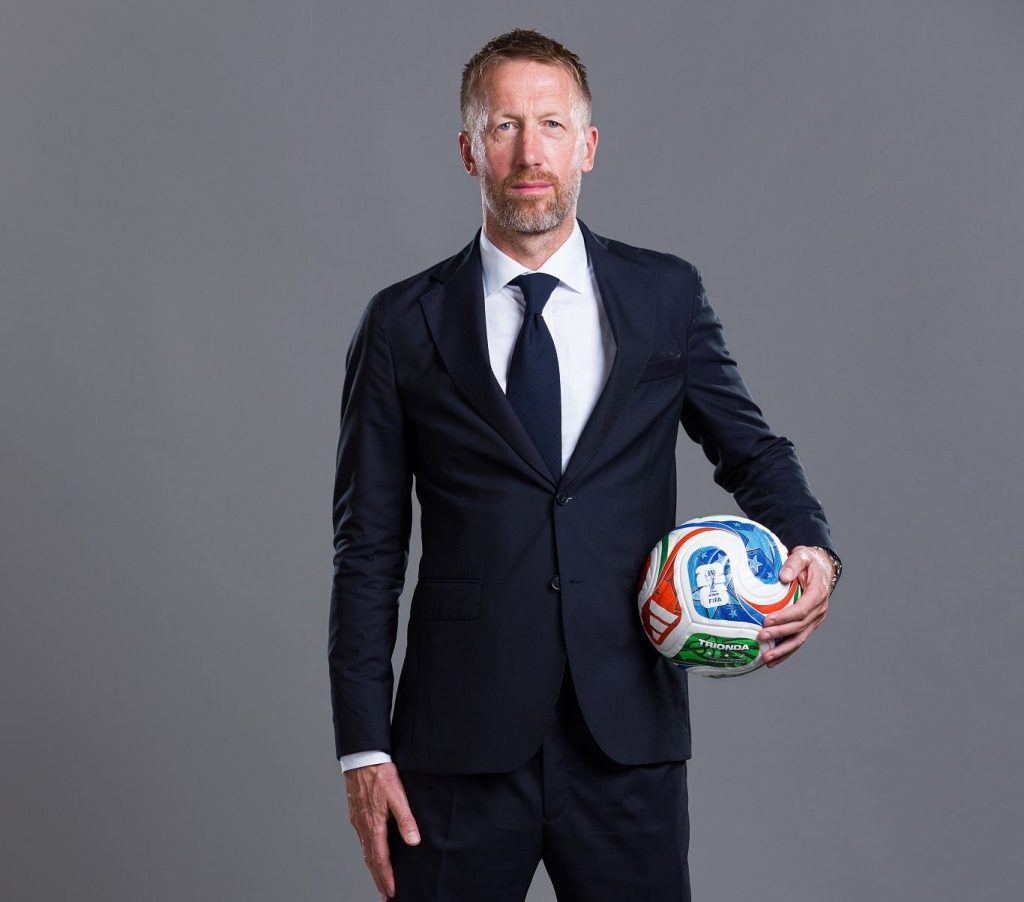
What Potter demonstrated in the play-offs was an immediate and important quality: tactical adaptability. Despite being primarily associated with patient, possession-based football in England, he took a completely different approach when managing Sweden through the two decisive matches.
| Sweden Play-Off Stats (Both Matches Combined) | Stat |
|---|---|
| Average possession | Less than 33% |
| Total passes per game | Fewer than 270 |
| Open-play sequences of 10+ passes (total, both games) | 7 |
| xG result | Higher than opponent in both matches |
| Formation | Switched from 4-4-2 to 3-4-3 |
He adapted his approach to suit his squad rather than forcing the squad to fit a predetermined system. The direct, low-possession, high-transition style suits Sweden’s lightning-fast forwards considerably better than the patient build-up for which Potter became known at Brighton and Chelsea.
Viktor Gyökeres: The Man Who Got Them Here
During the play-offs, one player was decisive. Viktor Gyökeres scored a hat-trick against Ukraine in the semi-final — his first international goals since November 2024 — and then netted the 88th-minute winner against Poland in the final. Without him, Sweden do not reach this World Cup.
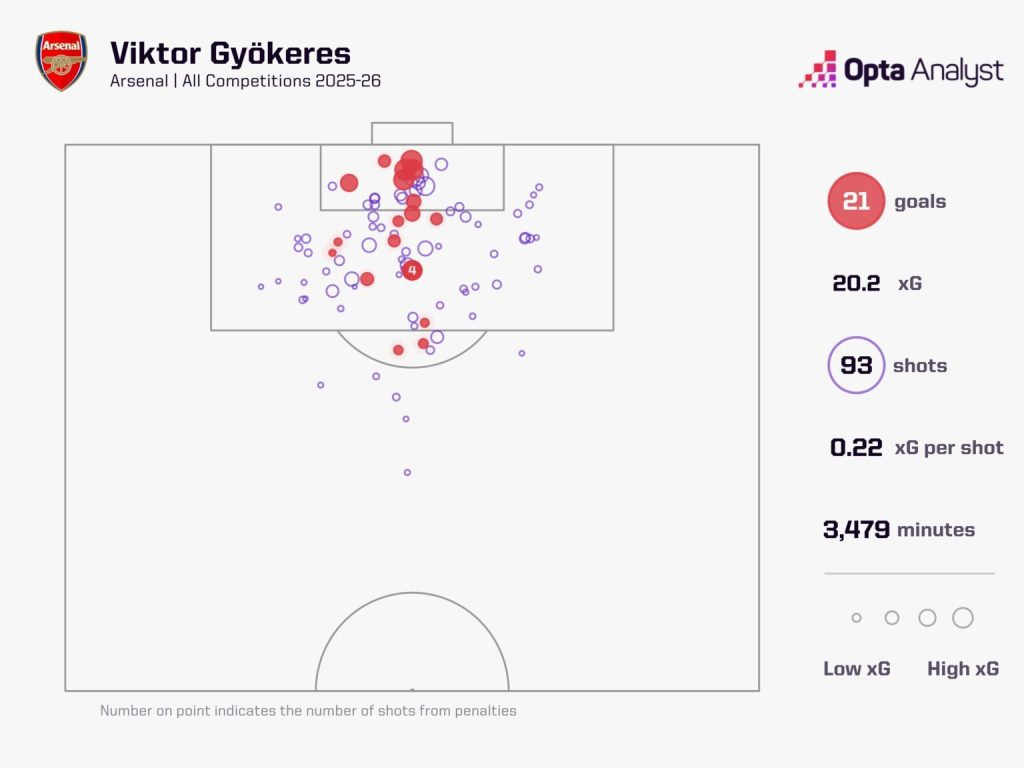
His Arsenal season confirmed his elite status. He became the first Arsenal player to score 20 or more goals across all competitions in their debut season since Alexis Sánchez in 2014-15 (25 goals), finishing with 21 goals in 2025-26.
| Viktor Gyökeres — 2025-26 Season | Stat |
|---|---|
| Goals (all competitions) | 21 |
| Goals after January 2026 | 14 |
| Shot conversion rate (Jan–end of season, club and country) | 34% (18 goals from 53 shots) |
| Shot conversion rate (Aug–Dec 2025) | 14% (7 goals from 50 shots) |
The turnaround in form after January was dramatic. Only Aston Villa’s Ollie Watkins scored more in all competitions in 2026 among Premier League players (15 — with Morgan Gibbs-White also matching Gyökeres on 14).
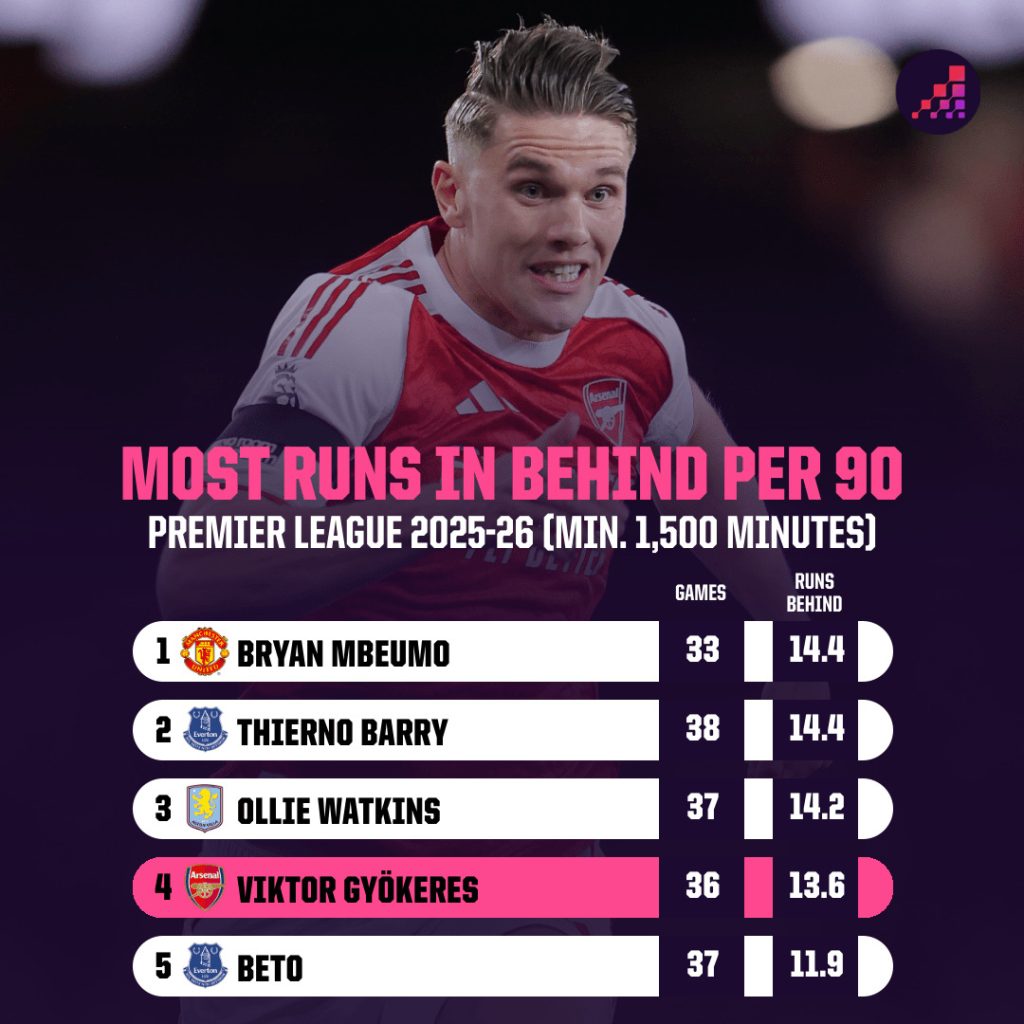
His movement is one of his most underappreciated qualities. In the UEFA Champions League 2025-26, only four players with 810+ minutes made more runs in behind per 90 minutes than Gyökeres (11.6). In the Premier League, he ranked fourth for this type of run per 90 among players with at least 1,500 minutes (13.6). His capacity to exploit space behind defences makes Sweden’s counter-attacking system genuinely dangerous.
The Supporting Cast
Anthony Elanga — Pure Pace
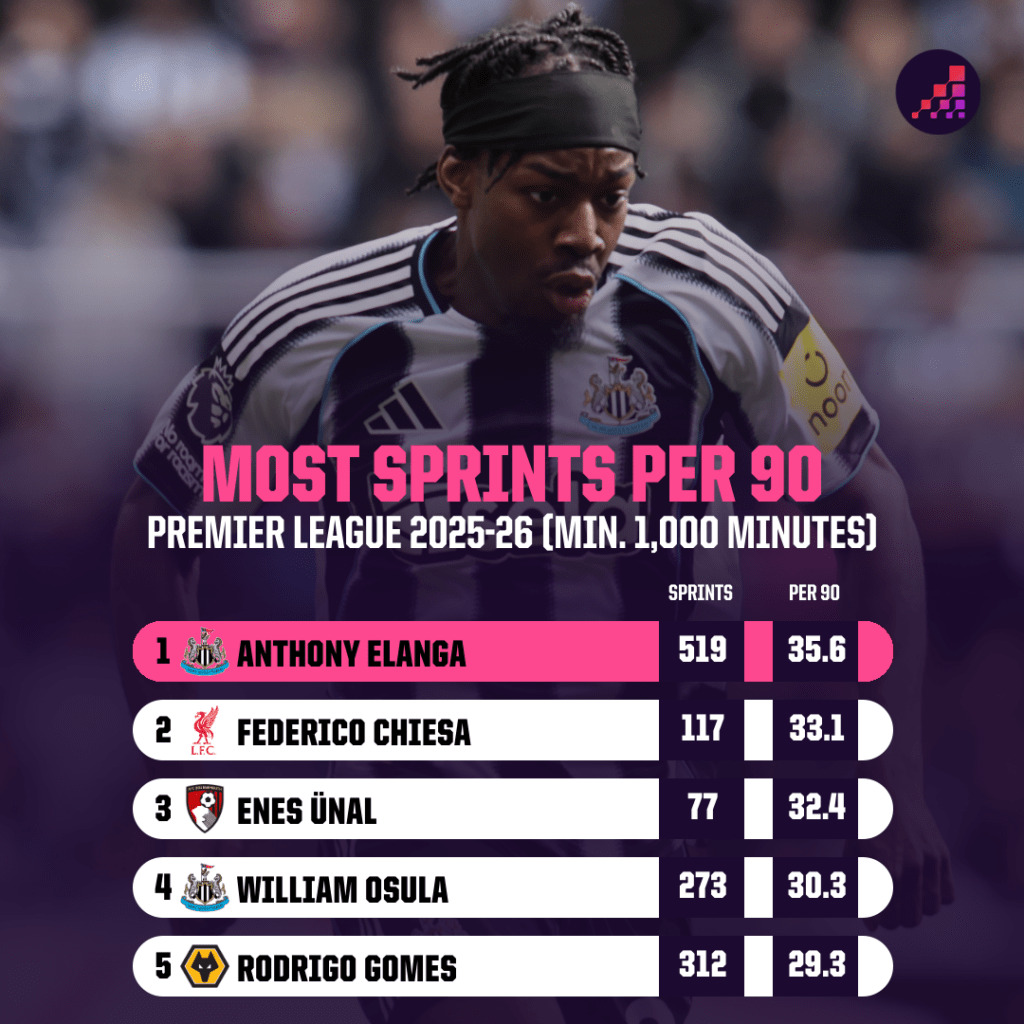
Elanga (Newcastle United) provides a different kind of attacking threat — raw, explosive speed that would not look out of place in an Olympic sprint final. He recorded the most sprints per 90 minutes of any player with at least 180 Premier League minutes in 2025-26, and the fifth-fastest top speed of any player in the Premier League this season (36.4 km/h against Chelsea in December 2025).
Alexander Isak — The Question Mark
The most prominent unknown in Sweden’s squad. Isak — formerly of Newcastle, now at Liverpool — has dealt with significant fitness and injury issues this season, playing no full 90 minutes for his club in 2025-26 and starting just three matches for club or country this calendar year. He scored five goals in 27 combined matches for Liverpool and Sweden.
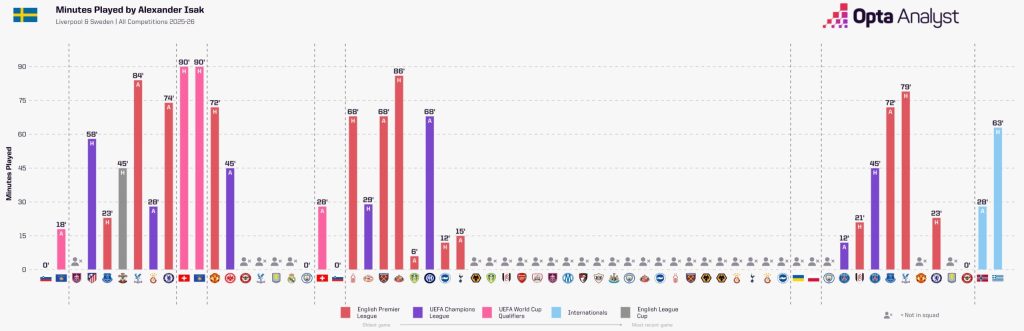
But in the recent friendly against Norway, he produced a superb technical goal after a brilliant solo run — a reminder that when fit and motivated, Isak remains a genuinely exceptional forward.
Benjamin Nygren — The Celtic Contributor
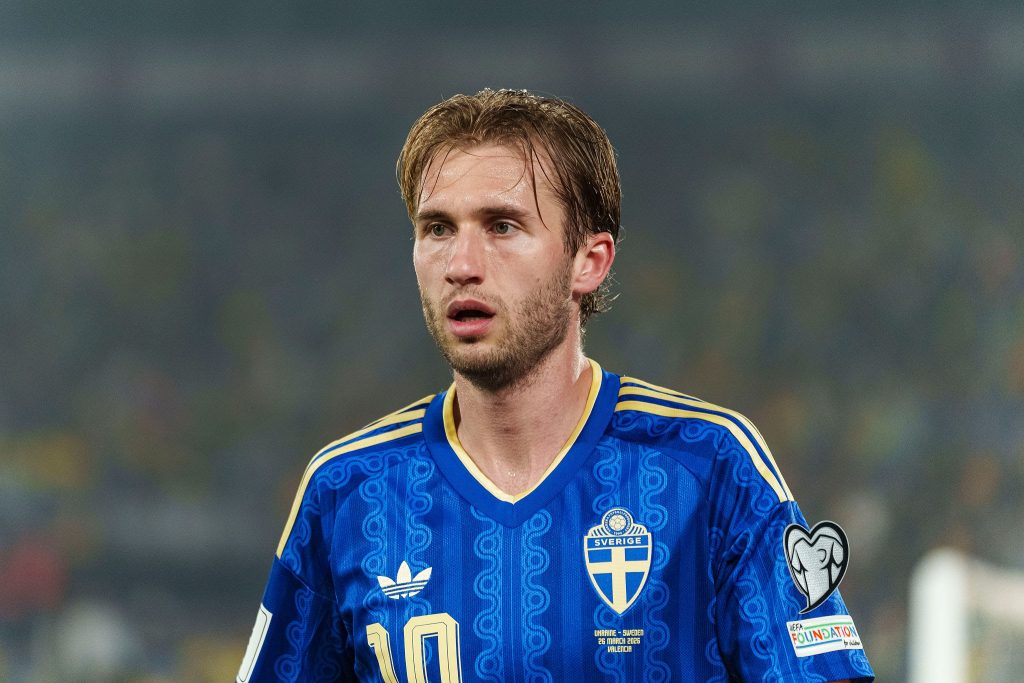
Nygren (Celtic) enjoyed a strong season — 21 goal involvements in all competitions (16 goals, 5 assists) and the most shot involvements for Celtic (150 — 92 shots and 58 chances created). In three starts for Sweden under Potter, he contributed to goals in each one, scoring once and assisting twice. A productive wildcard option.
The Experience Problem
Where other World Cup squads carry depth of international experience, Sweden’s is strikingly thin.
| Sweden Squad Experience at World Cup 2026 | Stat |
|---|---|
| Average caps per player | 19.9 |
| Lowest for Sweden at a major tournament since | 1970 World Cup (17.4) |
| Only lower average in this World Cup | South Africa (19.3) |
| Players with previous World Cup experience | 1 (captain Victor Lindelöf — 4 games in 2018) |
| Players with any major tournament experience | 2 (Lindelöf and Isak — 4 games at Euro 2020) |
| Players with 50+ caps | 2 (Lindelöf and Isak) |
Lindelöf is the only player in Potter’s squad to have appeared at a World Cup. Isak is the only other player to have any major tournament experience at all. This is an extraordinarily young and inexperienced squad for a tournament of this scale.
That inexperience is a genuine vulnerability — but it also means there is less psychological baggage. Players without accumulated disappointment can sometimes perform without the weight of expectation.
Can Potter Spring a Surprise?
Sweden have made it out of their group in each of their last four World Cup appearances, including a third-place finish at the 1994 tournament. Their road to 2026 was among the most difficult of any team in the competition — but they made it.
Potter’s tactical flexibility, demonstrated immediately in the play-offs, gives them a credible identity. The 3-4-3 suits their forward line. Gyökeres is in the form of his life. Elanga provides a pace dimension that very few opponents can neutralise. And Isak, if he finds fitness and rhythm, adds another tier of quality.
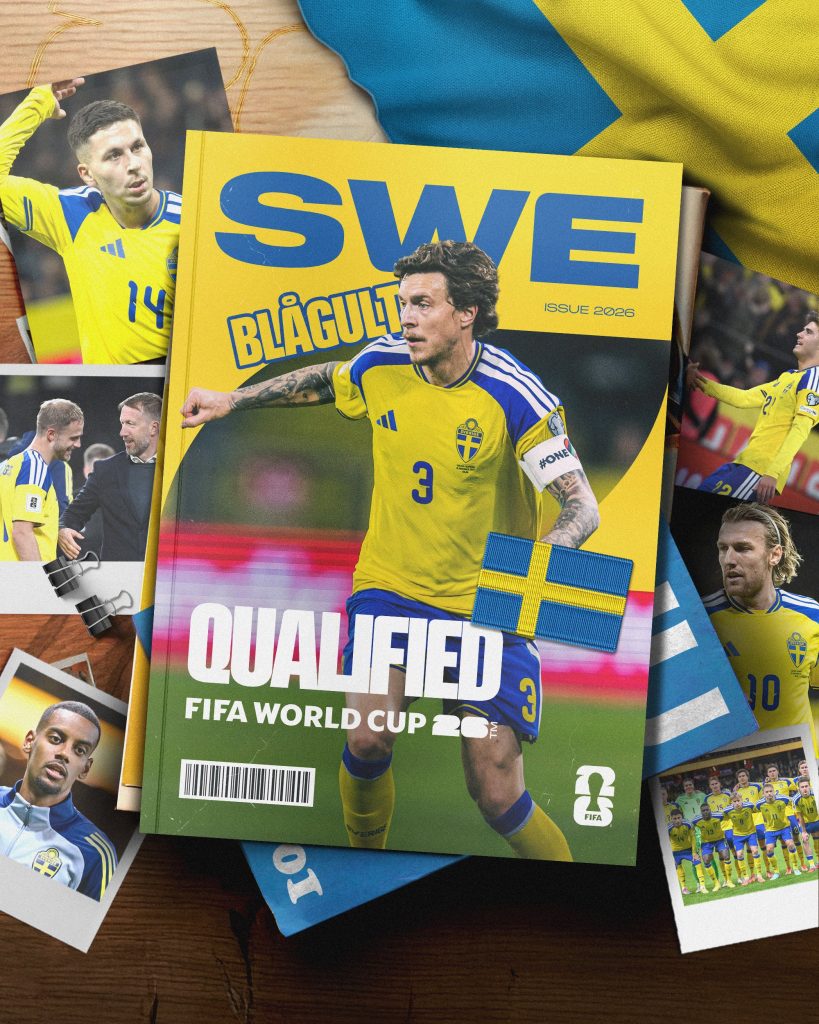
The squad lacks experience. But it does not lack talent in the positions that win games at tournament level.
In Group F alongside the Netherlands, Japan, and Tunisia, there are points to be taken. Whether Potter can guide this inexperienced group to unexpected success — as he did in a completely different context with Östersunds — is the central question of Sweden’s 2026 World Cup.
Read More: World Cup 2026: Group F Predictions and Preview