A new era of officiating is set to begin in England as semi-automated offside technology (SAOT) makes its debut during the FA Cup fifth round. Having already been utilized in major international tournaments, including last summer’s European Championships, this advanced system is designed to enhance decision-making accuracy by using optical tracking and virtual graphics.

But how does this system operate, and why is it not entirely automated? Let’s explore the mechanics of SAOT, its advantages, and its impact on football officiating.
Understanding Semi-Automated Offside Technology
SAOT relies on 30 high-speed cameras installed across Premier League stadiums. These specialized cameras record at 100 frames per second, double the frame rate of standard broadcast cameras.

The system tracks both the ball’s movement and 10,000 mesh data points per player, ensuring precise detection of offside positions. When an attacking player is found to be offside, the system flags the incident automatically to the Video Assistant Referee (VAR) and the SAOT operator for review.
Why Is It Not Fully Automated?
Despite its technological advancements, SAOT still requires human verification. The system can determine the kick-point, identify relevant players, and detect which body parts are involved in the offside call.
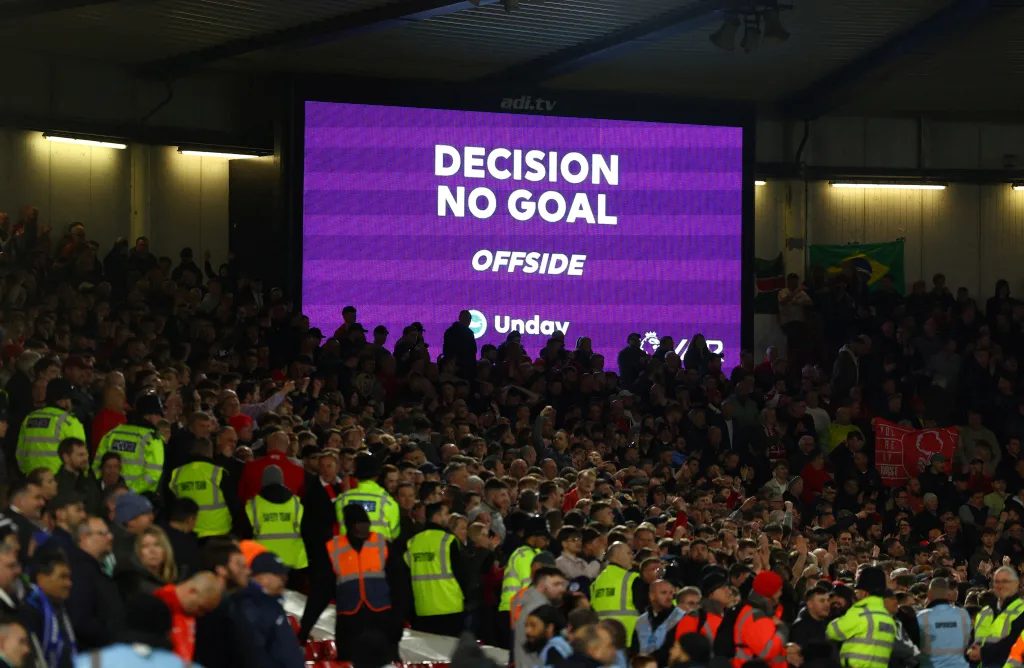
However, the VAR official must confirm the final decision, especially in cases involving subjective interpretations. Situations that may require additional review include:
- Deflections and deliberate plays by defenders
- Players in an offside position interfering with an opponent despite not touching the ball
This human involvement ensures that the technology supports rather than replaces referees in making critical decisions.
What Will Viewers See on Their Screens?
Once a final ruling is made, a 3D visual representation is shared with both broadcasters and stadium screens. This animated replay displays:
- Red lines for offside players
- Green lines for onside decisions
- A white vertical wall representing the offside line
- A blue ‘pulse’ marking the defender’s relevant body part
When an attacker is offside, the body part beyond the white wall is highlighted in red. The final visual is presented at an off-center angle, ensuring clarity when reviewing the offside call.

Unlike previous methods, this new system does not overlay graphics on live footage. Instead, broadcasters will switch to the decision visual as quickly as possible, minimizing disruptions to the viewing experience.
The introduction of semi-automated offside technology is expected to significantly reduce delays in decision-making while maintaining fairness in officiating. With fewer controversial offside calls and a streamlined review process, this innovation could shape the future of football officiating on a global scale.
As SAOT debuts in the FA Cup fifth round, all eyes will be on its effectiveness in enhancing accuracy and consistency in one of football’s most debated aspects.
Read More: Real Madrid’s Dani Ceballos Faces 2 Month Layoff Following Hamstring Injury