NZ
NZ IND
IND NAM
NAM IRE
IRE MOZ
MOZ UGA
UGA Aston Villa
 Man City
 Rayo
Rayo Elche
Elche GMB
GMB ZMB
ZMB NGA
NGA LES
LES Cagliari
 Bologna
 IPS1
IPS1 NFO1
NFO1 ALA1
ALA1 MCF1
MCF1 TOR3
TOR3 MON2
MON2 BRE1
BRE1 NICE2
NICE2 TAS129/7 (23.3/35 ov, target 276)
 VIC304/7 (50 ov)
 WA
WA NSW38/1 (9/50 ov)
 NZ-A135/3 (41 ov)
 IND-A113
 DHA
DHA RAJ
RAJ MYMS
MYMS CHATT
CHATT RAN
RAN BAR
BAR SYL
SYL KHU
KHU MEX-W
MEX-W ARG-W
ARG-W UAE
UAE NED
NED AFG170/3 (34.3/50 ov, target 170)
 ZIM169
 IND-W200/1 (27.1/50 ov, target 198)
 ZIM-W197
 DOLPH56/0 (3.5/8 ov, target 56)
 SWD51/4 (8/8 ov)
 WSW1
WSW1 BRI1
BRI1 Como
Como Sassuolo
 Augsburg
 Union Berlin
 Cologne
 Schalke
 Mainz
Mainz Bremen
 RB Leipzig
 Elversberg
 VFB2
VFB2 BMG3
BMG3 AHL4
AHL4 KHA1
KHA1
There has been a significant but underreported change in the way FIFA is determining league tables at the 2026 World Cup — and it may have a profound impact on the final group matches, how teams approach them, and which sides progress.
For the first time at a World Cup, FIFA is using head-to-head records instead of group goal difference as the primary tiebreaker for teams level on points.
It is a change that aligns FIFA with UEFA, which has always given priority to results between the teams in question. And it has already begun to shape the dynamics of the group stage in ways that the previous system never would have.
The Historical Context
The evolution of World Cup tiebreakers has a long history:
| World Cup Tiebreaker History | Detail |
|---|---|
| Until 1966 | Goal ratio (goals scored divided by goals conceded) |
| 1970 onwards | Goal difference |
| 2026 onwards | Head-to-head record takes precedence |
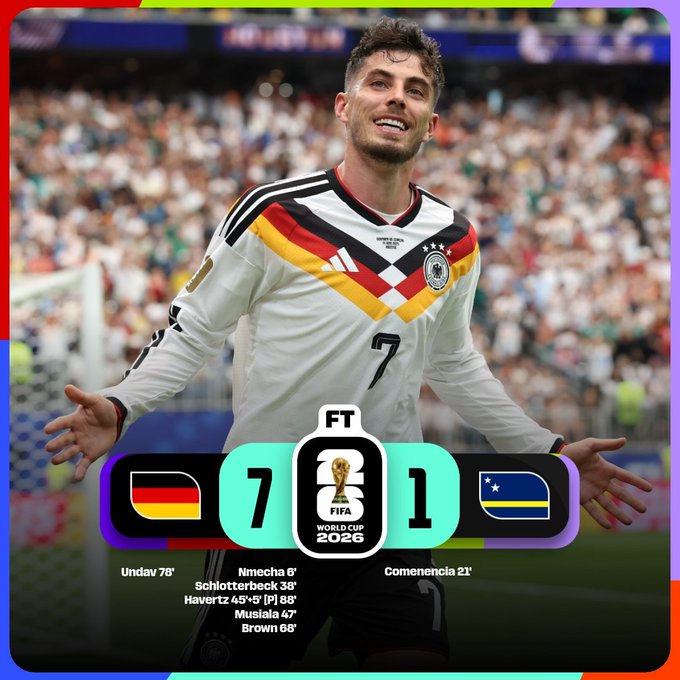
The logic behind the new system is that assessing the direct performance of two teams against each other is fairer — it removes the distorting effect of freak results. Germany’s 7-1 win over Curaçao is the clearest example from this tournament: a result that would massively boost a team’s goal difference but which many would argue does not reflect genuine superiority over the teams they actually need to compete with.
The counter-argument — that overall goal difference better reflects a team’s complete record across the group — retains some merit. FIFA has now sided with the other camp.
The system was first introduced at last year’s Club World Cup, where Flamengo won Group D ahead of eventual tournament winners Chelsea after two matches.
The Full Tiebreaker Order
When teams are level on points, this is the order FIFA now uses to separate them:
| Tiebreaker Priority | Method |
|---|---|
| 1st | Head-to-head points between the teams in question (if three teams involved, a mini-league is created removing results against the fourth team) |
| 2nd | Head-to-head goal difference |
| 3rd | Head-to-head goals scored |
| 4th | Group goal difference |
| 5th | Group goals scored |
| 6th | Fair play (yellow card: -1; red card for two cautions: -3; straight red: -4; yellow then straight red: -5) |
| 7th | FIFA world ranking |
| 8th | Better position in progressively older FIFA world rankings |
The Biggest Change: Winning the Group Before Matchday Three
The most significant practical consequence of the new system is a greater chance of teams not only advancing but winning their group before the final matchday.
Under the old system, a team needed to be four points clear of second place after two matches to mathematically secure top spot — an extremely rare scenario requiring both of the other group fixtures to end in draws.
Under the new head-to-head system, a team can secure first place with just a three-point lead — and it can happen through more paths than before.
It requires either:
- The team in first having beaten all teams currently on three points, or
- The other fixtures to have produced draws
Mexico: Already Group Winners After Two Games
Group A has already produced the tournament’s first example. Mexico won both of their opening games and sit on six points — three clear of South Korea on three, with Czech Republic and South Africa on one point each.
Crucially, Mexico already beat South Korea in the opening round. Under the new head-to-head system, even if both nations ended on six points, Mexico would win the group by virtue of that head-to-head result.
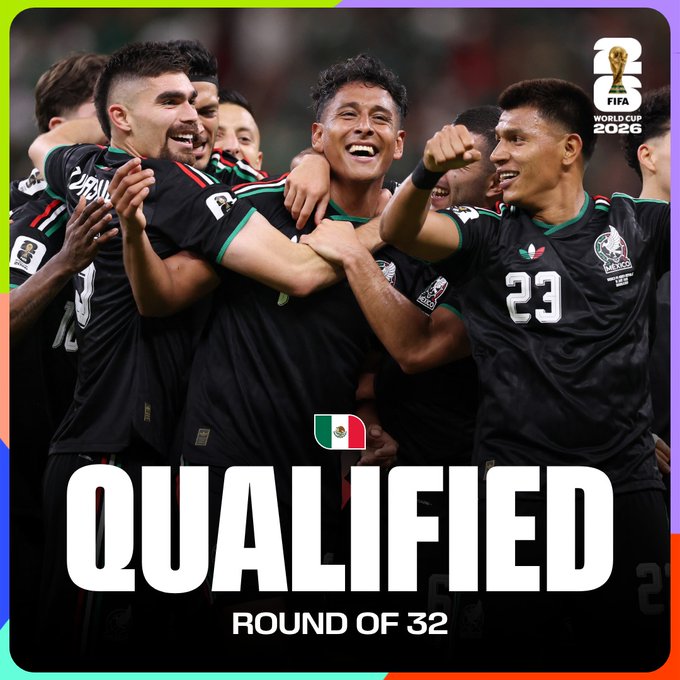
Mexico have therefore already won Group A.
They know with certainty they will play a last-32 tie in Mexico City against a third-placed team. Their final group match against Czech Republic effectively becomes meaningless in terms of their own group standing.
This creates an imbalance the Czech Republic could benefit from. Mexico may rest players for the Czech Republic match, and while the Czechs can only qualify automatically if South Korea lose to South Africa, the opportunity to face a weakened Mexico is significant — particularly in a tournament where the best third-placed finishers also advance.
Who Else Could Seal Top Spot on Matchday Two?
The head-to-head change means several groups could see their winners decided before the final round. Here is the full picture of which scenarios could produce a group winner after round two:
| Group | Scenario for Early Group Winner |
|---|---|
| Group A | Mexico have already won the group |
| Group C | Scotland win the group if they beat Morocco AND Brazil do not beat Haiti |
| Group D | USA seal top spot if Türkiye do not beat Paraguay |
| Group E | Germany win group with a win over Ivory Coast if Ecuador do not beat Curaçao |
| Group E | Ivory Coast seal top with a win if Curaçao do not beat Ecuador |
| Group F | Sweden seal top with a win over Netherlands if Japan do not beat Tunisia |
| Group G | No team can seal top spot on matchday two |
| Group H | No team can seal top spot on matchday two |
| Group I | No team can seal top spot on matchday two |
| Group J | Argentina seal top with a win over Austria if Jordan do not beat Algeria |
| Group J | Austria seal top with a win if Algeria do not beat Jordan |
| Group K | Colombia seal first if they beat DR Congo AND Portugal do not win against Uzbekistan |
| Group L | England win group with a win over Ghana if Panama do not beat Croatia |
| Group L | Ghana win group with a victory if Croatia do not beat Panama |
The number of groups where early qualification remains possible is striking — and the knock-on effects on final matchday dynamics are considerable.
Why This Changes Matchday Three Entirely
The implications extend beyond simply who advances. Consider the following scenarios that the head-to-head system now creates:
A team that has beaten its nearest rival — as Mexico has beaten South Korea — can enter the final group match knowing it cannot be overtaken even if things go wrong. That team will be tempted to rotate, rest key players, and prepare for the knockout round.
Their final group opponent — in this case Czech Republic — faces a potentially severely weakened side. That weakened performance then affects Czech Republic’s goal difference, which could be decisive for the best third-place finishers if group goal difference is needed at that stage (note: it only comes into play at priority four under the new tiebreaker order).
The incentives within groups are therefore subtly distorted. Under the old system, a team needed to keep winning to protect its goal difference advantage. Now, once the head-to-head is secured, the motivation to continue attacking is reduced.
The Alignment With UEFA
FIFA’s move brings it into line with the approach long used by UEFA at the European Championship and in group-stage competition across the Champions League and other club competitions.
UEFA has always reasoned that head-to-head results are the fairest way to separate teams because they directly compare what the two sides in question did when they faced each other — removing the unpredictability of mismatches against weaker opponents from the equation entirely.
The 7-1 Germany vs Curaçao result illustrates why this matters. Under the old system, that result would give Germany a goal difference boost that creates an artificial advantage not reflective of their performance against Ecuador or Ivory Coast. Under the new system, if Germany and Ecuador or Ivory Coast were to finish level on points, what would matter first is what happened between those two teams — not what happened when Germany faced the tournament’s smallest nation.
The Fair Play and Ranking Tiebreakers
At the extreme end of the tiebreaker ladder, the system includes some unusual options. Fair play — measured through a points-based card system — appears at sixth priority:
| Fair Play Card Values | Points |
|---|---|
| Yellow card | -1 |
| Red card for two cautions | -3 |
| Straight red card | -4 |
| Yellow card followed by straight red | -5 |
If teams remain level after all of the above, FIFA world ranking serves as the final objective tiebreaker — with “better position in progressively older FIFA world rankings” as the absolute last resort.
These tiebreakers are extremely unlikely to be needed, but their existence provides the complete picture of how the new system functions.
What Teams and Managers Must Now Understand
The practical implications for teams, coaches, and tactical preparation are substantial:
Prioritise beating your direct rival. A draw is no longer enough — the head-to-head win matters more than running up the score against a weaker team.
Protect head-to-head advantage ruthlessly. A team that has beaten its nearest competitor can afford to approach the final group game differently, but should not allow a result that reverses the head-to-head record.
The best third-place route is affected. If teams are able to coast through final group games knowing their group position is secured, the overall quality of those matches — and the goal difference tallies teams bring into the third-place standings — may be affected.
A Small Rule Change With Large Consequences
This is one of the most consequential rule changes in recent World Cup history, even if it has received relatively little attention compared to the expansion to 48 teams or the introduction of the hydration breaks.
FIFA’s reasoning is sound: head-to-head results are a fairer measure of relative quality than goal difference inflated by mismatches. But the system also creates its own distortions — primarily in how teams approach games once their head-to-head position is secured.
Mexico have already demonstrated the first consequence: a group winner declared with one game still to play.
By the time the round of 32 is reached, the new tiebreaker system will have shaped the final standings of every one of the 12 groups. Understanding how it works is essential to understanding what is happening on the pitch — and why some games that once would have mattered intensely are now being played in a very different context.