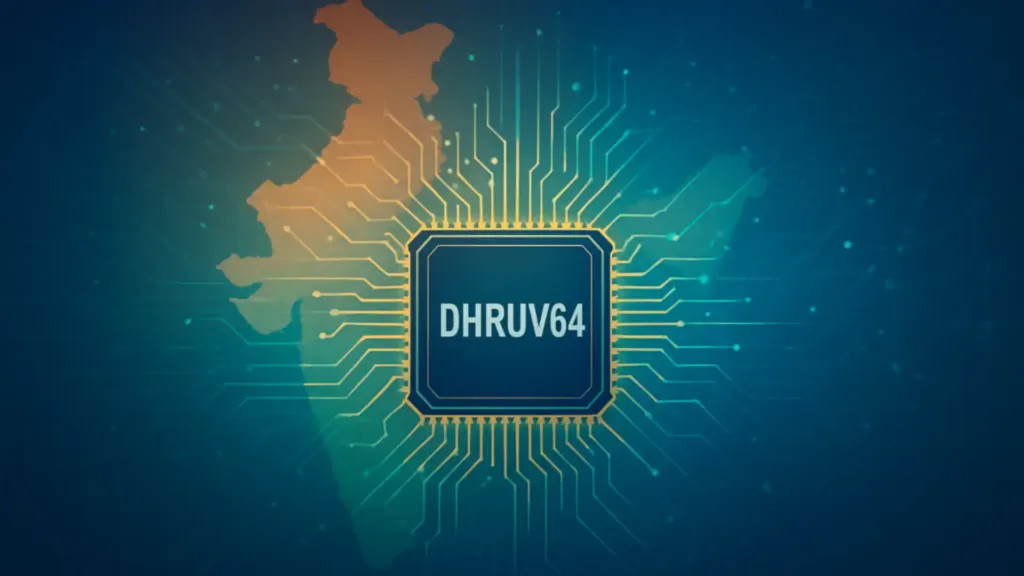
India has achieved a historic milestone. DHRUV64—the nation’s first fully indigenous 64-bit dual-core processor—has been successfully developed and fabricated entirely within India. This breakthrough represents far more than a technical achievement; it signals India’s emergence as a self-reliant semiconductor powerhouse capable of designing and manufacturing critical computing chips.
The DHRUV64 Specifications
DHRUV64 operates at 1.0 GHz and features dual cores built on a mature 28 nm manufacturing process containing approximately 30 million gates. While these specifications may seem conservative compared to cutting-edge international chips, they’re deliberately engineered for real-world reliability and cost-effectiveness. The 28 nm process is proven, stable, and suitable for mass production—perfect for products that need to work reliably for years.
The processor is built on open-source RISC-V (RV64) architecture, eliminating the royalty and licensing fees that plague India’s semiconductor sector when using proprietary architectures like ARM or x86. This architectural choice represents philosophical and economic independence.
Who Made DHRUV64?
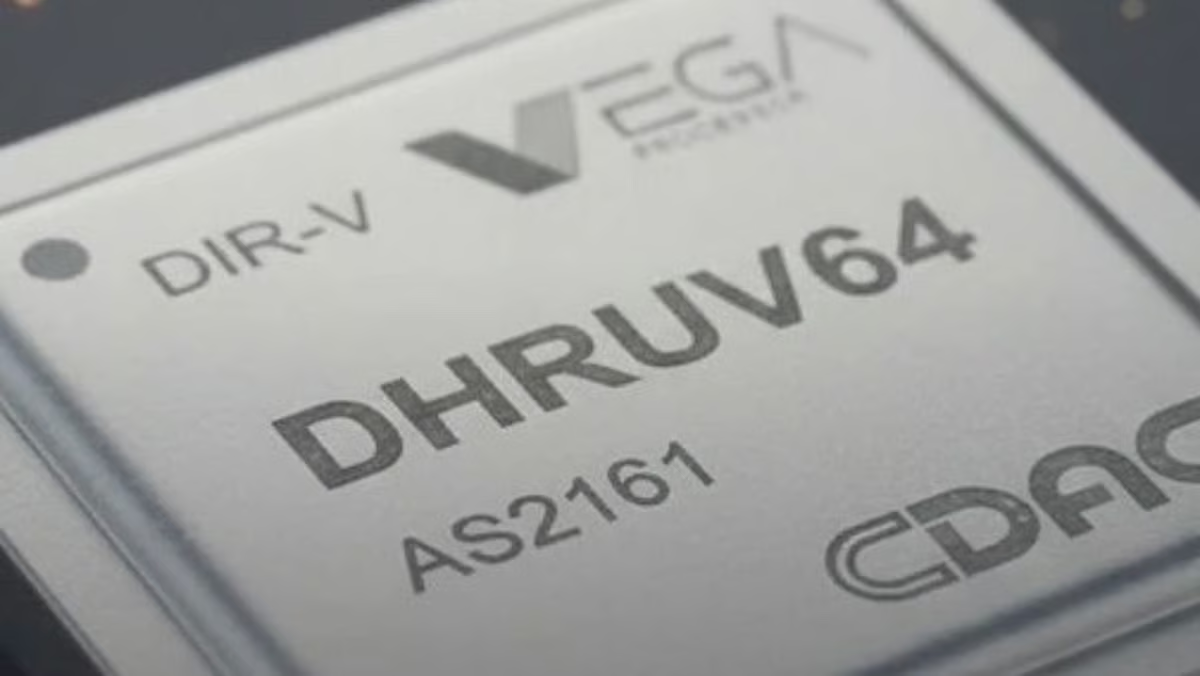
C-DAC (Centre for Development of Advanced Computing) designed the chip under the Microprocessor Development Programme (MeitY). Fabrication occurred domestically under the Digital India RISC-V (DIR-V) programme, with manufacturing believed to occur at SCL Mohali. This end-to-end Indian development—from conception to production—represents a fundamental shift in India’s semiconductor capabilities.
Strategic Applications Across Industries
| Application | Use Case |
|---|---|
| 5G Networks | Infrastructure and telecom equipment |
| Automotive | Vehicle electronics and IoT systems |
| Smart Devices | Consumer electronics and appliances |
| Factory Automation | Industrial IoT and robotics |
| Consumer Electronics | TVs, refrigerators, home devices |
DHRUV64 targets diverse sectors where reliability matters more than cutting-edge performance. These applications represent massive markets where India currently depends on foreign chips.
Part of a Larger Vision
DHRUV64 is the third processor under DIR-V, following THEJAS32 and THEJAS64. It builds on earlier indigenous processor projects: SHAKTI from IIT Madras, AJIT from IIT Bombay, and VIKRAM from ISRO. This progression demonstrates India’s commitment to building sustained semiconductor capability rather than pursuing one-off achievements.
Future chips—Dhanush and Dhanush+—are already in development, signaling that DHRUV64 represents the beginning, not the end, of India’s semiconductor journey.
Why This Matters Enormously
India consumes approximately 20% of global chip supply while hosting about 20% of the world’s chip designers. Yet India’s semiconductor fabrication capacity remains minimal. The semiconductor market is expected to grow from $24 billion today to $100–120 billion by 2030. Without indigenous chip production, India risks missing this explosive growth opportunity.
Government support is substantial. The India Semiconductor Mission, Design Linked Incentive, and Chips to Startup programme have approved 10 major projects worth ₹1.6 lakh crore across six states. DHRUV64 represents the payoff from this strategic investment.
Breaking Free from Foreign Dependency
RISC-V’s open-source architecture is revolutionary for Indian companies. Startups, developers, and research institutions can now build products without licensing fees or dependency on foreign chip companies. This unlocks an entirely new ecosystem of indigenous innovation.
For India’s technology sector, DHRUV64 represents what’s possible when government vision, academic excellence, and industrial capability align around a strategic goal: self-reliance in semiconductors.
The Path Forward
DHRUV64 won’t replace international processors in flagship applications. But in the massive markets of automotive, IoT, 5G infrastructure, and consumer electronics, indigenous chips eliminate foreign dependency while generating employment and IP for India.
This is Atmanirbhar Bharat in action—not through protectionism, but through genuine technological capability.
Learn More:
For updates on India’s semiconductor revolution and tech innovation, follow TechnoSports.
Last Updated: December 2025 | DHRUV64 specifications and availability subject to official announcements from C-DAC and MeitY.