RIY1
RIY1 TAA0
TAA0 LAZ0
LAZ0 PAR0
PAR0 RCL0
RCL0 PAR1
PAR1 MEX-W
MEX-W ARG-W
ARG-W ATM0
ATM0 DEP0
DEP0 MTL0
MTL0 NSH2
NSH2 ADO0
ADO0 HEE0
HEE0 Internacional0
 Botafogo0
 UAE
UAE NED
NED PAK
PAK ENG
ENG IND-W
IND-W ZIM-W
ZIM-W GMB
GMB LES
LES MOZ
MOZ ZMB
ZMB Inter Milan
 Fiorentina
 Churchill
 Punjab FC
 NGA
NGA UGA
UGA CHE0
CHE0 TOT2
TOT2 VAL1
VAL1 VIL2
VIL2 DOR1
DOR1 SGE0
SGE0 NAP3
NAP3 ROMA3
ROMA3 NZ-A135/3 (41 ov)
 IND-A113
 SYL
SYL KHU
KHU MYMS299/4 (87 ov)
 CHATT
CHATT DHA293/3 (84.1 ov)
 RAJ
RAJ RAN320/5 (80 ov)
 BAR
BAR DEN
DEN PNG
PNG NAM321/6
 IRE290 (47.3/50 ov, target 322)
 NZ180/5
 IND181/6 (19.5/20 ov, target 181)
 Mirassol1
 São Paulo0
 Vitória0
 Athletico-PR0
 VEN0
VEN0 JPN1
JPN1 ZAM0
ZAM0 FRA1
FRA1 Athletic
 Getafe
 C Palace
 Newcastle
 Hull
Hull Brentford
 Liverpool
 Brighton
 Man United
 Bournemouth
 Atalanta
 Frosinone
 KHO0
KHO0 ETT3
ETT3 RAC2
RAC2 ESP1
ESP1
This 15-second anime action short was created through three distinct stages. GPT Image 2 designed Candy-X and her character sheet. Claude Fable 5 developed the story as a time-coded video prompt. Renoise CLI then sent the reference and prompt to Seedance 2.0 for generation.
This was not a one-click film. Character preparation, prompt structure, generation review, and final editing remained separate decisions.
What Made the Candy-X Short Film Challenging?
The challenge was keeping a detailed character recognizable during nonstop motion. Candy-X has turquoise-and-pink hair, mechanical accessories, an oversized jacket, cyber backpack, armored boots, headphones, and a candy-themed blaster. Losing major details would weaken the connection between the design sheet and final shot.
The scene combined grappling, rail grinding, wall running, aerial combat, drones, and a final hero pose in one camera move. It needed a strong identity reference and a prompt organized by time rather than a loose list of ideas.
How Was the Character Created in GPT Image 2?
The workflow started in Renoise AI with GPT Image 2 because the character needed to exist before animation. Instead of one portrait, the character brief requested a 16:9 game-style sheet with full-body and turnaround views, equipment close-ups, a color palette, and weapon details.
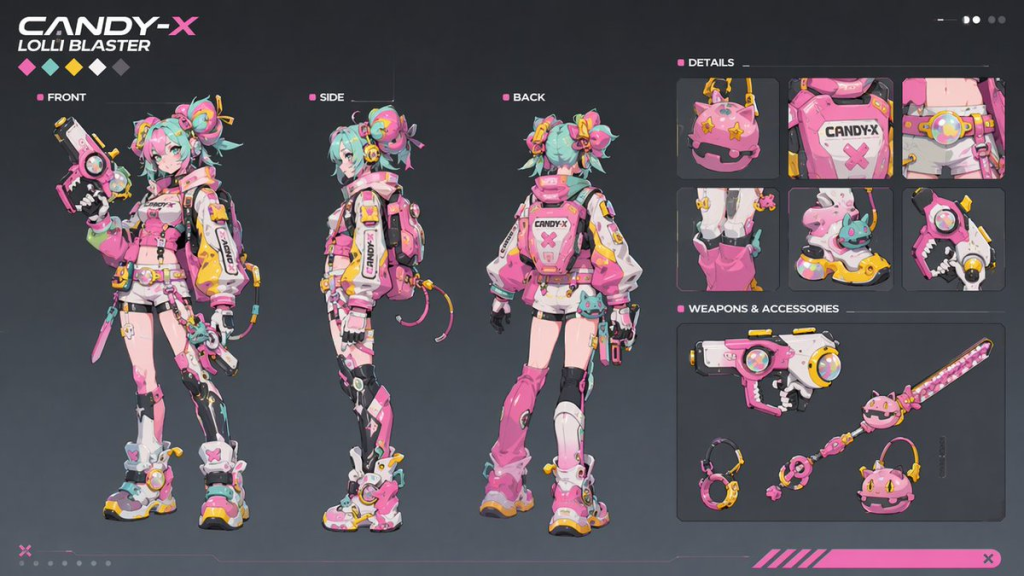
This established the silhouette, outfit, backpack, footwear, weapon, and candy-tech palette. The key lesson was to separate permanent identity details from the environment. Candy-X should remain recognizable whether she is in a design sheet or racing through a neon city.
Before the project moved forward, the turnaround views were checked for consistency, along with whether the accessories remained readable at video scale.
How Did Claude Fable 5 Shape the Story and Video Prompt?
Claude Fable 5 transformed the idea into a brief for one 15-second shot. Instead of describing “a cyberpunk girl in a candy city,” it divided the action into four beats: launch, city traversal, aerial combat, and final landing.
The reusable method is simple:
- Define the identity reference first.
- Break the story into timed actions.
- Specify camera behavior and physical motion.
- Separate atmosphere and sound instructions.
- End on a clear visual payoff.
The time codes were the most useful element. They gave Seedance 2.0 an order of priorities while preserving one continuous shot without cuts.
How Was Seedance 2.0 Run through Renoise CLI?
The character sheet and prompt were organized as one generation task, then submitted through Renoise CLI with Seedance 2.0. The reference, model, prompt, duration, and output stayed in the same terminal workflow.
For larger projects, prompts and references can remain in folders while Claude Code or Codex manages filenames, versions, and repeatable submissions. The CLI handles generation, not creative review.
Seedance 2.0 supports four- to 15-second clips and reference-based generation. This project used 15 seconds for a beginning, escalation, and payoff. Simpler projects should test shorter movement first.
What Worked, and What Still Required Review?
The resulting frame preserved the pink-and-cyan palette, cyber-idol silhouette, large backpack, oversized footwear, and candy-themed city. The action therefore remained connected to the original character bible.
A detailed prompt remains a directing brief, not a frame-accurate contract. “Maintain 100% consistency” expresses an intention but cannot guarantee identical details in every frame. Motion, camera banking, particles, and costume details compete for attention.
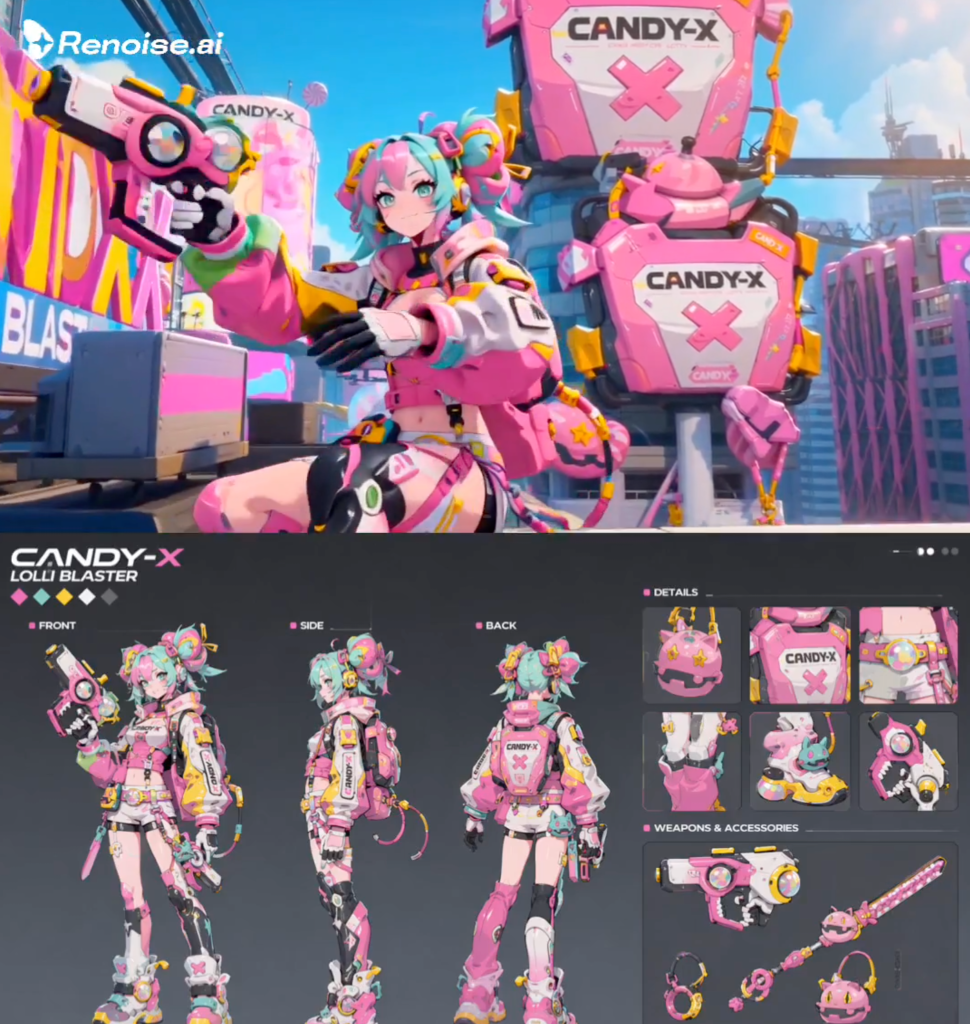
Review the fastest movement, simplify actions that cause identity drift, and revise one variable at a time. Final assembly, titles, music, and sound mixing still require editing software.
What Is Renoise AI Beyond This Single Short Film?
Renoise AI brings image, video, and audio models together with assets, Canvas, web tools, Agent workflows, and CLI access. Here it connected GPT Image 2 character development with Seedance 2.0 motion, while the CLI bridged planning and generation.
The same structure works for other narrative projects: design a stable character, plan the shots, select a model for each task, and review every output as a production asset.
Final Thoughts
The Candy-X short worked as a pipeline rather than one prompt. GPT Image 2 established the character, Claude Fable 5 structured the story, and Renoise CLI submitted the brief to Seedance 2.0. Separating identity, timing, and generation made every stage easier to review.
FAQ
Can GPT Image 2 create a character sheet for an AI short film?
Yes. Include full-body views, consistent turnaround angles, accessories, costume details, weapons, and a controlled palette. These references give the video model clearer identity information than one portrait, although results still depend on the prompt, reference clarity, and motion complexity.
Why use Claude Fable 5 before generating the video?
Claude Fable 5 can turn a visual concept into a time-coded video brief. Here it separated the 15-second action into beats and clarified the camera, movement, atmosphere, and ending, making the prompt easier to evaluate before generation.
What does Renoise CLI add to the workflow?
Renoise CLI connects prompts and reference files with generation models from a terminal. It supports repeatable submissions, versioned shots, and Claude Code or Codex projects. It automates task submission and organization, but creators still inspect and select the results.
Can Seedance 2.0 generate a complete short film in one prompt?
Seedance 2.0 can generate clips up to 15 seconds, including reference-based cinematic motion. A 15-second sequence can contain a simple narrative arc, but longer stories require multiple generated shots and external editing. Complex single-shot prompts may also need revisions when character details or actions compete for attention.
Read more: Ranbir Kapoor Says Ramayana Could Fill 10 Movies — Here’s Why They Stopped At Two