Anthropic unveiled Claude Opus 4.6 on Thursday, introducing a powerful upgrade to its flagship AI model that’s reshaping enterprise software markets. With a massive 1 million token context window and revolutionary “agent teams” capability, the release intensifies competition with OpenAI’s Codex while triggering fresh concerns across the software industry.
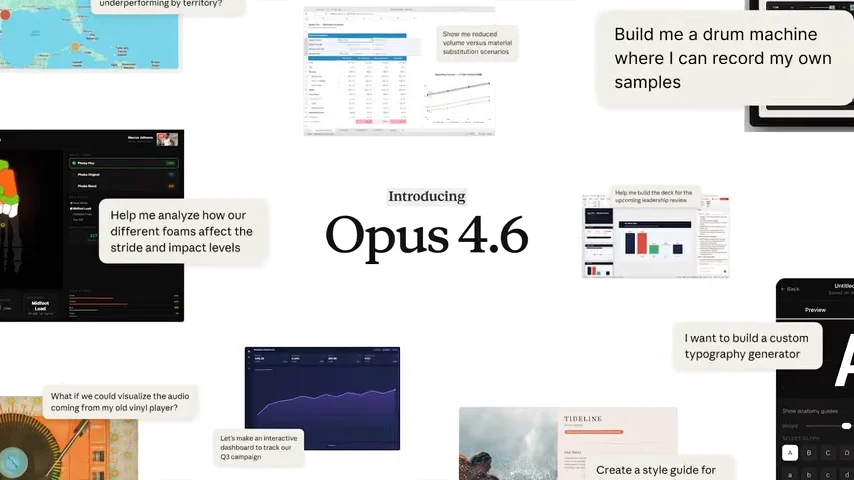
Claude Opus 4.6 Release: Game-Changing Features
Key Specifications & Improvements
| Feature | Claude Opus 4.6 | Previous (Opus 4.5) |
|---|---|---|
| Context Window | 1 million tokens | 200,000 tokens |
| Output Tokens | Up to 128,000 | Standard output |
| ARC AGI 2 Score | 68.8% | 37.6% |
| Terminal Bench 2.0 | 65.4% | 59.8% |
| Finance Agent | Top benchmark score | — |
| API Pricing | $5/$25 per million tokens | Unchanged |
| Launch Date | February 5, 2026 | November 2025 |
1 Million Token Context Window Unlocked
The expanded context window represents a fivefold increase from Opus 4.5’s 200,000 tokens, enabling Claude to process entire codebases, massive document collections, and complex enterprise datasets in a single task. On the MRCR v2 needle-in-a-haystack benchmark testing information retrieval from vast text, Opus 4.6 scored 76% compared to just 18.5% for Sonnet 4.5—what Anthropic calls “a qualitative shift” in usable context.

Agent Teams Enable Parallel Processing
Perhaps the most innovative feature is Agent Teams, allowing multiple AI agents to work simultaneously on different task segments rather than sequentially. Scott White, Anthropic’s Head of Product, compared it to managing a talented human team where responsibilities are distributed for faster coordination. This feature is currently available in research preview for API users and subscription customers.
PowerPoint Integration Goes Native
Claude now integrates directly into Microsoft PowerPoint through a side panel, reading existing layouts, fonts, and templates to generate or edit slides while preserving design elements. This marks a significant upgrade from previously requiring file transfers between Claude and PowerPoint. The integration is available in beta for Max, Team, and Enterprise plan customers.
Benchmark Dominance Across Categories
Opus 4.6 leads or matches competitors across most benchmarks. Standout performance includes 68.8% on ARC AGI 2 (compared to GPT-5.2’s 54.2% and Gemini 3 Pro’s 45.1%), measuring AI’s ability to solve problems easy for humans but hard for machines. The model also tops the Finance Agent benchmark and outperforms GPT-5.2 on GDPval-AA by approximately 144 ELO points.
Wall Street Impact: $285B Software Selloff
The launch triggered massive stock declines among software companies, with Thomson Reuters falling 15.83% and LegalZoom dropping nearly 20% on Tuesday. The broader software ETF posted its worst day since April, slumping 6%, as markets grappled with fears that AI tools could replace specialized research and financial analysis software.

Strategic Timing Against OpenAI
Released just 72 hours after OpenAI’s Codex launch, Opus 4.6 underscores the breakneck AI development race. Anthropic now claims 44% enterprise production usage according to recent surveys, driven by rapid capability gains since late 2024. The company’s Claude Code platform reached $1 billion in run rate revenue just six months after general availability.
For more AI industry news and updates, visit TechnoSports AI Tech.