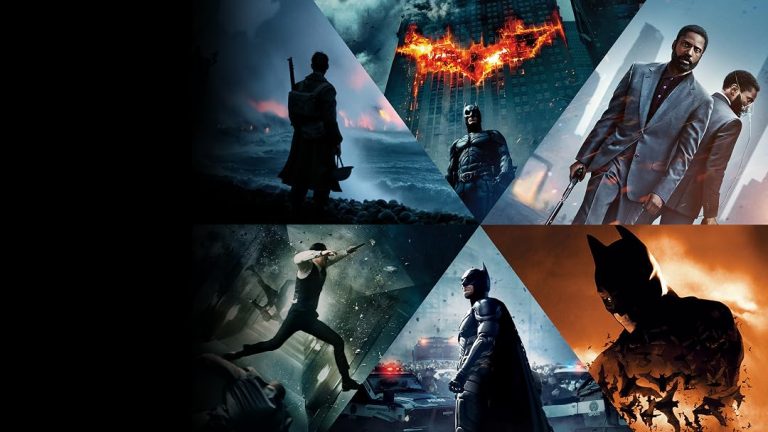
In July 2008, Warner Bros. released a superhero sequel expected to sell toys. The Dark Knight instead passed $1 billion and delivered an Oscar-winning performance. Sixteen years later, that director’s three-hour drama about a physicist won seven Academy Awards. Together, those films trace Christopher Nolan’s path from comic-book spectacle to Best Picture.
The Before: When a Superhero Film Could Still Surprise
The Dark Knight reached theatres on July 18, 2008, with Christian Bale back as Bruce Wayne. Warner Bros. Pictures and Legendary Pictures produced the film. It earned more than $1.006 billion worldwide, while Heath Ledger’s Joker won him a posthumous Academy Award for Best Supporting Actor.
The result mattered commercially: it showed that a bleak, adult crime film could out-earn lighter franchise competition. Culturally, it mattered because awards voters honored a performance delivered inside a superhero costume.
The Catalyst: Two Originals at Franchise Scale
Inception followed on July 16, 2010, starring Leonardo DiCaprio as Dom Cobb. It grossed roughly $836.8 million worldwide without a comic-book source, sequel number, or pre-sold brand behind it.
Four years later, Interstellar put Matthew McConaughey in the cockpit as Joseph Cooper and won the Academy Award for Best Visual Effects at the 87th Academy Awards on February 22, 2015. Together, the films established the formula studios now pursue: original ideas financed at franchise scale and sold largely on the director’s name. At the time, though, the pair looked like an anomaly rather than a template.
The After: Oppenheimer and the Awards Ceiling
Oppenheimer arrived in 2023, reportedly starring Cillian Murphy as J. Robert Oppenheimer. On March 10, 2024, it won seven Academy Awards, including Best Picture and Best Director, at the 96th ceremony.
The sweep completed a loop the earlier films had started. A studio had now funded a talk-driven period drama on a blockbuster budget and received the industry’s top prizes — a combination the theatrical market had spent a decade treating as commercially incompatible.
| Film | Release | Global Gross | Defining Award |
|---|---|---|---|
| The Dark Knight | July 18, 2008 | $1.006 billion | Best Supporting Actor, Heath Ledger |
| Inception | July 16, 2010 | $836.8 million | — |
| Interstellar | 2014 | Not stated in verified figures | Best Visual Effects, 2015 |
| Oppenheimer | 2023 | Not stated in verified figures | Best Picture and Best Director, 2024 |
What’s Next: The Template Under Pressure
These four films now make a scheduling argument. Studios pair a director-driven original with a wide theatrical window, then use awards season to extend its run — the same theatrical economics our earlier reporting on the final box office run tracked for a comparable large-format release.
Whether that model lasts depends on how many filmmakers can carry a $100 million-plus original on their own name. Nolan remains the clearest proof that it still works. Want franchise spectacle with awards credibility? Pick The Dark Knight. Want the original-premise bet that made everything afterward possible? Pick Inception.
FAQs
Did The Dark Knight really cross $1 billion?
Yes. It grossed more than $1.006 billion worldwide after its July 18, 2008 release.
How many Oscars did Oppenheimer win?
Seven, including Best Picture and Best Director, which it won at the 96th Academy Awards on March 10, 2024.
Which Nolan film won Best Visual Effects?
Interstellar won at the 87th Academy Awards on February 22, 2015.
What connects all four films commercially?
Each received blockbuster-scale financing without a pre-sold franchise sequel number, and each sold primarily on Nolan’s name.
Was this article helpful?
Your feedback directly improves future articles on this site.