NAM250/5 (45.3/50 ov)
 IRE
 AVL
 MNC
 RAY
 ELC
 GMB
 ZMB
 NGA
 LES
 CAG
 BOL
 COMO
 SAS
 FCA
 FCU
 KOE
 S04
 MOZ19
 UGA23/0 (0.5/20 ov, target 20)
 NZ180/5
 IND181/6 (19.5/20 ov, target 181)
 Ipswich1
 Nottm Forest1
 Alavés1
 Málaga1
 WA71/3 (11.2/50 ov, target 372)
 NSW371/8
 DEN
 KUW
 KENYA
 QAT
 SWD-W
 EPR-W
 TTN-W
 WPR-W
 NZ-A135/3 (41 ov)
 IND-A113
 DHA
 RAJ
 MYMS
 CHATT
 RAN
 BAR
 SYL
 KHU
 MEX-W
 ARG-W
 UAE
 NED
 PAK
 ENG
 IND-W
 ZIM-W
 AFG170/3 (34.3/50 ov, target 170)
 ZIM169
 CHE0
 DYI0
 CHO1
 QIN0
 HEN1
 BEI0
 LIA1
 ZHE0
 QWC1
 YUN0
 SHX0
 Shanghai Shenh0
 TIG0
 SHP0
 WTT1
 SHT3
 M05
 SVW
 RBL
 ELV
 Torino3
 Monza2
 Brest1
 Nice2
 Stuttgart2
 Gladbach3
 Al Ahli4
 Al Khaleej1

A Mac mini the size of a paperback sits on a desk in a Bengaluru apartment, fan barely audible, running a large language model locally at two in the morning. No data centre bill. No API meter ticking.
Just a chip doing the work that, two years ago, required rented silicon by the hour. How did Apple’s M4 get here, and what does it mean for the economics of running ChatGPT Claude-style workloads at scale?
The Chip on the Desk
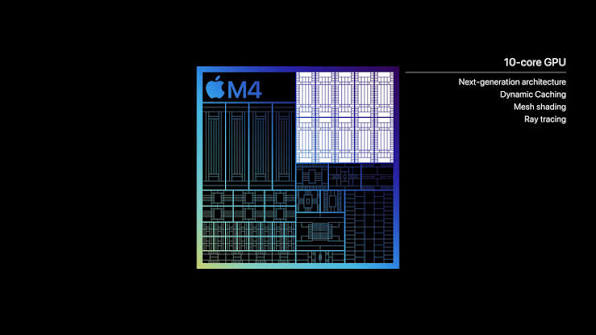
The M4 arrived in late 2024 across the iPad Pro, iMac, and Mac mini, built on TSMC’s second-generation 3-nanometre process. Apple’s pitch was blunt: more performance per watt than any competitor in a laptop-class package.
When the chip launched, Tim Cook described it as an “outrageously powerful chip for AI.” That framing matters more in 2026 than it did at launch. The cost of cloud inference has become the central anxiety of the AI industry, and the M4’s architecture speaks directly to it.
This breakdown examines how its design choices translate into real cost efficiency — for developers, small teams, and anyone tired of per-token billing.
Inside the M4’s efficiency Play
The M4’s advantage starts with memory. Its unified memory architecture lets the CPU, GPU, and Neural Engine read from a single pool, so a 16-bit model weighing 8GB runs without the copy overhead that plagues discrete-GPU rigs.
Bandwidth sits at roughly 120GB/s in widely cited figures — modest next to an H100, but enough for quantised models in the 7B to 30B parameter range.
The Neural Engine delivers around 38 TOPS, a figure Apple has cited publicly, and the 10-core CPU (four performance, six efficiency cores) handles pre- and post-processing without waking the power-hungry cores.
The result is inference measured in single-digit watts rather than the hundreds a data centre GPU draws.
| Component | M4 Configuration | Why It Cuts Cost |
|---|---|---|
| Process | TSMC 3nm (N3E) | Lower power draw per operation |
| CPU | 10 cores (4P + 6E) | Efficiency cores handle routine tasks |
| Neural Engine | ~38 TOPS | Offloads inference from CPU/GPU |
| Memory | Unified, up to 32GB | No data-copy tax between units |
| Idle power | Single-digit watts | Cheap to leave running 24/7 |
For teams probing how retrieval-augmented systems behave, our guide on Tracing RAG Evolution From hybrid search shows why local vector work pairs well with this architecture.
Why ChatGPT Claude-Style Inference Fits the M4
Here’s the thing: frontier models themselves still demand data-centre GPUs. What the M4 changes is the perimeter around them. Embedding generation, reranking, summarisation of private documents, and small-model agents can all run locally, so a developer pays cloud rates only for the frontier calls that genuinely need them.
Teams weighing subscription tiers against local compute can start with our comparison of Claude Vs Chat GPT: differences to see where paid APIs earn their keep. The arithmetic is simple. A Mac mini M4 launched at $599 (roughly ₹50,000 in India) with no recurring hardware rental. Against cloud GPU instances that bill by the hour, the machine pays for itself once local inference displaces a few hundred hours of rented compute — a threshold many solo developers reportedly cross within months.
Context: The Broader Cost Reckoning
The industry is watching token volumes climb while providers scramble to defend margins, a tension we explored in our coverage of Chat GPT 2026 Keystroke concerns and pricing pressure.
Against that backdrop, Apple’s bet is architectural patience: ship silicon efficient enough that the edge absorbs work the cloud no longer wants. For a primer on how local models reason over documents, see our piece on Tracing RAG Evolution From vector search fundamentals.
What’s Next for Apple Silicon Economics
Apple’s cadence points toward tighter memory pools and faster Neural Engines in each generation, and the M5 generation is expected to widen the gap between edge and cloud economics. Developers who build pipelines assuming local-first inference today will be best positioned when those chips land.
The honest caveat remains scale: nobody runs a frontier model on a mini. For anyone running ChatGPT Claude-style workflows, the takeaway is to audit which calls actually need frontier horsepower and push the rest onto the desk.
The cheapest token is the one your own silicon never bills you for.
Related Articles
- Chat GPT and the Hidden Cost of Over-Reliant Prompt Engineering
- Custom Chat GPT: A Tactical Breakdown of Configuring Personalized Knowledge Base Instructions
- Chat GPT Code Interpreter 5 Essential Practices for Clean Output
FAQs
Can the M4 run large language models locally?
Yes, quantised models in the 7B to 30B parameter range run comfortably within the M4’s unified memory, depending on the configuration you buy.
Does local inference really reduce costs?
It reduces cloud API spending for routine tasks like embeddings and summarisation, though frontier-model calls still require paid cloud access.
Is the Mac mini M4 a good AI development machine?
Was this article helpful?
Your feedback directly improves future articles on this site.