Your AI assistant just got a lot more personal. OpenAI has officially launched a personal finance experience inside ChatGPT, giving Pro subscribers in the U.S. the ability to securely connect their bank accounts, credit cards, and investment portfolios — and then ask ChatGPT questions directly grounded in their own financial data.
It’s one of the most significant expansions of ChatGPT’s real-world utility since the launch of memory features, and it signals that OpenAI is serious about moving from general-purpose AI assistant to something closer to a personal financial advisor for the masses.
Here’s everything you need to know.
Table of Contents
What Is ChatGPT’s Personal Finance Feature?
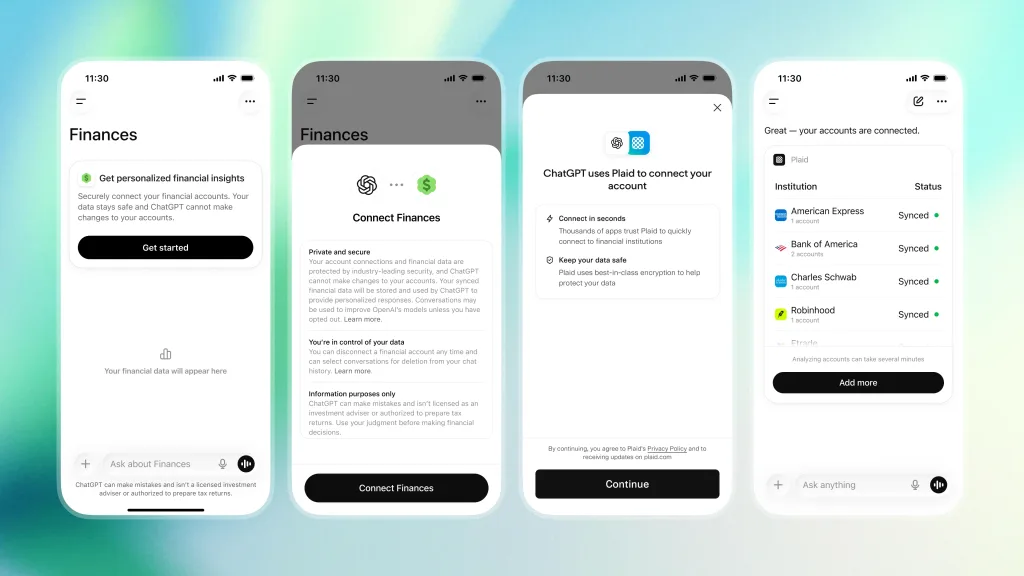
OpenAI is launching a personal finance experience in ChatGPT, giving Pro users in the US the ability to connect financial accounts, view a dashboard of their money, and ask questions grounded in their financial context.
Once authenticated, the synced and categorised data appears in a dashboard that provides an overview of portfolio performance, spending categories, subscriptions, and upcoming payments. Think of it as having a financial analyst embedded directly inside the chat interface you already use every day — except this one actually knows your numbers.
Also Read: ChatGPT vs Claude: Which AI Assistant Should You Use in 2026?
Key Features at a Glance
| Feature | Details |
|---|---|
| Account Connection | Via Plaid; 12,000+ financial institutions supported |
| Supported Institutions | Chase, Fidelity, Schwab, Capital One, Robinhood, Amex & more |
| Dashboard | Portfolio performance, spending, subscriptions, upcoming payments |
| AI Model Used | GPT-5.5 Thinking (default); GPT-5.5 Pro (Pro users) |
| Finance Memories | Saves goals, loans, mortgages for context-aware answers |
| Data Privacy | Can’t see full account numbers; can’t make account changes |
| Availability | ChatGPT Pro users in the US (preview); iOS and web |
| Subscription Cost | ChatGPT Pro — $200/month |
| Coming Soon | Intuit integration; expansion to Plus users |
Powered by Plaid — and Built on Real Context
OpenAI has partnered with the financial connection service Plaid to manage the account connections. Users can connect to over 12,000 financial institutions, including Schwab, Fidelity, Chase, Robinhood, American Express, and Capital One.
Plaid is the same infrastructure layer that powers apps like Venmo, Robinhood, and Coinbase — so this isn’t a scrappy integration. It’s enterprise-grade financial data piping, applied to a conversational AI interface.
Users also have the option to add Financial memories, which save context such as a savings goal, a mortgage, an outstanding loan, or a planned major purchase. ChatGPT uses these memories to improve the relevance of future finance-related conversations.
That contextual layer is what separates this from a generic budgeting app. Instead of charts telling you that you overspent on food in April, ChatGPT can now say: “You’re spending 34% more on dining out than last quarter — at this rate, your house downpayment goal gets pushed back by three months.”
What Can You Actually Ask It?
More than 200 million people turn to ChatGPT every month with questions about their finances and other forms of future planning. The difference now is those questions can be answered with your actual data behind them, not generic advice.
Some real examples of what you can ask:
- “Help me build a plan to buy a house in my area in the next 5 years”
- “Which subscriptions am I paying for that I haven’t used this month?”
- “What’s eating most of my budget right now?”
- “How much can I realistically save before December if I cut restaurant spending by 20%?”
The initiative aims to simplify users’ understanding of their financial situations without the need to switch between multiple apps, accounts, and records.
Also Read: Best AI Tools for Budgeting and Personal Finance in 2026
The Privacy Question — Addressed Head-On
This is the one that will make or break adoption, and OpenAI knows it. Financial data can be removed at any time. OpenAI also provides controls for removing personal finance information from ChatGPT’s memory feature. The company says private chats in ChatGPT will not use personal finance data.
ChatGPT can access balances, transactions, investments, and liabilities through linked accounts. However, it cannot see full account numbers or make changes to the accounts.
That read-only constraint is important — and deliberate. OpenAI is threading a needle here: useful enough to be genuinely helpful, locked down enough that a security incident doesn’t result in financial loss. Still, as American Banker noted, the question of how securely this data is stored and handled long-term depends heavily on how the rollout is executed — something worth watching as the feature expands.
The Hiro Acquisition Connection
The new product comes just one month after OpenAI acquired the team behind personal finance startup Hiro, which was backed by firms like Ribbit, General Catalyst, and Restive, in April. This wasn’t a spontaneous feature — OpenAI has been building toward this move for months, acquiring the talent, the infrastructure knowledge, and the fintech credibility to launch something serious.
It also signals that OpenAI views the personal finance space as a long-term product category, not a one-time feature drop.
Which AI Model Powers It?
The feature defaults to GPT-5.5 Thinking for finance conversations, while GPT-5.5 Pro is available to ChatGPT Pro users for more accurate responses. OpenAI’s internal benchmark scores GPT-5.5 Pro at 82.5 out of 100 on a personal finance test, with GPT-5.5 Thinking scoring 79. For context, older models like GPT-5.4 Thinking scored 76.6 and GPT-5.5 Instant just 65.1 — a meaningful gap in accuracy for something as consequential as financial advice.

Rollout Timeline: Who Gets It and When?
The preview is rolling out first to a smaller group of Pro users on web and iOS. OpenAI said the phased launch will help the company learn from early usage before expanding the feature to Plus users and eventually making it available more broadly.
OpenAI said it is also working with ecosystem partners like Intuit to help users take action inside ChatGPT — including going from a credit card recommendation to understanding approval odds and submitting an application, or from asking about tax implications to getting an estimate and scheduling time with a local tax expert.
That last part is where this gets genuinely transformative. Seamlessly going from financial insight to taking action — applying for a card, booking a tax consultation — inside a single chat interface is the vision. Right now it’s a preview. Six months from now, it could be the default way hundreds of millions of people manage money.
Should You Trust ChatGPT With Your Finances?
Here’s the honest answer: it depends on your comfort level with data sharing, and how much you trust OpenAI’s infrastructure. The Plaid backbone is well-established, the read-only access is reassuring, and the data-removal controls are a step in the right direction.
What’s undeniable is that personal finance has been one of the most talked-about use cases for generative AI since the beginning — and OpenAI has now made the most credible attempt yet to actually deliver on that promise.
For Pro users in the US, this is worth trying. For everyone else — the expansion is coming.
For the latest in AI tools, consumer tech, and digital finance, follow TechnoSports. Have thoughts on ChatGPT managing your money? Drop them in the comments.