UAE244/8
 NED164/5 (28.5/50 ov, target 245)
 PAK
PAK ENG241 (46.4/50 ov)
 IND-W318/6 (49.1/50 ov)
 ZIM-W
ZIM-W MOZ
MOZ ZMB
ZMB FOR0
FOR0 EXC0
EXC0 INT
INT FIO
FIO CHU
CHU PFC
PFC NGA
NGA UGA
UGA ATH
ATH GET
GET MEX-W
MEX-W ARG-W
ARG-W CRY
CRY NEW
NEW HUL
HUL BRE
BRE LIV
LIV BHA
BHA GMB112/9
 LES109 (19.5/20 ov, target 113)
 Atlético1
 Deportivo0
 Lazio2
 Parma1
 DEN
DEN PNG
PNG KENYA
KENYA JER
JER MOUNT185
 TUSK19/0 (4.5/50 ov, target 186)
 ROCKS35/3 (8.3/50 ov, target 287)
 EAGLE286/7
 LIMWn
LIMWn NW-W
NW-W NCWmn
NCWmn FsWm
FsWm SWD-W
SWD-W EPR-W
EPR-W TTN-W
TTN-W WPR-W
WPR-W SIKM
SIKM NAGA
NAGA JHK
JHK DELHI
DELHI ODSA
ODSA SVCS
SVCS CGR
CGR AP
AP BRODA
BRODA J & K
J & K CHD
CHD HP
HP MAN
MAN BOU
BOU ATA
ATA FRO
FRO Lens2
Lens2 Paris FC1
 Al Riyadh2
 Al Taawoun1
 Chelsea0
 Spurs2
 Valencia1
 Villarreal2
Brazil were in trouble at half-time in Houston.
Japan led 1-0 and had them exactly where they wanted them — a passive, sluggish Seleção with an ageing midfield, no tempo and a second half of pushing forward to come. For Hajime Moriyasu’s side, this was the plan playing out beautifully. For Brazil, it was the kind of position that could have ended their World Cup 2026 campaign before the quarter-finals had even arrived.
It did not end there. Brazil came out in the second half with renewed purpose, scored the latest winning goal in a World Cup knockout match on record — excluding extra time, since 1966 — and booked their place in the next round. The scenes that followed were electric. Players sprinted to the crowd. Staff poured onto the pitch. Supporters in gold and green erupted inside Houston Stadium.
And then there was Carlo Ancelotti.
The Italian head coach stood on the touchline with an expression that suggested he had perhaps just watched a training session. Calm. Measured. Entirely unmoved by the chaos unfolding around him. Whether that composure concealed private relief at escaping a potential catastrophe, or whether it reflected genuine belief that the turnaround was always coming, is impossible to say with certainty. What is clear is that his influence was felt long before Ancelotti’s demeanour was noted by cameras.
The First Half: A Brazil That Looked Lost
Brazil’s starting XI against Japan was their oldest in a World Cup knockout match since 2006, when they faced France in the quarter-finals.
| Match | Average Age of Brazil Starting XI |
|---|---|
| vs France, 2006 World Cup QF | 30y, 31d |
| vs Japan, 2026 World Cup R32 | 29y, 245d |
The age profile alone did not cause the problems. The lack of dynamism did. In the first half at Houston, Brazil looked sluggish and without direction — a team waiting for something to happen rather than making it happen.
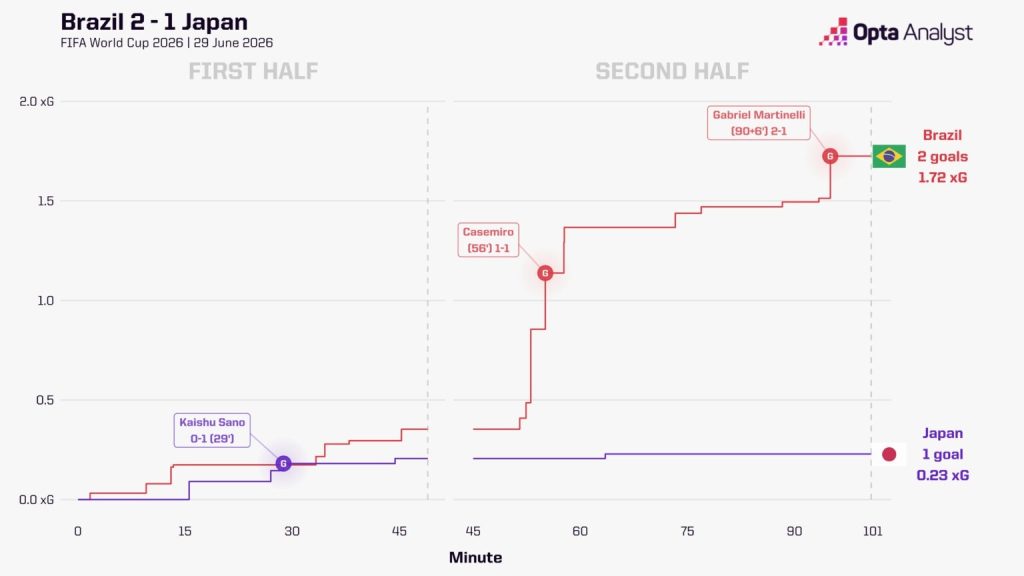
Japan did not need much of an invitation. In a moment of characteristic dynamism, Kaishu Sano broke through and put the Samurai Blue in front. It was precisely the kind of quick, incisive transition that Brazil’s older midfield was ill-equipped to handle, and it set the tone for what felt like it could be a very damaging forty-five minutes to come.
When Lucas Paquetá went down injured before the break, the concern among Brazil supporters was that a like-for-like replacement would simply continue the same flat, uninspiring pattern. Ancelotti had other ideas.
The Half-Time Decision That Changed the Game
Rather than bringing on a direct Paquetá replacement, Ancelotti introduced Endrick — the young, Real Madrid-contracted forward who had been the subject of persistent calls from Brazilian fans throughout the tournament.
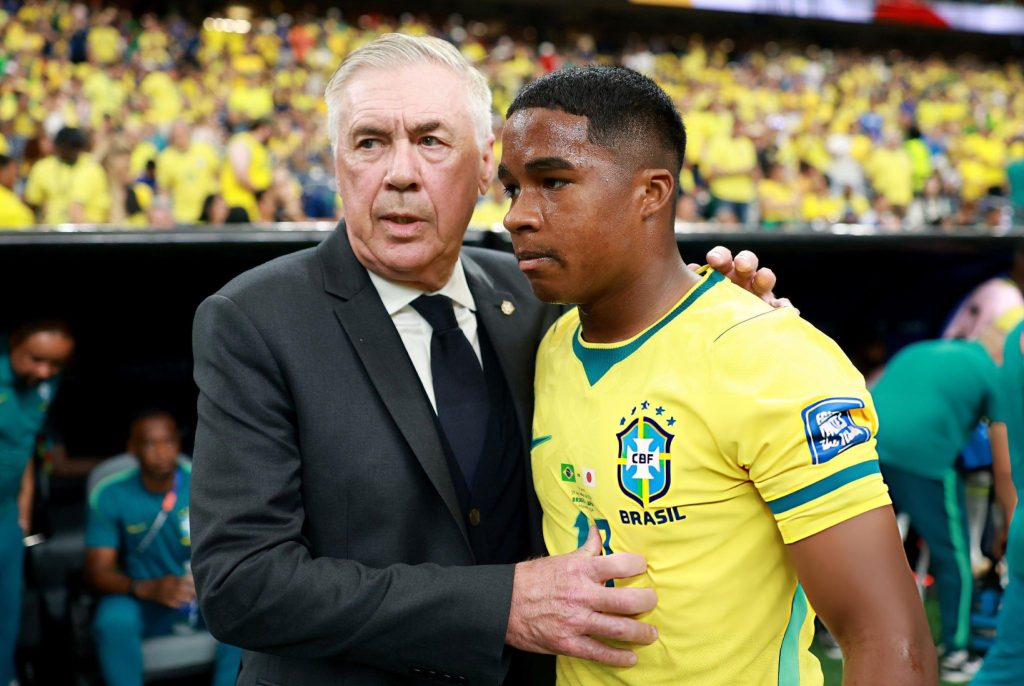
It was not a conventional call. It meant a reshaped attack and a slightly altered setup. But the logic became apparent almost immediately. Endrick brought exactly what Brazil had been missing in the first half: energy, movement and unpredictability in central areas. He was not the game’s decisive figure, but his presence changed the atmosphere both on the pitch and in the stands.
The other significant decision — and arguably the braver one — was Ancelotti’s choice to keep Casemiro on the pitch. The experienced midfielder had been booked in the first half and was beaten with embarrassing ease by Sano for Japan’s opener. The orthodox management response would have been to withdraw him, protect him from a second yellow, and move on.
Ancelotti kept faith. Casemiro repaid it.
Casemiro’s Equaliser and a Changed Brazil
The goal that brought Brazil level was, in many ways, a perfect illustration of what changed at half-time. Casemiro arrived at the back post and headed home — a familiar sight for anyone who followed him at Manchester United this season, in what was the most prolific goalscoring campaign of his club career.
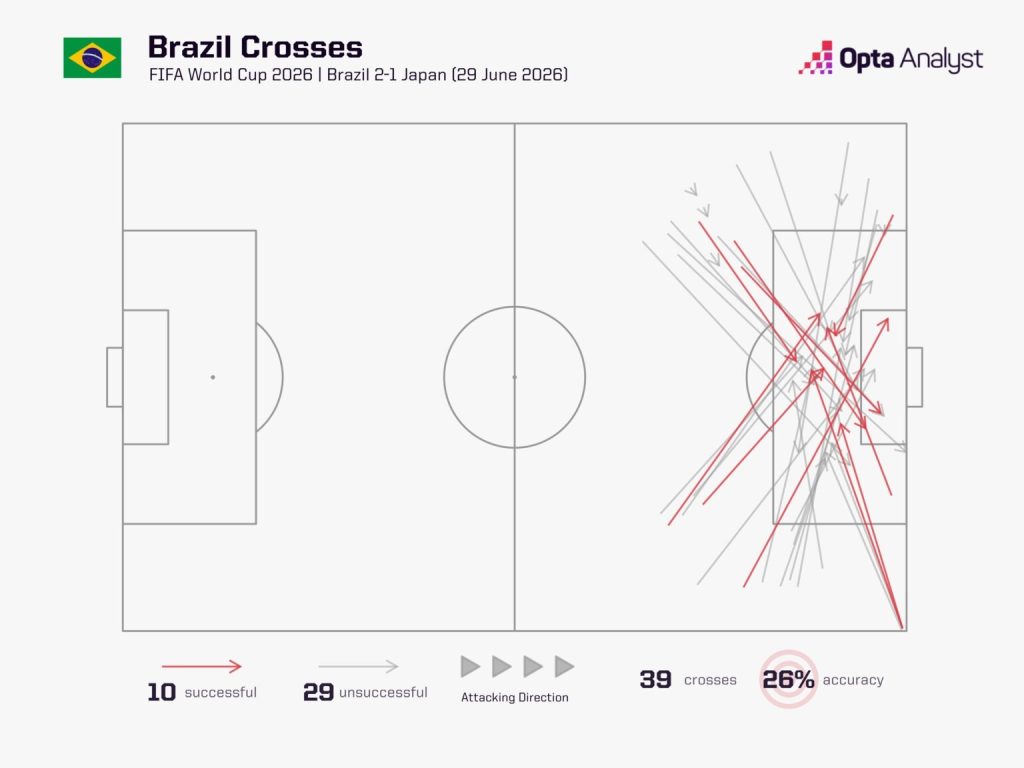
It was also a reflection of a deliberate shift in approach from Brazil in the second half. The numbers make it stark.
| Half | Crosses Delivered by Brazil |
|---|---|
| First half | 12 |
| Second half | 27 |
Twenty-seven crosses in a single half. Brazil have only exceeded that total in a World Cup game twice in the period since 1966. It was blunt, direct and at times unsophisticated — but it worked. Japan’s backline was placed under sustained aerial pressure, and the shift in territorial dominance was comprehensive.
Field tilt — the share of final-third passes belonging to each team — paints a picture of how complete Brazil’s second-half dominance was. Nearly 80% of all final-third passes in the entire game were attributed to Brazil. In the second half alone, that figure will have been considerably higher.
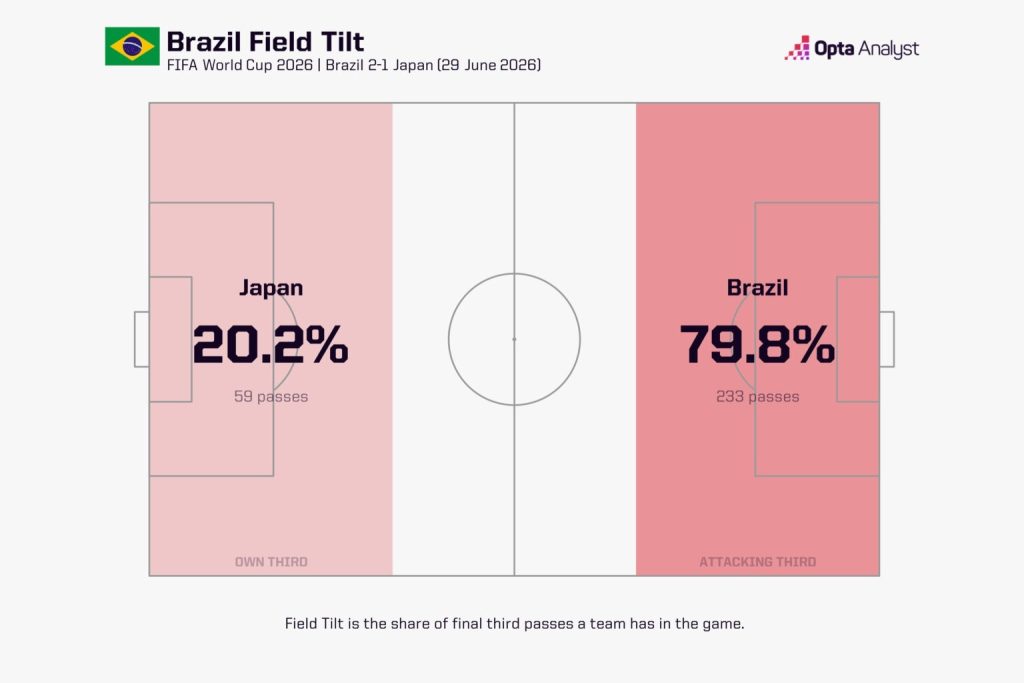
Japan’s plan, understandably, had been to absorb pressure and hurt Brazil in transition. It is a strategy that has worked against stronger opposition. On this occasion, though, the opportunities simply did not arise. Brazil’s encampment in Japan’s half denied the Samurai Blue the space they needed. One moment came close — Vinícius Júnior struck the post, and the resulting quick attack saw Keito Nakamura choose a cross when a pass to the arriving Daichi Kamada would have been the more dangerous option. Japan could not capitalise.
Martinelli: The Unlikely Match-Winner
If Endrick’s introduction felt bold, the arrival of Gabriel Martinelli raised a few eyebrows. Replacing Matheus Cunha — who had been operating as the central focal point — with a natural wide forward, at a moment when Brazil were delivering cross after cross, seemed counterintuitive.
Martinelli justified it in the most conclusive way possible.
Deep into second-half stoppage time, with the match still level and the prospect of extra time looming, he found a pocket of space between Japan’s right wing-back and centre-back. He held his run, stayed patient and produced a composed finish beyond Zion Suzuki.
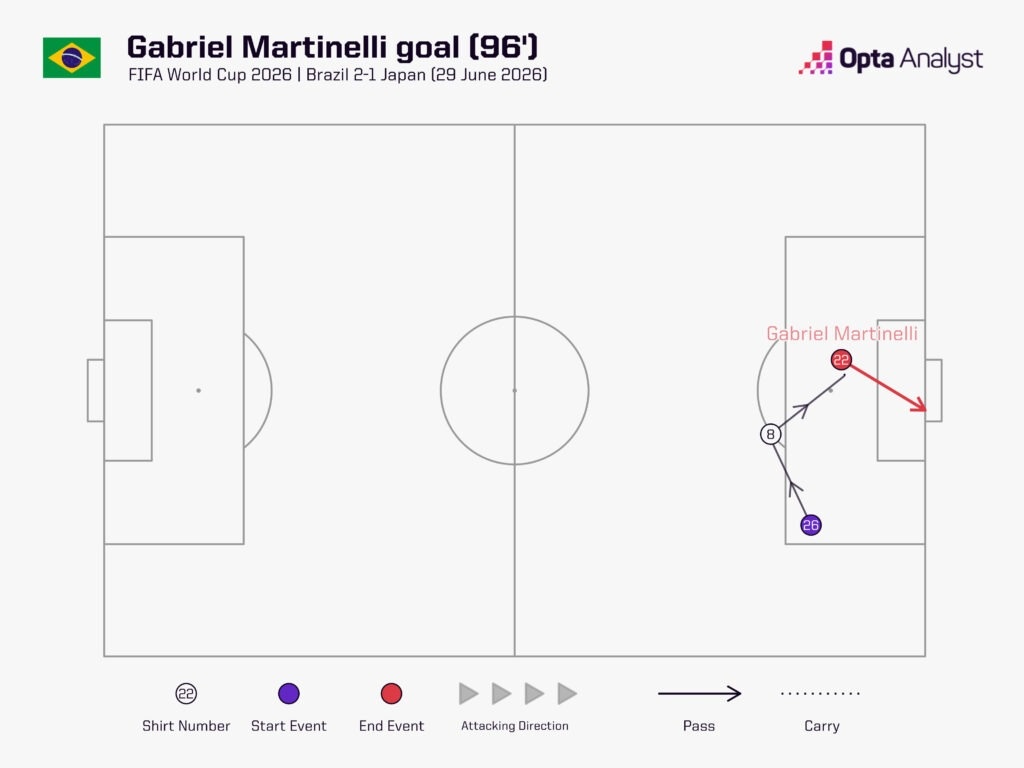
Bedlam followed. Brazil were through.
What the Result Means in Historical Context
The significance of avoiding defeat here cannot be overstated for a nation that treats World Cup failure as something close to a national emergency.
Brazil’s World Cup knockout record is one of the most decorated in football history. Falling in the round of 32 would have represented a low point that stretched back further than most Brazilian fans would care to contemplate.
| Year | World Cup Exit Stage | Notes |
|---|---|---|
| 1938 | Semi-finals | Lost to Italy |
| 1950 | Final (group format) | Lost to Uruguay in final match |
| 1954 | Quarter-finals | Lost to Hungary |
| 1958 | Winners | Beat Sweden in final |
| 1962 | Winners | Beat Czechoslovakia in final |
| 1966 | Group stage | Only non-knockout exit |
| 1970 | Winners | Beat Italy in final |
| 1974 | Fourth place | — |
| 1978 | Third place | — |
| 1982 | Second group stage | — |
| 1986 | Quarter-finals | — |
| 1990 | Round of 16 | Last time eliminated before QF pre-2026 |
| 1994 | Winners | Beat Italy on penalties |
| 1998 | Final | Lost to France |
| 2002 | Winners | Beat Germany in final |
| 2006 | Quarter-finals | — |
| 2010 | Quarter-finals | — |
| 2014 | Fourth place | Infamous 7-1 loss to Germany |
| 2018 | Quarter-finals | — |
| 2022 | Quarter-finals | — |
Going back as far as 1938, the only times Brazil have failed to reach the quarter-finals of a World Cup that featured a knockout stage were 1966, when they did not escape the group, and 1990, when they lost to Argentina in the round of 16. An exit against Japan would have represented their worst performance since 1990 at the very least — a generational low.
That context underlines what was at stake in the second half in Houston.
Brazil’s Resilience: A New Development
The win was not only significant in terms of avoiding embarrassment. It also pointed to something that Brazilian football has not always been associated with — the ability to dig out a result when behind.
Monday’s victory was only Brazil’s second win in nine World Cup matches in which they have trailed, with a record of W2, D1, L6 in such games. Their only previous such victory came in their opening match as hosts at the 2014 World Cup, when they came from a goal down to beat Croatia 3-1.
Brazil’s World Cup Record When Trailing
| Result | Count |
|---|---|
| Wins | 2 |
| Draws | 1 |
| Losses | 6 |
Resilience, in that context, has not been a traditional strength. Winning a World Cup knockout game from behind, in a competition this intense, against a Japan side that was disciplined and dangerous, is not something this group of players would have managed without firm direction from the touchline.
The Ancelotti Factor
Much of the pre-tournament discourse around Brazil at World Cup 2026 centred on Vinícius Júnior and whether he could finally translate his extraordinary club form into consistent performances at international level. That conversation will continue.
But the result against Japan pointed to a different kind of trump card: the man in the technical area.
Ancelotti’s substitutions changed the game. His decision to retain Casemiro, when most would have taken him off, was vindicated by the equaliser. His introduction of Endrick provided the energy Brazil needed. His willingness to bring on Martinelli in a crossing-heavy game, unconventional as it looked, produced the winning goal.
None of that is coincidental. It reflects the kind of reading of a match that Ancelotti has spent four decades developing across the biggest clubs in European football. The calmness he projected when everyone else was celebrating was not detachment — it was the quiet confidence of a manager who had made his decisions and trusted them.
Brazil are through. They are not, by any measure, playing beautiful football at World Cup 2026. The midfield remains ageing. The defence can be exposed. The reliance on crosses in the second half was pragmatic rather than elegant.
But they are in the quarter-finals. They avoided their lowest low in a generation. And right now, with Ancelotti making the right calls when it matters most, that might be enough to go further still.
FAQs
How did Brazil qualify from the round of 32 at World Cup 2026?
What was the historical significance of Brazil’s win over Japan?
What tactical changes did Ancelotti make at half-time?
Who scored Brazil’s goals against Japan at World Cup 2026?
How old was Brazil’s starting XI against Japan at World Cup 2026?
Brazil’s starting XI had an average age of 29 years and 245 days, making it their oldest lineup in a World Cup knockout match since their 2006 quarter-final against France, when the average age was 30 years and 31 days.