NAM250/5 (45.3/50 ov)
 IRE
 AVL
 MNC
 RAY
 ELC
 GMB
 ZMB
 NGA
 LES
 CAG
 BOL
 COMO
 SAS
 FCA
 FCU
 KOE
 S04
 MOZ19
 UGA23/0 (0.5/20 ov, target 20)
 NZ180/5
 IND181/6 (19.5/20 ov, target 181)
 Ipswich1
 Nottm Forest1
 Alavés1
 Málaga1
 WA71/3 (11.2/50 ov, target 372)
 NSW371/8
 DEN
 KUW
 KENYA
 QAT
 SWD-W
 EPR-W
 TTN-W
 WPR-W
 NZ-A135/3 (41 ov)
 IND-A113
 DHA
 RAJ
 MYMS
 CHATT
 RAN
 BAR
 SYL
 KHU
 MEX-W
 ARG-W
 UAE
 NED
 PAK
 ENG
 IND-W
 ZIM-W
 AFG170/3 (34.3/50 ov, target 170)
 ZIM169
 CHE0
 DYI0
 CHO1
 QIN0
 HEN1
 BEI0
 LIA1
 ZHE0
 QWC1
 YUN0
 SHX0
 Shanghai Shenh0
 TIG0
 SHP0
 WTT1
 SHT3
 M05
 SVW
 RBL
 ELV
 Torino3
 Monza2
 Brest1
 Nice2
 Stuttgart2
 Gladbach3
 Al Ahli4
 Al Khaleej1
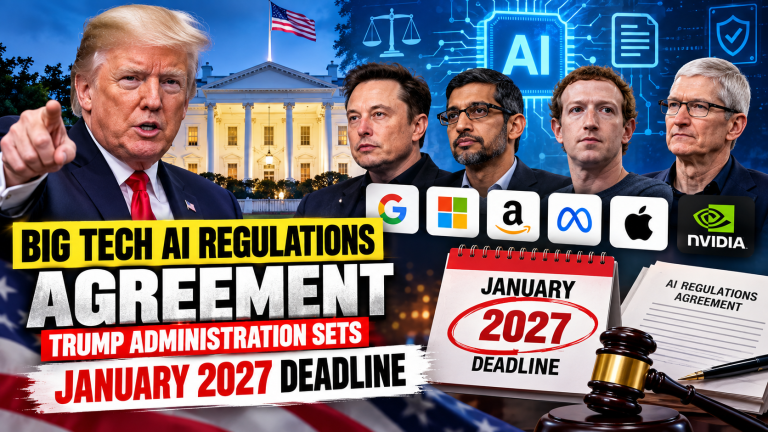
Big Tech just faced a new regulatory reality. The number: $500 million annually. On Wednesday, September 30, 2026, the Trump administration reportedly announced a sweeping AI compliance framework—though officials have not yet confirmed the details.
Reportedly, the framework places OpenAI, Google, and Microsoft at the centre of a federal compliance programme led by Department of Commerce Secretary Howard Lutnick. Under the unconfirmed proposal, the first major test arrives on Friday, January 15, 2027, when participating companies would be required to implement the new federal AI safety standards.
What does the Big Tech AI regulations agreement include?
According to unconfirmed details, the agreement creates a shared framework for federal AI safety compliance across participating technology companies. Representatives from OpenAI, Google, and Microsoft reportedly took part in negotiations held in Washington, D.C., while Lutnick led the federal oversight delegation.
Reportedly, the most concrete financial commitment is an annual minimum of $500 million for national AI infrastructure auditing. That funding is intended to support checks on the systems and infrastructure used to develop and operate advanced AI services. The available details do not specify whether the audits will be performed by federal agencies, independent contractors, or a combination of both. The arrangement therefore goes beyond model behaviour. It links safety obligations to computing infrastructure, audit capacity, and corporate accountability.
How will companies meet the January 2027 AI safety deadline?
Under the proposed framework, participating firms would need to implement the federal AI safety standards by January 15, 2027. The deadline gives companies a defined compliance target, although the published information does not yet explain the technical tests, reporting templates, or penalties attached to missed requirements.
The deadline matters because it converts a negotiated framework into an operational obligation. Companies will need to translate the agreement into internal controls covering model development, deployment, monitoring, and infrastructure audits. OpenAI, Google, and Microsoft already operate different AI platforms, so a common federal standard could reduce differences in how safety claims are documented. The timing also puts pressure on legal and engineering teams. A January deadline leaves little room for companies to wait for voluntary industry alignment.
Why is Washington targeting AI infrastructure audits?
The reported $500 million annual commitment points to a wider concern: AI safety depends on more than the text produced by a chatbot. Data-centre operations, model access controls, evaluation systems, and incident reporting can all affect how safely an AI service operates. Infrastructure auditing could make technical safeguards easier for regulators to verify.
A model may pass a controlled evaluation yet create risks through weak access management, inadequate monitoring, or poorly documented updates. Audits can examine those surrounding systems rather than relying only on statements from the companies building the models. The approach also reflects the scale of modern AI development. As companies expand computing capacity, federal oversight is moving toward the facilities and processes that support AI services. Our earlier coverage of enterprise AI leadership changes offers a related view of how corporate structures are adapting around this market.
What does the agreement mean for OpenAI, Google, and Microsoft?
If finalized, the pact would give the three companies a common regulatory reference point, but it does not automatically create identical obligations for every AI product. Consumer chatbots, developer APIs, cloud platforms, and enterprise tools may face different audit requirements once the standards are published in full.
The agreement could shift competition from safety promises to verifiable compliance records. Companies that can document testing, infrastructure controls, and corrective actions may gain an advantage with government and enterprise customers. At the same time, the $500 million annual commitment could increase opeDario Amodei and Trump shows how closely AI executives and policymakers are now being watched. This pact places that relationship inside a formal compliance process rather than leaving it to private meetings.
What happens before January 15, 2027?
The next stage involves the publication of practical rules explaining how the federal standards will work. Companies and regulators must still clarify audit scope, enforcement powers, data-access requirements, and the treatment of future AI systems that were not covered in the initial negotiations.
The January deadline will be meaningful only if the administration eventually publishes measurable requirements before companies begin compliance work. Without clear testing methods and enforcement language, the agreement could remain a political commitment rather than a functioning safety regime. For users, developers, and investors, the important signals will be the final standards and the first audit disclosures. Those documents will show whether Washington has created a repeatable oversight system or simply secured a broad promise from the industry. It is worth watching how Big Tech develops from here. For more detail, see VentureBeat AI.
The big tech agreement moves AI regulation toward infrastructure-level accountability, with January 15, 2027, set as the first major compliance test.
FAQs
When was the AI regulations agreement announced?
The Trump administration reportedly announced the agreement on Wednesday, September 30, 2026.
Which companies participated in the negotiations?
Representatives from OpenAI, Google, and Microsoft reportedly participated in the framework negotiations.
Who led federal oversight of the agreement?
Department of Commerce Secretary Howard Lutnick reportedly led the federal oversight delegation.
How much will participating firms allocate to auditing?
Participating firms reportedly agreed to allocate at least $500 million annually toward national AI infrastructure auditing.
Was this article helpful?
Your feedback directly improves future articles on this site.