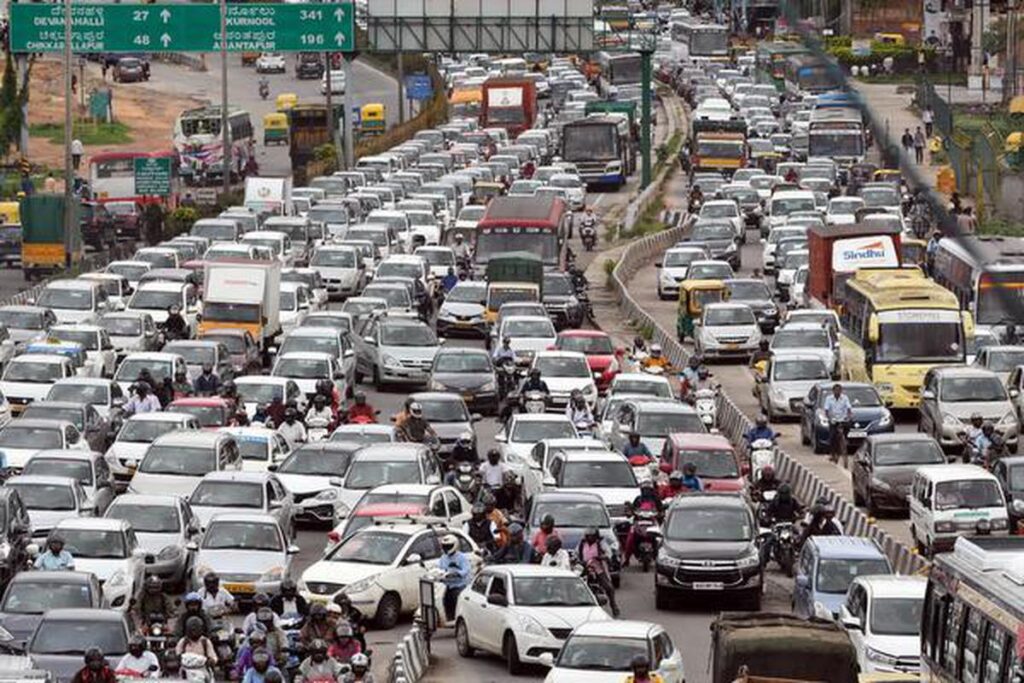
India’s tech capital has earned an unwelcome global distinction: Bengaluru is now the world’s second-most congested city in 2025, according to the TomTom Traffic Index. With a staggering 74.4% congestion level and commuters wasting 168 hours annually stuck in traffic, the Silicon Valley of India is paying a steep price for rapid growth without matching infrastructure.
Bengaluru Traffic Crisis: By the Numbers
| Metric | 2025 Data | Comparison | Impact |
|---|---|---|---|
| Global Congestion Rank | 2nd worldwide | Beat by Mexico City only | City trails only Mexico |
| Congestion Level | 74.4% | +1.7% vs 2024 | Worsening trend |
| 10 km Travel Time | 36 min 9 sec | +2 min vs 2024 | Slower commutes |
| Average Speed | 16.6 km/h | Down from 17.6 km/h | Crawling pace |
| Rush Hour Speed | 13.9 km/h | -1 km/h vs 2024 | Nearly walking speed |
| Annual Hours Lost | 168 hours (7 days) | +12.8 hours vs 2024 | Week of productivity gone |
| 4.2 km Journey | 15 minutes average | – | Severe local congestion |
India Dominates Global Congestion Rankings
Bengaluru isn’t alone in its traffic woes. India placed six cities in Asia’s top 10 most congested list: Bengaluru, Pune (5th globally), Mumbai, New Delhi, Kolkata, and Jaipur. Chennai ranked 11th in Asia, while Hyderabad stood at 15th.
Pune secured fifth place globally with 71.1% congestion, making it the second Indian city in the worldwide top 10. Mumbai ranked 18th globally despite showing a 3.3 percentage-point improvement, with commuters still losing 126 hours yearly.
Why Bengaluru’s Traffic Keeps Getting Worse
The root cause? Rising vehicle numbers, ongoing road construction, and limited public transport options have created a perfect storm. As India’s premier tech hub, Bengaluru has experienced explosive growth—its infrastructure simply hasn’t kept pace.
During morning rush hour, traveling 10 km takes 41 minutes 6 seconds, with evening rush hour extending this to 45 minutes 27 seconds—longer than many international flights between neighboring countries. At peak congestion, speeds drop to a glacial 13.2 km/h—barely faster than a brisk walk.
For tech professionals, gamers, and esports enthusiasts working from Bengaluru (covered extensively on TechnoSports), this means significant productivity losses. The 168 hours lost annually equals seven full days—time that could be spent gaming, content creation, or simply living.
The Human Cost: A Week Lost Every Year
Think about what 168 hours represents: Seven days and 40 minutes of life spent sitting in traffic. For working professionals in Bengaluru’s booming tech, gaming, and esports industries, this translates to:
- Missed deadlines and reduced productivity
- Health impacts from stress and sedentary time
- Environmental damage from idling vehicles
- Economic losses from fuel waste and opportunity costs
The situation worsened in 2025, with commuters spending nearly 13 additional hours in traffic compared to 2024—equivalent to losing an extra full workday annually.
Mexico City: The Only City Worse Than Bengaluru
Mexico City topped the global congestion chart, securing the dubious honor of being the world’s most congested city. Following Mexico and Bengaluru, Dublin (Ireland) and Łódź (Poland) ranked third and fourth respectively.
A Rare Bright Spot: Kolkata’s Improvement
Interestingly, Kolkata—which was the second-most congested city globally in 2024—dropped to 29th place in 2025, though motorists still spent around 150 hours annually in traffic. This dramatic improvement suggests that targeted interventions can work, offering hope for Bengaluru.
Hyderabad was among the few Indian cities showing improvement, with congestion reducing by 1.3 percentage points, proving that India’s traffic crisis isn’t inevitable.
The TomTom Traffic Index Methodology
The TomTom Traffic Index analyzes anonymized GPS data and real driving speeds, covering more than 3.65 trillion kilometers worldwide. The index benchmarks cities based on congestion levels, travel times, and average speeds, providing a comprehensive city-by-city view of traffic conditions.
This data-driven approach ensures reliability, drawing from real-world driving patterns rather than estimates or simulations.
What Needs to Change
Experts and urban planners point to urgent needs:
- Expanded metro networks to reduce private vehicle dependence
- Better urban planning to prevent infrastructure lag
- Smart traffic management using AI and real-time optimization
- Incentivized public transport adoption
- Dedicated bus lanes and cycling infrastructure
For Bengaluru’s massive tech workforce—including game developers, esports professionals, and content creators tracked by TechnoSports—these improvements can’t come soon enough.
The Bottom Line
Bengaluru’s second-place global ranking is a wake-up call. As India’s innovation capital continues growing, the city must invest aggressively in public transport, smart traffic systems, and infrastructure that matches its economic ambitions. Otherwise, the “Silicon Valley of India” risks becoming synonymous with gridlock rather than innovation.
Interested in tech news and urban development? Follow TechnoSports for coverage of smart city initiatives, technology trends, and how infrastructure impacts India’s tech ecosystem.
Stay updated on Bengaluru’s tech scene and urban challenges at TechnoSports—where innovation meets reality.