

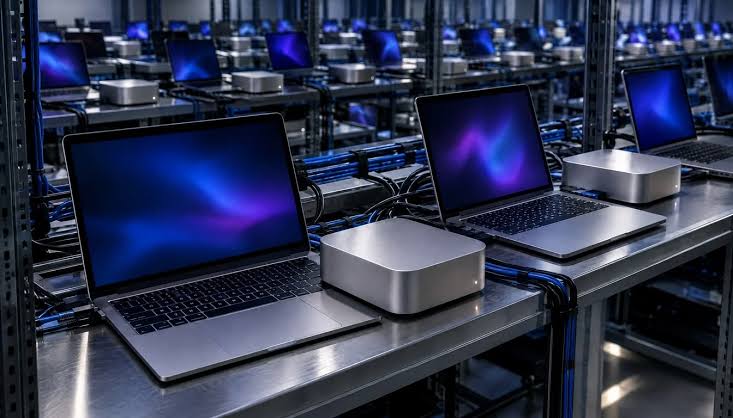
Apple has published research on a system called Minions that turns idle Macs into a shared GPU cloud for AI inference. It is a research paper, not a product, and Apple has not announced any macOS feature built on it.
The paper is titled “Minions: A Dynamic and Distributed Virtual GPU Cloud Built on Idle Apple Silicon Devices.” It was listed on Apple Machine Learning Research on 12 October 2026 and updated on arXiv on 13 October, as summarised by Shattered.
More on this topic: TechnoSports Apple Research coverage.
Key Details at a Glance
| Component | Role |
|---|---|
| Minion Server | Coordinates work and provides the task API |
| PostgreSQL metadata store | Tracks task state, assignment history and execution metadata |
| Minion Executor | Runs on each Mac, pulls subtasks, uses the local GPU, uploads output to object storage such as S3 |
| Minion Watchdog | Detects failed executors and reassigns their work |
| Scheduling | Pull-based: executors poll for work |
The Big Idea
Companies often own plenty of Macs that sit idle overnight or between tasks. Minions routes AI inference work to whichever machines have spare capacity, so a company can use hardware it already owns instead of buying more GPUs.
The authors say some inference jobs that waited more than 10 hours for dedicated GPU capacity can often start within minutes once idle Macs join the pool.
What It Does Not Claim
This is about availability and queue time, not raw speed. A single Mac GPU is weaker than a data-center accelerator. The system suits work that splits into independent pieces, such as embeddings or batched language model completions.
Capacity is opportunistic. It shrinks when Macs are busy or offline, and the pull-based design means sleeping or disconnected machines cause less disruption.
How It Differs From Other Approaches
Mac clustering over Thunderbolt 5 and RDMA links nearby Macs to act as one bigger machine. Minions instead pools networked machines through a scheduler. Centralised GPU clouds from Nvidia and AMD are faster but scarce and expensive.
Idle-compute projects are not new and date back to the late 1990s, but those were mostly CPU-based and run by volunteers. Minions targets GPU inference in enterprise Mac fleets. See more in our Apple coverage.
Open Questions
The material available does not include performance benchmarks, real deployment sizes, the chip models tested or cost per inference. Security is another question, since work laptops would run subtasks sent from a central server, and data isolation, battery and heat all need answers.
Commentators expect independent benchmarking to follow, and do not expect Apple to turn this into a product soon. That view is opinion, not part of the paper.
Quick Answers
What is Apple Minions?
A research system that pools idle Apple Silicon GPUs across macOS devices into a virtual GPU cloud for inference.
Is it a product?
No. It is a research paper and reference architecture.
What is the main claim?
Jobs that waited 10+ hours for GPU capacity can often start within minutes.
Source: Shattered, Apple Machine Learning Research, Apple silicon on Wikipedia.
Why This Matters for Enterprises
Many companies run large Mac fleets for design, development and office work. Machines that sit idle at night or during meetings represent unused GPU power, and a scheduler that can borrow it for batch AI jobs would turn that into a free resource.
The approach is not for latency-critical chat applications. It fits overnight batch work such as generating embeddings, summarising documents or running evaluations, where finishing hours later is acceptable. Keep an eye on the follow-up research and any independent benchmarks.


