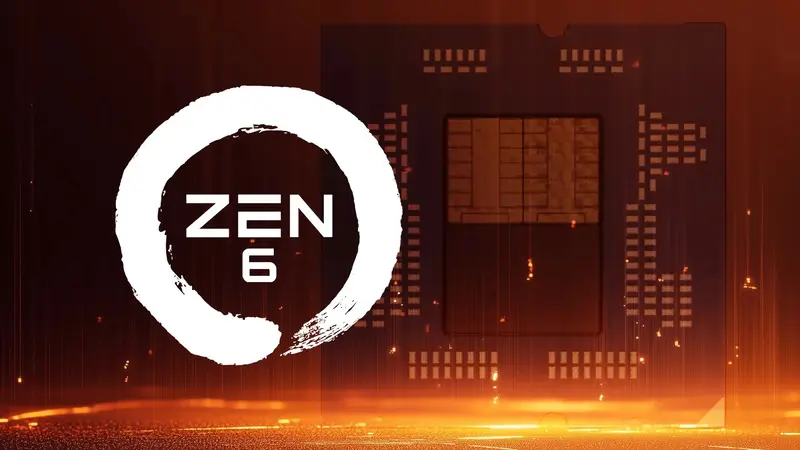
AMD is breaking its own rules — and it’s about time. For nearly a decade, AMD’s Ryzen desktop CPUs have stuck religiously to 8-core CCDs (Core Complex Dies). Now, according to reliable leaker HXL via VideoCardz, the Red team’s next-gen Zen 6 “Olympic Ridge” desktop lineup will shatter that ceiling with 12-core CCDs — opening the door to seven different core configurations and a potential 24-core flagship.
This isn’t just a spec bump. It’s AMD fundamentally rethinking desktop CPU architecture to counter Intel’s upcoming Nova Lake, which is rumored to hit 52 cores on the high end.
Table of Contents
The Full Olympic Ridge Lineup Leaked
According to HXL’s post, AMD’s Ryzen 10000 series (assuming the company maintains its naming convention) will span an unprecedented range of core counts:
| Configuration | CCD Count | Core Layout | Total Cores |
|---|---|---|---|
| Entry | Single | 6-core | 6 cores, 12 threads |
| Mainstream | Single | 8-core | 8 cores, 16 threads |
| Mid-range | Single | 10-core | 10 cores, 20 threads |
| High-end Single | Single | 12-core | 12 cores, 24 threads |
| Dual Mid | Dual | 8+8 | 16 cores, 32 threads |
| Dual High | Dual | 10+10 | 20 cores, 40 threads |
| Flagship | Dual | 12+12 | 24 cores, 48 threads |
This is the most flexible desktop CPU lineup AMD has ever attempted. The current Zen 5 generation tops out at 16 cores, so the flagship Zen 6 chip would represent a 50% core count increase — before even accounting for architectural IPC gains, higher clocks, and the inevitable X3D variants.
The 12-Core X3D Dream
Here’s where gamers are getting genuinely excited: if AMD builds a single-CCD 12-core X3D variant, it would have all 12 cores sharing one unified pool of 3D V-Cache. This matters enormously for gaming.
Current dual-CCD X3D chips like the Ryzen 9 7950X3D and 9950X3D stack 3D V-Cache on only one of the two CCDs, creating scheduling complexities where games must be pinned to the correct chiplet to get full performance. A single-CCD 12-core X3D would eliminate that problem entirely — all cores get direct, symmetric access to the cache.
With Zen 6 CCDs reportedly packing 48 MB of L3 cache per chiplet (up from 32 MB on Zen 5), a 12-core X3D variant could theoretically sport 240 MB of total cache with 2-Hi 3D V-Cache stacking. For gaming, this would be nothing short of monstrous.
Why AMD Is Doing This Now
The answer is straightforward: Intel Nova Lake. Intel’s next-gen desktop platform is going dual-compute-tile with rumored configurations up to 52 cores (though most won’t be performance cores). Even the single-tile Nova Lake chips are expected to max out at 24 cores (8P+16E), directly competing with AMD’s 24-core Zen 6 flagship.
Intel is also implementing bLLC (big last-level cache) — essentially its own take on X3D — to close the gaming gap with AMD. If AMD stuck with 8-core CCDs and 16-core flagships, it would cede the core count crown entirely while Intel gained ground on cache advantages. The 12-core CCD strategy neutralizes both threats.
Tom’s Hardware reports that Zen 6 is expected to deliver IPC improvements and higher clock speeds — potentially hitting 6.5 GHz+ on TSMC’s 2nm (N2P) process node with GAA (Gate-All-Around) transistors. Combined with the expanded core counts, AMD’s performance leap could be substantial.

The AM5 Compatibility Question
AMD has previously promised AM5 socket compatibility through Zen 6, and recent ASUS and COLORFUL motherboard leaks have confirmed B850 and X870 boards explicitly supporting Zen 6 CPUs. However, there’s one significant wrinkle: BIOS size.
Older AM5 boards with 32 MB BIOS chips may struggle to accommodate the expanded firmware requirements for Zen 6’s new 12-core CCDs and additional configurations. AMD and motherboard manufacturers are pushing 64 MB BIOS chips as the standard for Zen 6 compatibility — and some older boards may need to drop features like integrated Wi-Fi drivers to make room.
For users with 2024-era X670E or B650 boards, there’s a real chance you’ll need a BIOS update (and possibly lose some functionality) or upgrade to a newer 800-series board to get full Zen 6 support.
What About That Memory Crisis?
Here’s the uncomfortable reality: by the time Olympic Ridge launches (likely late 2026 or even CES 2027), RAM prices may still be catastrophically high due to the ongoing AI-driven memory shortage. A 24-core flagship is impressive on paper, but if DDR5-6000 kits cost 3x what they did in 2024, adoption will be painful.
Intel faces the same problem, of course, but AMD’s pricing flexibility and established AM5 platform means users won’t need to replace motherboards — a meaningful cost advantage in a brutal component market.
The Verdict: AMD’s Boldest Move in Years
If these leaks pan out, Zen 6 “Olympic Ridge” represents AMD’s most aggressive desktop CPU strategy since the original Zen launch in 2017. Seven core configurations, 12-core CCDs, potential for a unified X3D gaming monster, and maintained AM5 compatibility — AMD is swinging for the fences.
The real question isn’t whether AMD can build these chips. The question is whether consumers and system builders can afford the memory to feed them.
Stay on top of AMD Zen 6 developments, Intel Nova Lake competition, and PC hardware pricing trends at Technosports.