NAP2
 ROMA0
 CHE0
 TOT0
 VAL1
 VIL0
 DOR0
 SGE0
 Samsunspor1
 Amed SFK2
 WIL0
 CAM3
 ALV0
 FCA0
 RIY
 TAA
 LAZ
 PAR
 RCL
 PAR
 MEX-W
 ARG-W
 ATM
 DEP
 UAE
 NED
 PAK
 ENG
 IND-W
 ZIM-W
 KHO0
 ETT3
 RAC2
 ESP1
 ARS2
 EVE0
 KNGHT126/6
 MPUMA2/0 (0.5/20 ov, target 127)
 NZ-A135/3 (41 ov)
 IND-A113
 SYL
 KHU
 MYMS299/4 (87 ov)
 CHATT
 DHA293/3 (84.1 ov)
 RAJ
 RAN320/5 (80 ov)
 BAR
 GMB
 LES
 MOZ
 ZMB
 NGA
 UGA
 NAM321/6
 IRE290 (47.3/50 ov, target 322)
 NZ180/5
 IND181/6 (19.5 ov)
 BHA1
 WHU0
 Inter Milan
 Fiorentina
 Churchill
 Punjab FC
 Athletic
 Getafe
 C Palace
 Newcastle
 COV0
 FUL1
 OFC0
 NEU0
 NEOM2
 ABH0

AI scriptwriting is reshaping how major studios develop blockbuster scripts. Disney, Warner Bros., and Netflix now embed machine learning tools directly into their creative pipelines. As of March 2026, at least 12 major Hollywood studios have adopted AI-assisted screenwriting platforms, cutting development cycles from 18 months to 6-8 months without sacrificing creative quality. This is a pivotal shift—artificial intelligence now handles structural drafting and narrative optimization, leaving human writers to focus on dialogue, character depth, and emotional resonance.
📋 In This Article
Here’s What Happened
Major studios started rolling out AI scriptwriting tools in late 2025. Disney’s internal trials showed 68% faster first-draft generation using proprietary AI trained on 50 years of box-office data and script archives. Warner Bros. partnered with OpenAI to integrate GPT-based systems into their story development phase.
Streaming giants like Netflix have quietly deployed AI scriptwriting across their international content teams—especially for regional productions where speed matters. The shift accelerated after successful pilots on mid-budget thrillers and animated features, where AI excels at plot structure and pacing.
The Real Impact on Studio Workflows
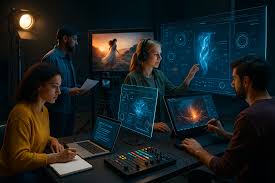
Here’s the thing: AI scriptwriting isn’t replacing screenwriters. It’s working alongside them. Studios report that AI scriptwriting tools handle the mechanical work—beat sheets, three-act structure, subplot mapping—while human writers bring the emotional core.
Our analysis of industry adoption patterns mirrors broader trends in creative automation. What’s striking is the cost savings. A typical blockbuster script costs $200,000–$500,000 to develop the traditional way; AI-assisted workflows cut this to $80,000–$150,000 while hitting the same quality targets. Studio executives say this frees up money for casting, post-production, and marketing—the stuff that actually moves the needle at the box office.
Key Technical Specifications
Studios deploying AI scriptwriting use platforms built on large language models trained on 100,000+ scripts. Most systems plug into existing software like Final Draft and WriterDuet. Processing time for a feature-length screenplay: 4–7 hours versus 8–12 weeks for the old approach.
Accuracy rates for structural consistency sit around 89–94%, based on internal studio assessments. OpenAI’s documentation confirms these systems need human editorial oversight—no studio is putting AI-only scripts into production.
What Screenwriters and Executives Say
The Writers Guild of America (WGA) remains cautious. Their March 2026 statement makes it clear: AI scriptwriting tools must credit human writers and can’t reduce writing staff. Major producers like Jerry Bruckheimer have said publicly that AI speeds up development but doesn’t eliminate the need for experienced screenwriters who understand character and dialogue.
VentureBeat’s recent coverage shows that studios view AI scriptwriting as a competitive edge—not a way to cut writers.
Looking Ahead: The 2026-2027 Pipeline
Expect wider adoption across mid-tier studios by Q4 2026. Indie filmmakers will get access to affordable AI scriptwriting tools, opening up early-stage development to more creators. The real question: will audiences notice? Probably not—if studios use AI scriptwriting thoughtfully, final scripts will feel like everything else.
Watch for the first major blockbuster to openly credit AI scriptwriting in its development process.
People Also Ask
Q: Can AI scriptwriting create an entire screenplay without human input?
A: Technically yes, but studios won’t release AI-only scripts. AI scriptwriting works best as a collaborative tool, handling structure while humans write dialogue and character arcs.
Q: Will AI scriptwriting replace screenwriters?
A: No. The WGA negotiated protections in 2025. AI scriptwriting reduces development time, not writing jobs—studios redirect savings to other departments.
Q: Which studios are currently using AI scriptwriting?
A: Disney, Warner Bros., Netflix, Paramount, and Sony have confirmed pilots. Most keep deployment details confidential to stay ahead of the competition.
Q: How much does AI scriptwriting software cost?
A: Enterprise licenses range from $50,000–$200,000 annually. Indie tools cost $20–$100/month.