BAN
 WI235/4 (70 ov)
 AFG
 ZIM326/5 (87 ov)
 AZ0
 JUV2
 B040
 OLM1
 SLB2
 LECH1
 CEL1
 USG2
 CEL2
 BES1
 HBE0
 OFI2
 GOA
 Bengaluru
 Hamburg
 Gladbach
 Venezia
 Udinese
 Toulouse
 Strasbourg
 Everton
 Coventry
 Sevilla
 Alavés
 NZ
 IND
 PAL
 REMO
 MIL0
 FER2
 AND2
 SLZ0
 CRY1
 TSG1
 LEV1
 JAG0
 WAR138/7 (20 ov)
 BOL138/5
 DMJIR290 & 134/5 (46 ov) (f/o)
 HYD-R519/8d
 KRBLS280 & 2/1 (2 ov)
 SRB241 & 388/5d
 FSLB259 & 54/1 (26 ov) (f/o)
 PRB503/4d
 LAHW234 & 40/4 (17 ov, target 412)
 FATA362 & 283
 ISB215 & 163/6 (51 ov)
 MUL327
 PCBXI151/8d
 SL223/7d & 121/6 (38 ov)
 ZIM-A
 IRE-A420/9 (90 ov)
 MS-W
 SS-W
 MR-W
 AS-W
 BH-W
 HH-W
 KAY
 SPR
 TUSK
 RHINO
 MOUNT
 ROCKS
 CHR
 POA
 WI-A123 (16.3/20 ov, target 220)
 LIONS219/7
 ST-W166 (19/20 ov, target 184)
 PS-W183/3
 BIK83
 KAG86/1 (9.4/20 ov, target 84)
 JAB133/8 (20 ov, target 150)
 LUL149/8
 MAL1988
 SL1991/1 (13.5/50 ov, target 89)
 STG1
 NKC3
 SUN0
 DZG2
 TOR1
 ARA2
 MON1
 FCN0
 UCRA2
 EGN0
 KBH2
 IBE1
 CRU
 BAH
 LSK0
 PLZ1
 NEC3
 OMON1
Zyphra introduces Zyphra Hierarchical Attention, a sparse attention mechanism designed to avoid the quadratic computation costs of transformer models. Surprisingly, the method reportedly adds just 81,920 trainable parameters to achieve subquadratic efficiency while preserving dense attention performance across multiple evaluation suites.
What Zyphra Introduces Hierarchical Attention Delivers
Zyphra introduced Zyphra Hierarchical Attention (ZHA), a sparse method built around a tree-structured indexer. Marktechpost reports that it addresses a limitation in earlier indexers, which required full context scans; its distillation process reportedly uses four billion tokens during a Kullback-Leibler warmup phase, limited to a fixed 32K context window. This protocol lets developers retrofit frozen pretrained models with minimal disruption to existing workflows, adding exactly 81,920 trainable parameters—a 0.00024% increase over the base size—and evaluations reportedly reached context lengths of 256K.
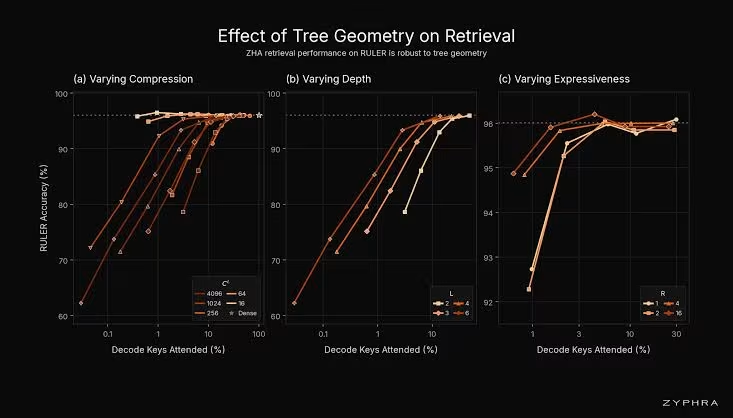
Reported speedups come from a modeled H100 BF16 roofline, since no optimized deployment kernels exist yet, while an FP4 router variant has completed quantization testing. Benchmarks show mixed results: the LongBench v2 deep tree scored 63.4% versus dense attention’s 58.0%, using just 1.1% of available keys; however, NoPE Nemotron-3.5-Lightning-30B-A3B fell 25.3 points behind dense baselines on RULER-13. Hardware requirements remain unclear: RAM needs, storage specifications, and processor compatibility haven’t been confirmed, leaving users to estimate resources from baseline model sizes.
Addressing Sparse Attention Limitations
Earlier sparse systems rely on indexers that scan the full context, creating computational bottlenecks. ZHA instead uses a tree-structured indexer to find relevant keys efficiently, eliminating the need for exhaustive searches.
The method keeps the full KV cache while simplifying the attention calculation pathway. Its hierarchical search aims to speed up inference as contexts extend beyond standard limits. This design targets overhead that can erode sparse attention’s efficiency gains, offering a structural alternative to brute-force reductions in computation.
Commercial Availability and Roadmap
Commercial pricing remains unconfirmed, leaving potential licensing arrangements for developers unclear. The public launch date hasn’t been set either, suggesting Zyphra is still refining the distillation process before general distribution. Interested parties should follow technical disclosures for kernel optimization updates and details on broader model expansion; organizations considering integration must account for these scheduling uncertainties when planning deployment timelines.
Consistency across different model families remains the main obstacle to widespread adoption. Stakeholders are waiting for a firm decision on whether Zyphra will open-source the distillation pipeline or limit access to enterprise partners. Resolving architectural differences will shape the method’s long-term viability in production, especially for applications that need to retain extremely long contexts. The move toward sparse attention helps explain why Zyphra introduces zyphra hierarchical attention as a direct response to growing context demands. Developers seeking efficient inference pipelines will watch distillation results as they stabilize across architectures, while success will depend on consistent performance and quick fixes for current benchmark vulnerabilities. Industry observers expect iterative refinements to address edge cases before a broad commercial release. ZHA is designed to scale sparse attention subquadratically with near-zero parameter growth, but cross-model stability and kernel availability remain critical next steps for developers. Source: Marktechpost
FAQs
What is Zyphra Hierarchical Attention?
Zyphra Hierarchical Attention is a sparse attention mechanism that uses a tree-structured indexer to reduce computational complexity while retaining the full KV cache. How many parameters does the implementation add? The solution adds exactly 81,920 trainable parameters to the base model, a 0.00024% increase in overall model size.
What is the maximum tested context length? Evaluation protocols have tested the method at context lengths up to 256K. Is there confirmed pricing or a launch date? Zyphra hasn’t announced confirmed commercial pricing, and the official public launch date remains unconfirmed. How did the method perform on LongBench v2? On LongBench v2, the deep tree configuration scored 63.4%, beating dense attention’s 58.0% with just 1.1% of keys.
Read Next
- The google suncatcher Satellite Runs AI in Orbit and Sends a Haiku Home
- Stuck Without A Hard Drive
- ‘AI is not creating the problem’: OpenAI CEO Sam Altman says AI is merely uncovering all
Was this article helpful?
Your feedback directly improves future articles on this site.