NZ
 IND
 NAM
 IRE
 MOZ
 UGA
 Aston Villa
 Man City
 Rayo
 Elche
 GMB
 ZMB
 NGA
 LES
 Cagliari
 Bologna
 IPS1
 NFO1
 ALA1
 MCF1
 TOR3
 MON2
 BRE1
 NICE2
 TAS103/5 (20.2/35 ov, target 276)
 VIC304/7 (50 ov)
 WA
 NSW22/1 (4.2/50 ov)
 NZ-A135/3 (41 ov)
 IND-A113
 DHA
 RAJ
 MYMS
 CHATT
 RAN
 BAR
 SYL
 KHU
 MEX-W
 ARG-W
 UAE
 NED
 AFG170/3 (34.3/50 ov, target 170)
 ZIM169
 IND-W200/1 (27.1/50 ov, target 198)
 ZIM-W197
 DOLPH56/0 (3.5/8 ov, target 56)
 SWD51/4 (8/8 ov)
 WSW1
 BRI1
 Como
 Sassuolo
 Augsburg
 Union Berlin
 Cologne
 Schalke
 Mainz
 Bremen
 RB Leipzig
 Elversberg
 VFB2
 BMG3
 AHL4
 KHA1
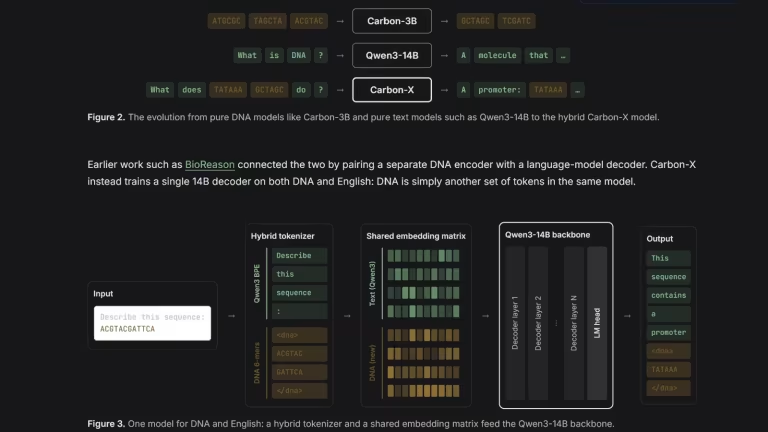
Quick take: Hugging Face and research partners have released Carbon, an open-source family of AI models trained on DNA. A viral post says you can ask it in plain English whether a gene change could be harmful and get an explanation, but it is still in the research phase and not approved for doctors to use.

Autocomplete for the Genome
DNA is a long string of four letters: A, C, G and T. Carbon treats it like text, predicting what comes next and how likely a given change is. Scoring that likelihood is how it estimates whether a mutation looks harmful, without needing labelled training examples.
A note on naming: the post calls it “Carbon-X”. I could only find the family called Carbon, in 500M, 3B and 8B sizes, so use the official name when you cite it.
Carbon at a Glance
| Detail | Information |
|---|---|
| Sizes | 500 million, 3 billion and 8 billion parameters |
| Training data | About 1 trillion tokens, roughly 6 trillion DNA base pairs, mostly from eukaryotes |
| Tokenizer | Hybrid: 6-letter DNA chunks plus English text, so it can handle both |
| Context | The 8B model handles about 196,000 base pairs natively |
| Open source | Model weights, training code and data pipeline released on the Hugging Face Hub |
| Partners | Hugging Face, Zhongguancun Academy and TIGEM/University of Naples Federico II |
Details are from Hugging Face’s model card, the technical report and RuntimeWire.
What It Can Do
- Variant effect prediction: Scoring how a single change in a gene, such as in BRCA2 or TP53, affects the model’s likelihood. Public tutorials already demo this for clinically relevant genes.
- Sequence generation: Continuing or recovering DNA sequences.
- Long-range retrieval: Using distant context within a long stretch of DNA.
The Speed Claim
The developers pitch Carbon as the fastest open DNA model. One write-up says it has about 300 times the throughput of Evo 2 with less than half the parameters, comparing the 8B and 20B models. Those are the developers’ claims, so wait for independent tests.
What It Is Not
This is a research tool. A model score is not a diagnosis, and nobody should make medical decisions from it. If you have worries about your genes, see a doctor or a genetic counsellor.
Read more about Hugging Face. For more AI and science news, visit TechnoSports, including our story on OpenAI’s Orchestra Bio deal.
Frequently Asked Questions
What is Carbon?
An open-source family of DNA language models from Hugging Face and partners.
Can doctors use it?
No. It is in the research phase.
Is it free?
The weights and code are open source on the Hugging Face Hub.
What is Hugging Face Carbon?
Carbon is an open-source family of DNA language models from Hugging Face and partners. It comes in 500M, 3B and 8B sizes.