MBSG
 CFC
 PSG
 LYON
 SEV
 OSA
 NED
 OMA
 NZ
 IND
 NAM
 IRE
 PAK
 SL
 SA
 AUS
 Barcelona1
 Real Madrid2
 Udinese0
 Milan2
 Real Sociedad2
 Levante1
 Lecce0
 Juventus2
 MOW9/1 (2.1/20 ov)
 TOK
 NZ-A317
 IND-A113 & 488/8 (119 ov)
 SYL575/4 (167.3 ov)
 KHU
 MYMS465/7d
 CHATT424/6 (121 ov)
 DHA521
 RAJ162 & 215/5 (59.1 ov) (f/o)
 RAN402 & 5/0 (2.3 ov)
 BAR443/9d
 SIKM30/1 (15 ov)
 NAGA187
 JHK
 DELHI309/5 (90 ov)
 ODSA194
 SVCS13/0 (5 ov)
 BRODA259/6 (86 ov)
 J & K
 CHD363/2 (87 ov)
 HP
 CGR35/1 (14 ov)
 AP231
 BRB
 MIS
 BIK
 CHR
 JER
 KUW
 MEX-W51 (12.5/20 ov, target 187)
 ARG-W186/7
 NGA148
 UGA147/9 (20 ov, target 149)
 GMB112/9
 LES109 (19.5/20 ov, target 113)
 MOZ110/7 (19/20 ov, target 110)
 ZMB109/9
 IND-W328/6
 ZIM-W207 (48.5/50 ov, target 329)
 ENG241
 Abha
 Al Faisaly
 Sassuolo
 Lazio
 AS Roma
 Cagliari
 Torino
 Como
 NEF
 ITT
 Sunderland0
 Leeds0
 Freiburg1
 Bayern3

DeepSeek V4-Pro AI’s price cuts, effective May 23, 2026, have created quite a stir in the artificial intelligence sector. This bold move has pushed established players to rethink their long-term monetisation strategies.
The Beijing-based company’s decision to cut the cost of its proprietary large language model API by 75% is a game changer. Analysts believe this sparked a price war among major AI companies globally. By making enterprise-level automation more accessible, DeepSeek is aggressively chasing the market share currently enjoyed by OpenAI and Anthropic. The DeepSeek V4-Pro will play a crucial role in how this story unfolds.
This shift toward aggressive, high-volume pricing shows a strategic effort to encourage developers to leave behind pricier, established alternatives. Industry tracking data reveals that this cost-per-token reduction marks the most significant change in the commercial AI field since GPT-4 debuted.
This adjustment hits particularly hard for startups and large data processing firms operating on tight margins. For them, even a slight change in cost per million tokens can significantly impact profitability.
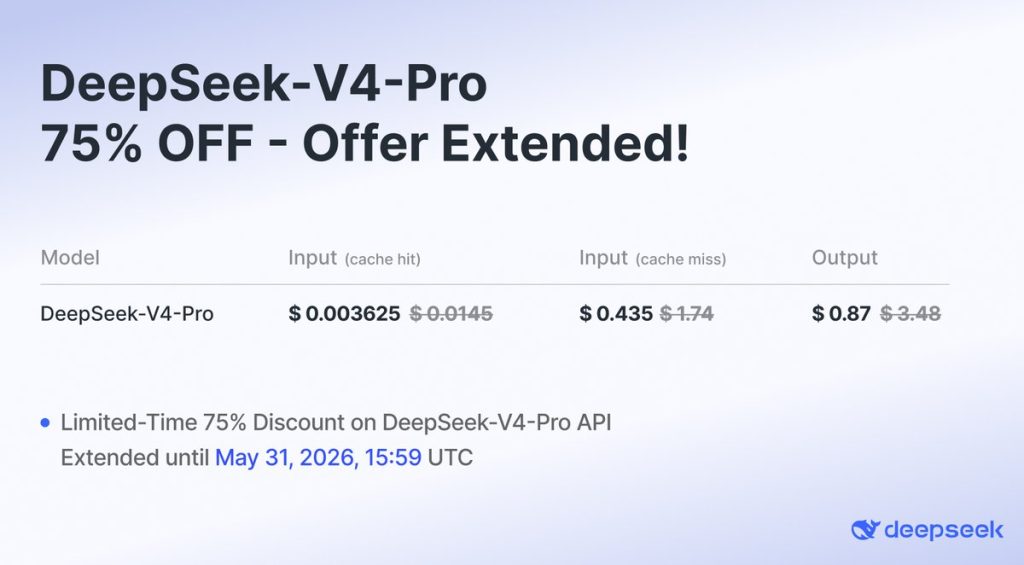
DeepSeek V4-Pro: Market Comparison and Competitive Positioning
The competition among LLM providers has shifted from performance-focused rivalry to a contest over operational efficiency and cost-per-inference. Historically, OpenAI and Anthropic have maintained premium pricing to offset their hefty R&D expenses. However, this latest move has compelled them to reevaluate the value they offer. (Source: The Verge)
| Provider | Model Class | Market Position (May 2026) |
|---|---|---|
| DeepSeek | V4-Pro | Aggressive Price Leader |
| OpenAI | GPT-4o/o1 | Premium Enterprise Standard |
| Anthropic | Claude 3.5 Opus | High-Trust Security Focus |
Not everyone is on board with this aggressive pricing strategy. Critics warn that such drastic cuts might lead to unsustainable development cycles. Still, we believe this move signals a necessary evolution for the industry. It suggests that foundational models are becoming more commoditized, pushing companies to differentiate themselves through specialized agents rather than just raw processing power. (Source: TechCrunch)
Implications for Enterprise Adoption and Infrastructure
This pricing shift aligns with broader trends surrounding the democratization of artificial intelligence tools. With costs dropping, firms are likely to move away from managing small, local models and lean toward utilizing powerful, cloud-based APIs for daily tasks.
This transition puts significant pressure on infrastructure providers to optimize their server setups. High-volume traffic is poised to become the new standard for commercial viability.
Brands need to refine their supply chains and pricing strategies to stay competitive in this race to the bottom. As the industry evolves, the focus will likely shift toward how well these low-cost models can tackle complex, multi-modal reasoning tasks compared to their pricier counterparts. We anticipate that the next product cycle will emphasize integration efficiency as the key success metric, surpassing simple benchmark scores.
FAQs
How do the DeepSeek V4-Pro price cuts compare to OpenAI?
The 75% reduction positions DeepSeek as a cost disruptor, potentially pushing OpenAI to offer bulk usage discounts to keep enterprise clients focused on budget efficiency.
Will these price cuts affect model performance?
While official benchmarks stay stable, independent developers report that lower costs enable more extensive prompt testing, which can improve fine-tuning outcomes for specialized enterprise applications.
Is this price war sustainable for the industry?
The industry is in a state of flux; while lower prices benefit end-users, they place significant financial strain on smaller AI firms that can’t match the same level of internal server infrastructure.