
 NZ
NZ IND
IND NAM
NAM IRE
IRE MOZ
MOZ UGA
UGA Aston Villa
 Man City
 Rayo
Rayo Elche
Elche GMB
GMB ZMB
ZMB NGA
NGA LES
LES Cagliari
 Bologna
 IPS1
IPS1 NFO1
NFO1 ALA1
ALA1 MCF1
MCF1 TOR3
TOR3 MON2
MON2 BRE1
BRE1 NICE2
NICE2 TAS103/5 (20.2/35 ov, target 276)
 VIC304/7 (50 ov)
 WA
WA NSW22/1 (4.2/50 ov)
 NZ-A135/3 (41 ov)
 IND-A113
 DHA
DHA RAJ
RAJ MYMS
MYMS CHATT
CHATT RAN
RAN BAR
BAR SYL
SYL KHU
KHU MEX-W
MEX-W ARG-W
ARG-W UAE
UAE NED
NED AFG170/3 (34.3/50 ov, target 170)
 ZIM169
 IND-W200/1 (27.1/50 ov, target 198)
 ZIM-W197
 DOLPH56/0 (3.5/8 ov, target 56)
 SWD51/4 (8/8 ov)
 WSW1
WSW1 BRI1
BRI1 Como
Como Sassuolo
 Augsburg
 Union Berlin
 Cologne
 Schalke
 Mainz
Mainz Bremen
 RB Leipzig
 Elversberg
 VFB2
VFB2 BMG3
BMG3 AHL4
AHL4 KHA1
KHA1
The biggest World Cup in history is here — and it’s bringing a sweeping set of new rules along with it. As 48 teams battle across the United States, Canada, and Mexico, fans will quickly notice that the beautiful game looks a little different this summer. With every recent World Cup, FIFA has viewed the tournament as an opportunity to experiment with new rules and technology. And an expanded 48-team World Cup in the U.S., Canada and Mexico is no exception.
The International Football Association Board approved changes to the laws of the game that will begin with the World Cup and continue with the 2026-27 domestic seasons around the world. The changes were made in an effort to improve match pace and player and fan experience. Here’s a complete breakdown of the key changes you need to know.
Quick Overview of the Key Changes
| Rule Change | What It Means |
|---|---|
| Goalkeeper 8-Second Rule | Keepers holding the ball over 8 seconds concede a corner |
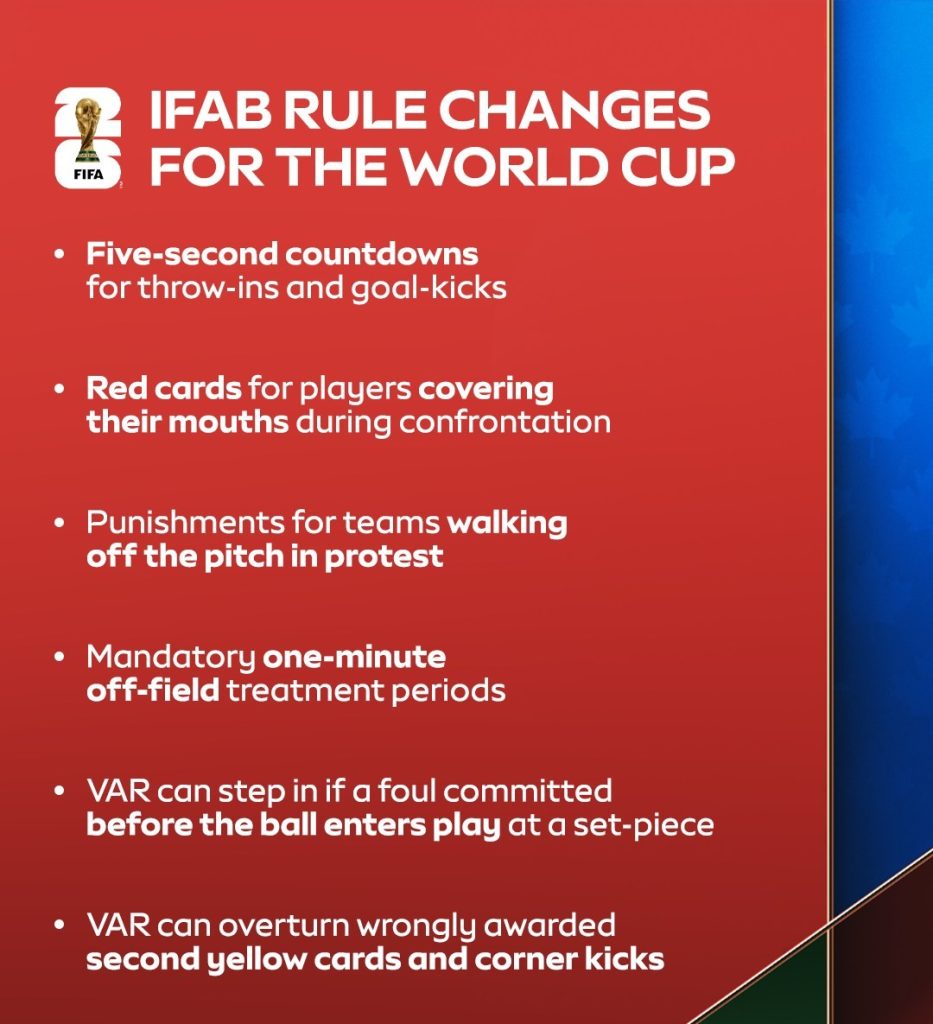
| 5-Second Restarts | Throw-ins & goal kicks must be taken within 5 seconds |
| 10-Second Substitutions | Subbed players must leave the pitch within 10 seconds |
| Hydration Breaks | Mandatory 3-minute break in each half |
| Expanded VAR | Reviews second yellows, mistaken identity & corners |
| Captain-Only Protocol | Only the captain may approach the referee |
| Medical Treatment Rule | Treated players must stay off for one minute |
| Mouth-Covering Red Card | Red card for covering mouth during confrontations |
1. The Goalkeeper 8-Second Rule
Perhaps the most talked-about change targets time-wasting goalkeepers. If a goalkeeper holds the ball for more than 8 seconds, the other team will now get a corner kick instead of an indirect free kick. Under this regulation, a goalkeeper who controls the ball with his hands must release it within eight seconds, with referees visibly counting down the final seconds.
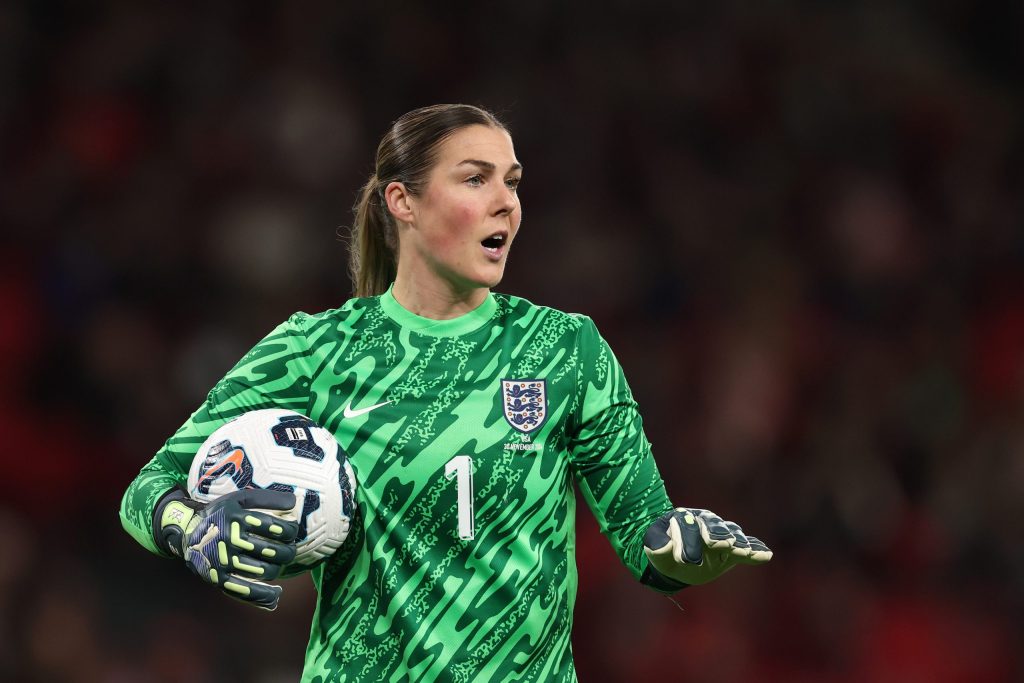
This replaces the old, rarely-enforced rule. Until now a keeper could hold the ball for six seconds, a rule that was almost never enforced. The referee will signal a five-second countdown to the goalkeeper, and the ball must be played before that expires.
2. Five-Second Countdowns on Restarts
Stalling on throw-ins and goal kicks is also being clamped down on. Referees will show a clear 5-second countdown. If a throw-in takes too long, the other team gets the ball. If a goal kick goes over the limit, the other team gets a corner kick.
The scale of this change is significant. The average football match has around 30 goal kicks and throw-ins, which means 30 opportunities to lose possession from a dead ball.
3. The 10-Second Substitution Rule
The slow walk off the pitch during substitutions is officially over. A substituted player must leave the field of play within 10 seconds to prevent time-wasting and disruption to the match, IFAB said. If the player takes longer, the new player can’t take the field until the first stoppage after one minute has elapsed following the restart.
This rule has already had a real impact in warm-up matches. If that deadline is missed, the player replacing them will be held back off the pitch for a period of one minute. Iceland fell foul of this rule against Japan, who managed to score the only goal of their friendly while that minute’s delay took place.
4. Mandatory Hydration Breaks
In a nod to the North American summer heat — and the sporting culture of the host nations — every match will now feature scheduled breaks. FIFA have confirmed that every match at the 2026 World Cup, regardless of the weather conditions, will include a three-minute interval midway through each half—dubbed “hydration breaks”—thereby effectively splitting each contest into four quarters.
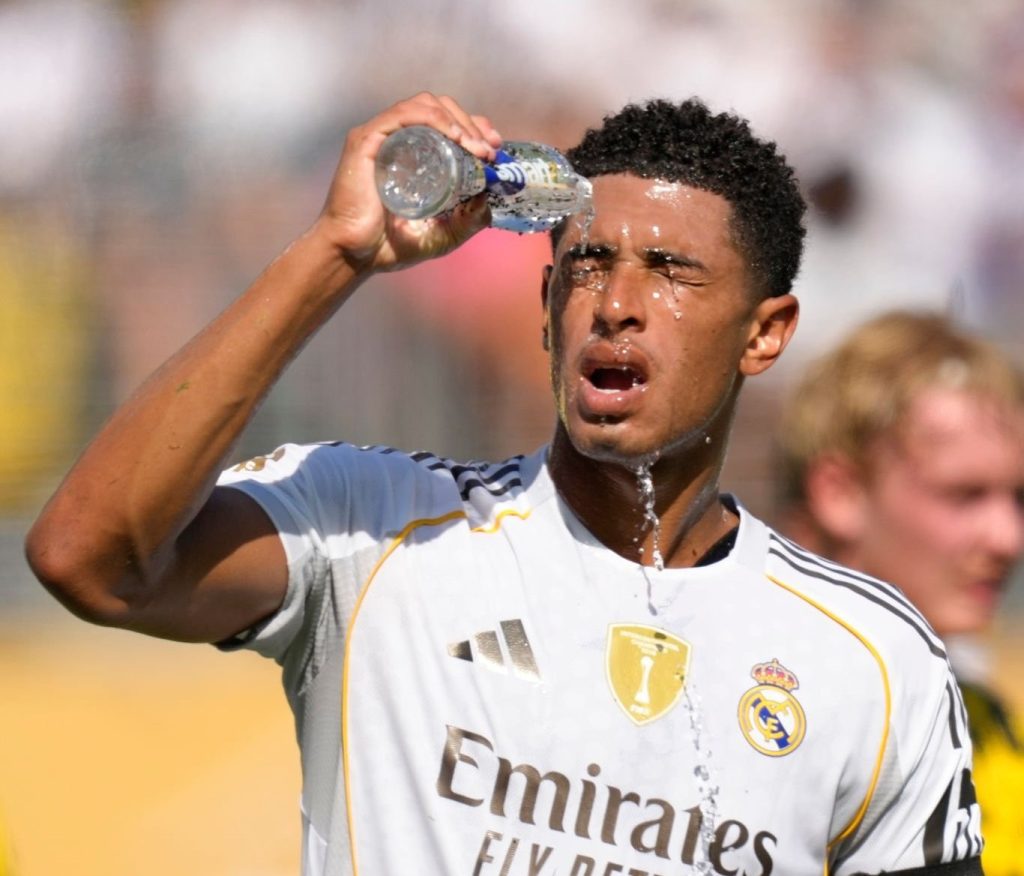
“For every game, no matter where the games are played, no matter if there’s a roof, [or] temperature-wise, there will be a three-minute hydration break. It will be three minutes from whistle to whistle in both halves,” said 2026 World Cup chief tournament officer Manolo Zubiria. Notably, The Athletic reported coaches will be able to discuss game strategies on their laptops during that break in action, and that is a big change for soccer.
5. Expanded VAR Powers
Video review is getting a wider remit than ever before. IFAB approved three new situations where VAR can jump in: clearly incorrect second yellow cards for players; mistaken identity on yellow and red cards; and incorrectly awarded corner kicks, but not for reversing goal kicks that should have been ruled a corner kick.
The corner-kick provision comes with a caveat. The lawmakers stress that it must not hold up play and is only for obvious mistakes, and that the corner itself should not be delayed. FIFA is also upgrading offside technology — the referee’s assistant will receive an audio alert during World Cup matches if a player is more than 10 centimeters offside. The assistant will then raise his or her flag.
6. The Captain-Only Protocol
To restore respect for officials, FIFA is enforcing a clear boundary around the referee. In a dispute over a decision, only the team captain may approach him. A four-meter respect zone applies around the official, and any other outfield player who steps into it to protest gets an automatic yellow card.
7. Medical Treatment & Tactical Timeout Ban
Two related changes address the abuse of injury stoppages. With the obvious exceptions – goalkeepers, players about to take a penalty, players with head injuries or concussions – there is now an increased mandatory period of one minute on the sidelines for players who receive treatment on the pitch.
Additionally, the so-called tactical timeout has been outlawed. IFAB has also banned what have come to be known as tactical timeouts, in which a goalkeeper receives treatment on an injury while the rest of the players head to the bench for a consultation with their managers. Goalkeepers can still receive treatment and hold up a match while they do, but referees will have the power to ban players from heading to the sidelines for tactical discussions while the game is paused.
As FIFA’s head of refereeing Pierluigi Collina put it: “We will not allow the teams going to the benches when a goalkeeper is lying on the ground injured.“
8. Red Card for Covering the Mouth
A new disciplinary rule targets discriminatory conduct. Players will receive a red card if they cover their mouths while addressing an opponent during an altercation — regardless of what is actually said. However, this is narrowly applied — crucially, this rule will only apply to moments of aggression. Players regularly cover their mouths when in conversation with teammates or friends on the pitch, and these moments will not be punished.

Bonus: Yellow Card Reset
There’s also good news for players carrying bookings. Single yellow card accumulation will reset after the group stage and again after the quarterfinal — meaning less suspensions.
Why These Changes Matter
The overarching goal is a faster, cleaner game. The biggest changes include modifications to the time limits for substitutions, enforcement of the countdown on throw-ins and goal kicks, medical treatment moving players off the pitch, and expanded VAR protocols. So, the World Cup is not only introducing a new format, but also a set of rule changes designed to make matches faster, cleaner, and more consistent.
As Collina summed up FIFA’s mission: “We are trying to clean the game as much as possible.”
Read More: FIFA World Cup 2026: Top Eight Young Players Who Could Break Out