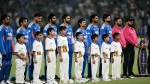
Women’s Asia Cup Rising Stars 2026: Sony Pictures Networks India (SPNI) has secured exclusive broadcasting rights for the Women’s Asia Cup Rising Stars 2026, offering unprecedented multi-language coverage of the February 13-22 tournament that showcases Asia’s most promising women’s cricket talent. The historic broadcast, available in English, Hindi, Tamil, and Telugu, marks a significant moment for women’s cricket visibility in India.
Table of Contents
Women’s Asia Cup Rising Stars 2026 Tournament Overview: The Rising Stars Platform
The Women’s Asia Cup Rising Stars represents cricket’s farm system—a proving ground where tomorrow’s international stars demonstrate they’re ready for the big stage today.
| Detail | Information |
|---|---|
| Tournament Dates | February 13-22, 2026 |
| Broadcast Platforms | Sony Sports Network, Sony LIV |
| Language Feeds | English, Hindi, Tamil, Telugu |
| Multi-Language Matches | Feb 13, 15, 17, semi-finals, final |
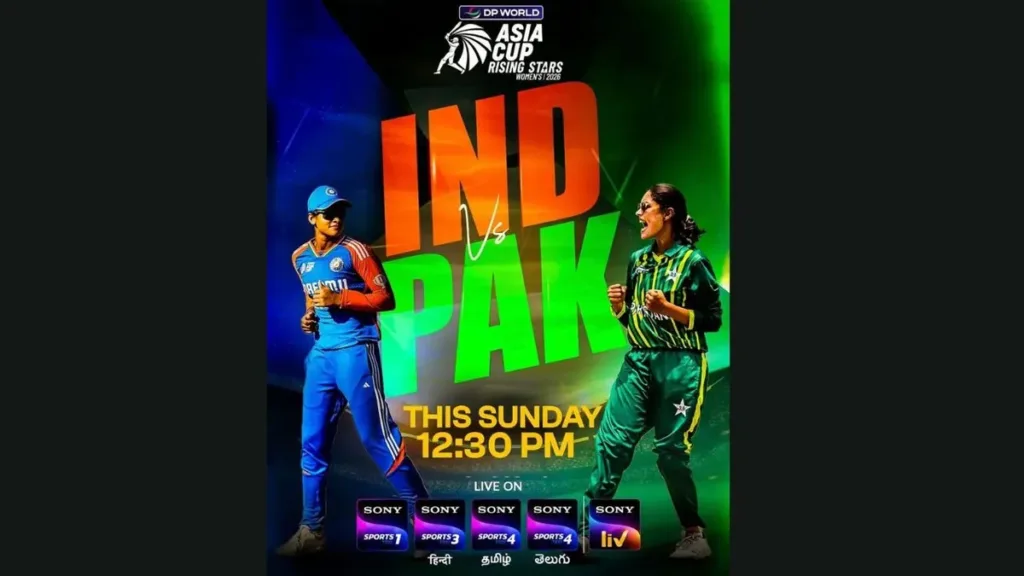
| Key Match | India vs Pakistan (February 15) |
| Participating Teams | India A, Pakistan, Sri Lanka A, Bangladesh A, UAE, Thailand, Nepal |
The four-language broadcast represents a conscious effort to make women’s cricket accessible across India’s linguistic diversity—particularly significant for expanding the sport’s fanbase in Tamil Nadu and Telangana, where women’s cricket has seen explosive grassroots growth.

The India Squad: Youth Meeting Experience
India A’s roster blends promising debutants with seasoned domestic performers, creating an intriguing mix of raw talent and tactical awareness.
Leadership: Radha Yadav
Captain Radha Yadav brings invaluable leadership credentials from her Women’s Premier League (WPL) performances. The left-arm spinner’s experience in high-pressure T20 situations makes her ideal to guide a young squad navigating international tournament intensity.
Yadav’s all-round skills—she’s equally comfortable contributing crucial lower-order runs as dismantling batting lineups with her variations—provide tactical flexibility. Her ability to read match situations and adjust field placements mid-over has earned praise from coaches and commentators alike.
The Debutant to Watch: Anushka Sharma
Anushka Sharma headlines the tournament’s debut class. The batting all-rounder earned her maiden national call-up through consistently dominant domestic cricket performances and impressive WPL outings that showcased both technical soundness and aggressive intent.
Sharma’s selection reflects selectors’ confidence in her temperament for international cricket. Her ability to anchor innings while maintaining scoring rates makes her a modern T20 asset—exactly the skill profile India seeks as it builds depth across formats.
The All-Rounder Brigade
Humairaa Kaazi strengthens the middle order with her experienced domestic pedigree. A seasoned campaigner who’s seen everything Indian domestic cricket can throw at players, Kaazi provides balance through both batting reliability and handy bowling contributions.
Her sharp match awareness—knowing when to attack, when to consolidate, when to rotate strike—comes from years navigating pressure situations in domestic tournaments where individual brilliance often determines outcomes.
Minnu Mani represents the modern all-rounder archetype—equally dangerous with bat and ball in T20 cricket. Her rise through domestic ranks demonstrates the impact dedicated T20 specialists can have when given platforms to develop format-specific skills rather than being forced into multi-format molds prematurely.
The Consistent Accumulator: Vrinda Dinesh
Vrinda Dinesh brings precisely what every successful batting lineup needs: reliability. In an era celebrating six-hitting and strike rates, Dinesh’s value lies in her ability to consistently reach double figures, rotate strike, and provide the stability that allows aggressive teammates to play their natural games.
Her domestic league performances showcase the technique and temperament required for consistent run-scoring—qualities that translate directly to international cricket’s unforgiving standards.
The India-Pakistan Showdown: February 15
All eyes turn to February 15 for the marquee India-Pakistan clash—a fixture that transcends cricket to become cultural event, political proxy, and national obsession simultaneously.
While this tournament features A-teams and development squads rather than full national teams, the rivalry’s intensity remains unchanged. For young players, performing in India-Pakistan matches can accelerate careers or haunt reputations for years.
Sony Sports Network’s multi-language broadcast ensures maximum accessibility for this tentpole match, recognizing that casual cricket fans who might skip other tournament matches will tune in specifically for the India-Pakistan encounter.
Regional Competition: Beyond India and Pakistan
The tournament’s competitive depth extends across participating nations:
Sri Lanka A (Captain: Anushka Sanjeewani) arrives with technical sophistication developed through domestic structures increasingly focused on women’s cricket development. Sri Lankan cricket’s emphasis on spin bowling typically translates well to subcontinental conditions.
Bangladesh A (Captain: Fahima Khatun) brings the hunger of a rapidly improving cricket nation. Bangladesh women’s cricket has progressed dramatically over the past decade, with domestic investment yielding international competitiveness that no longer surprises observers.
UAE (Captain: Esha Oza) represents cricket’s geographic expansion. The UAE’s investment in women’s cricket infrastructure, driven by both genuine development goals and hosting ambitions for major tournaments, has created genuine competitive depth.
Thailand (Natthakan Chantham) and Nepal (Rubina Chettri) showcase cricket’s Asian expansion beyond traditional powerhouses. These nations’ presence in regional tournaments normalizes women’s cricket in markets where the sport fights for attention against established sports.
The Broadcasting Significance
Sony’s four-language approach acknowledges that India’s cricket audience isn’t monolithic. While Hindi and English reach massive audiences, Tamil and Telugu feeds recognize southern India’s passionate cricket fanbases who prefer consuming content in regional languages.
Why Multi-Language Matters:
Tamil Nadu’s women’s cricket explosion—evidenced by the state producing disproportionate national team representatives—creates demand for Tamil-language coverage that contextualizes performances within state cricket culture.
Telangana’s cricket infrastructure investments, including dedicated women’s cricket academies and domestic tournament expansion, have built audiences seeking Telugu-language commentary that celebrates local players and contextual storylines.
The language diversity also signals to sponsors and stakeholders that women’s cricket broadcasts can achieve the audience scale justifying premium advertising rates—a critical step toward sustainable economic models supporting the sport’s growth.
The Bigger Picture: Women’s Cricket’s Visibility Crisis
Despite India’s women’s team achieving remarkable international success—T20 World Cup finals appearances, consistent top-tier rankings, record-breaking viewership for major matches—domestic and age-group cricket still struggles for broadcast visibility.
This tournament’s comprehensive coverage represents progress toward normalizing women’s cricket as broadcast content worthy of the same production values, promotional budgets, and multi-language accessibility afforded to men’s cricket.
Commercial Reality Check:
Women’s cricket broadcasts still generate lower advertising revenues than men’s equivalents, creating economic disincentives for broadcasters to invest in comprehensive coverage. Sony’s multi-language commitment despite these economics suggests strategic long-term thinking—building audiences now to capture future commercial upside as women’s cricket’s economic model matures.
What Viewers Should Watch For
Beyond tournament outcomes, several narratives deserve attention:
Talent Identification: Selectors use tournaments like this to evaluate players under international-intensity pressure before potential senior team call-ups. Breakout performances can accelerate careers dramatically.
Tactical Evolution: How do young teams approach T20 cricket’s strategic puzzles? Do they replicate senior team approaches or experiment with tactics reflecting their unique skill sets?
Regional Cricket Strength: Do traditional powerhouses dominate, or do emerging nations demonstrate genuine competitive depth suggesting the sport’s geographic expansion is substantive rather than superficial?
Format-Specific Development: Are players demonstrating T20-specific skills (death bowling variations, innovative shot-making, sharp fielding) or merely translating longer-format approaches to shorter contests?
The Path Forward
The Women’s Asia Cup Rising Stars serves purposes beyond determining a tournament champion. It provides international experience to players who might otherwise wait years for senior team opportunities. It showcases cricket’s regional strength to commercial stakeholders evaluating investment decisions. It normalizes women’s cricket as broadcast content deserving comprehensive coverage rather than niche curiosity.
For Indian viewers, the tournament offers glimpses of potential future stars before they achieve household-name status. The players performing in this tournament could become the core of India’s 2030 women’s cricket teams competing for World Cups and Olympic medals.
Sony’s commitment to four-language broadcasts, comprehensive coverage, and prominent promotion signals confidence that audiences exist for women’s cricket content when barriers to access—language, availability, visibility—are removed.
Follow comprehensive women’s cricket coverage and tournament analysis at TechnoSports.co.in.