Thales, a global technology leader in defense, aerospace, and digital security, has announced the launch of HexaForce, its next-generation multi-domain command and control (C2) system. The system incorporates artificial intelligence (AI) to address the increasing volume of operational data and the accelerating pace of modern conflicts, primarily targeting NATO and allied nations.
HexaForce is designed to enhance national sovereignty by providing a rapid response framework. Its architecture is built on open, interoperable standards and underwent testing during the NATO CWIX 2026 exercise.
Table of Contents
Thales System Capabilities and AI Integration
The HexaForce system is engineered for high-intensity warfare, supporting command requirements for operations involving over 100,000 personnel. It operates across various domains, including land, sea, air, cyber, space, and information operations.
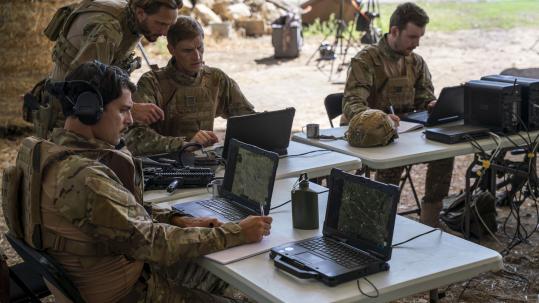
Thales integrates its dedicated AI accelerator, cortAIx, into HexaForce. This technology leverages Large Language Models (LLMs) and agentic AI to optimize several operational phases:
* Shortening planning cycles.
* Improving operational picture awareness.
* Facilitating real-time sharing and consolidation of tactical and operational situational pictures.
* Accelerating decision-making processes.
* Enhancing effector allocation.
* Optimizing in-the-field maintenance and support.
The integration of AI is projected to significantly increase data processing and operational intelligence capabilities. Thales states the system aims to automate the analysis, correlation, and prioritization of data streams from military, open-source, and civilian origins. Live trials are underway, with a goal to increase daily target processing capacity from 100 to 1,000. These capabilities are informed by operational feedback from Artemis.IA, a data-centric platform deployed with the French Ministry of Armed Forces since 2023.
Interoperability and Strategic Vision
Christophe Salomon, Executive Vice-President, Secure Communications and Information Systems at Thales (https://www.thalesgroup.com/), emphasized the system’s adaptability. “Some armed forces require a dedicated data platform, while others need operational cross-domain interfaces to link up with allies and complete their systems, or faster multi-domain command functions leveraging artificial intelligence,” Salomon stated. “With HexaForce, Thales provides a sovereign solution tailored to each of these operational needs, setting a new benchmark in multi-domain C2 for NATO and allied nations amidst rising high-intensity conflicts.”
HexaForce is positioned to orchestrate assets across armed forces and coalition partners, from strategic commanders to tactical units. It incorporates a distributed data network designed for resilience even under degraded communication conditions. The system supports Data-Centric Security (DCS) and Federated Mission Networking (FMN) standards. Its open architecture allows nations to integrate their chosen technology partners within a modular environment, enabling connectivity with legacy systems from third-party vendors while maintaining sovereign control over data.
Development of HexaForce involved co-creation with frontline forces, employing agile methodologies and short feedback loops to integrate end-user requirements throughout the process. This approach is consistent with broader trends in defense technology, where continuous iteration and user involvement are becoming critical for rapid deployment and adaptation. For more information on industry development (https://technosports.co.in/), visit our dedicated sections.