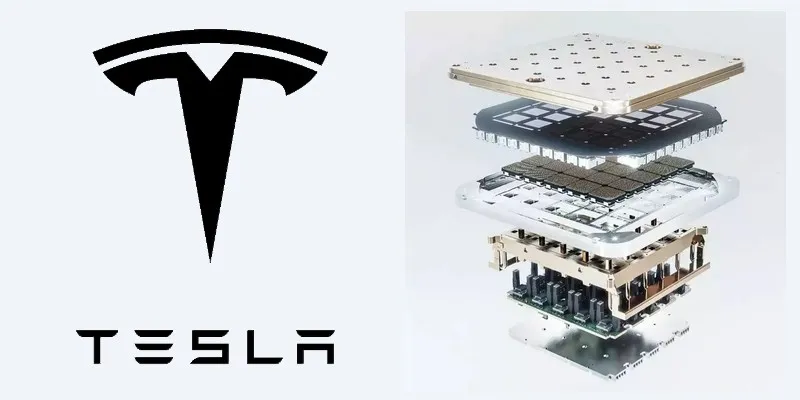
Tesla just detailed what keeps your car from crashing when its computer fails: full fail-over redundancy. The AI4 chip powering both Full Self-Driving and Optimus robots runs two 20-core computers in parallel, constantly cross-checking each other.
If one glitches, the other takes over instantly. No warnings. No safe mode. Just seamless control transfer. And now, references to a three-chip AI4.5 variant are appearing in new builds — a mysterious upgrade nobody saw coming.
Table of Contents
Built for Redundancy, Not Records
Tesla’s AI4 isn’t chasing benchmark records. It’s prioritizing reliability over raw power using Samsung’s mature 7nm process instead of bleeding-edge nodes. Here’s what’s inside:
| Component | Specification |
|---|---|
| Architecture | Dual-SoC (System-on-Chip) with full redundancy |
| CPU Cores | 20x ARM Cortex-A72 per chip (40 total) |
| Clock Speed | Up to 2.35 GHz |
| RAM | 16GB GDDR6 (8GB per chip) |
| Storage | 256GB total |
| Memory Bandwidth | 384 GB/s (192 GB/s per chip) |
| Manufacturing | Samsung 7nm process |
| Compute Power | 100-150 TOPS (INT8) combined |
| Performance vs HW3 | 3–5x faster overall |
| Camera Resolution | ~4.4x front camera improvement |
The killer feature? GDDR6 memory — the same high-bandwidth RAM used in gaming GPUs. Tesla switched from LPDDR4 (68 GB/s in HW3) to GDDR6 (384 GB/s in AI4), solving the memory bottleneck that constrained earlier FSD versions.
How Fail-Over Redundancy Actually Works
Tesla’s dual-computer setup isn’t new — HW3 had it too. But AI4 brings it back with serious upgrades. Here’s the operational flow:
Normal Operation: Both computers process the same sensor data simultaneously, running identical FSD software and cross-verifying results in real-time.
Fault Detection: If Computer A produces an error or calculation mismatch, Computer B flags it instantly.
Seamless Takeover: Computer B assumes full control without driver intervention, alerts, or safety mode activation.
Powers Two Products: The same AI4 hardware runs in both Tesla vehicles and Optimus humanoid robots, enabling unified AI development across automotive and robotics.
For a system where computational failure could mean death, this isn’t overkill — it’s the bare minimum for SAE Level 4+ autonomy.
AI4.5: The Three-Chip Mystery
In January 2026, Tesla’s Electronic Parts Catalog quietly listed “Hardware 4.5” with a part number (2261336-S2-A) priced at $2,300. Tesla initially claimed it was a labeling error, but firmware researcher “Green” found code references to a three-SoC configuration — meaning three AI4 chips instead of two.
Why would Tesla add a third chip?
Triple Modular Redundancy (TMR): With three chips, the system can “vote” when one disagrees. If one chip hallucinates an obstacle but two see clear road, the car continues driving smoothly instead of forcing disengagement.
Shadow Mode Experimentation: Two chips run production FSD with redundancy; the third runs experimental next-gen software in background, validating updates without safety risk.
Raw Throughput: Larger FSD v14+ neural networks demand more memory and compute. Three chips distribute the inference load, running bigger models that two chips can’t handle.
Whether AI4.5 is real or a bridge to AI5, the three-chip architecture addresses current limitations without waiting for the next-generation silicon.
AI4 vs. NVIDIA Drive Thor: The Reality Check
Tesla’s biggest competitor isn’t another automaker — it’s NVIDIA’s Drive Thor platform. Here’s the brutal comparison:
| Metric | Tesla AI4 | NVIDIA Drive Thor |
|---|---|---|
| Process | Samsung 7nm | TSMC 4N (5nm-class) |
| Compute | 100-150 TOPS (INT8) | 2,000 TFLOPS (FP4) |
| CPU | 20x ARM Cortex-A72 | ARM Neoverse (server-grade) |
| Memory | GDDR6, 384 GB/s | LPDDR5X, higher bandwidth |
| Strategy | Redundancy-first, cost-effective | Performance-first, expensive |
On paper, Thor obliterates AI4. But Tesla made a specific engineering trade: prioritize memory bandwidth and reliability over theoretical compute. The bet is that FSD’s bottleneck isn’t raw TFLOPS — it’s memory bandwidth and fault tolerance.
What’s Next: AI5 and the 9-Month Design Cycle
AI4 is already a stepping stone. Tesla’s AI5 chip enters limited production late 2026, with volume production in 2027. Elon Musk claims AI5 will offer a 3-5x performance leap over AI4 and power the upcoming Cybercab and advanced Optimus robots.
Beyond that, Musk outlined an aggressive 9-month chip design cycle, aiming to iterate AI6, AI7, and beyond faster than any semiconductor company in history. For context, traditional chip development takes 2-3 years. Tesla wants to cut that to months.
Whether that’s realistic or Musk-level optimism remains to be seen. But the AI4 → AI4.5 → AI5 progression in under two years suggests Tesla’s silicon team is moving faster than anyone expected.
The verdict: AI4’s dual-brain architecture isn’t the most powerful self-driving chip. But it might be the most reliable — and in autonomy, that’s what matters most.
Follow Tesla FSD updates, autonomous driving tech, and AI chip developments at Technosports.