Most smartwatch upgrades are a story about numbers going up. The Apple Watch Series 12, announced on September 9, 2026, is a story about a sensor array being rebuilt from the ground up — and about a single new metric that may quietly change how millions of people plan their day.
Apple calls it the Health Sensing System. In practice, it means the watch on your wrist is now reading your body roughly 17,000 times a day instead of occasionally checking in. And every morning, it hands you one number between 0 and 10 that answers a question no fitness tracker has ever answered well: should you actually push hard today, or should you not?
Table of Contents

Apple Watch Series 12: Price in India
| Variant | Size | Price (India) |
|---|---|---|
| Aluminium (GPS) | 42mm | ₹56,900 |
| Aluminium (GPS) | 46mm | ₹62,900 |
| Aluminium (Cellular) | 42mm | ₹68,900 |
| Aluminium (Cellular) | 46mm | ₹74,900 |
| Titanium | 42mm / 46mm | From ₹99,900 |
| Ceramic with Titanium Milanese Loop | — | ₹1,24,900 |
- US pricing: From $399
- Pre-orders: Live now in India and 50+ countries
- In stores: Friday, September 18, 2026
- Software: Ships with watchOS 27
The Headline: A Completely Rebuilt Health Sensing System
This is the real story of Series 12, and it is worth understanding properly.
Apple has replaced both the optical and electrical heart sensors. The new optical array uses larger, power-efficient green LEDs, which is the enabling change behind everything else — bigger LEDs capture a cleaner signal at lower power cost, so the watch can afford to measure far more often.
The result:
- Heart rate is measured every five seconds, continuously, through the day
- Heart Rate Variability is captured up to 24 times more frequently than the previous generation
That HRV number is the important one. HRV is the most reliable consumer-accessible signal of nervous-system stress and recovery, and it has historically been the noisiest thing a smartwatch tries to measure — because most watches sample it only a handful of times overnight. Sampling it 24 times more often is the difference between a rough guess and an actual trend line.
The Readiness Score
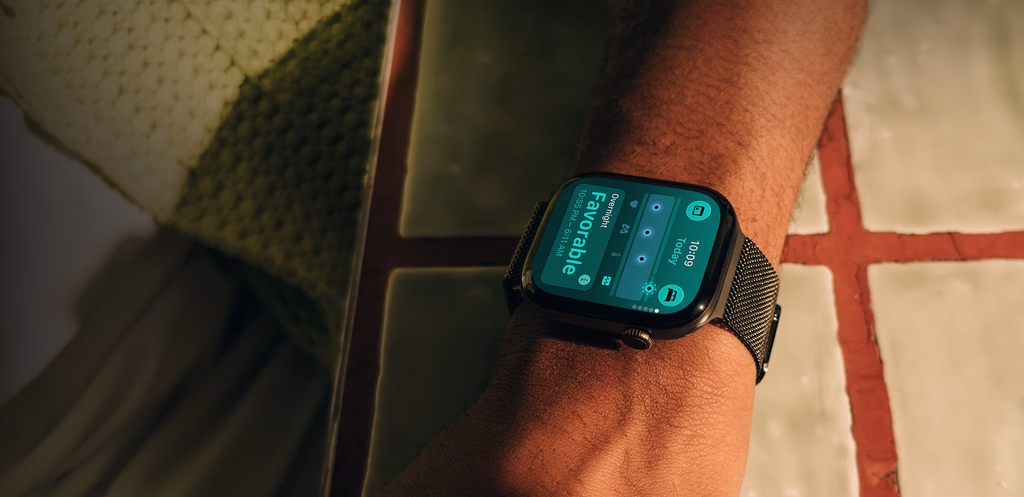
All of that data feeds into a single daily Readiness Score from 0 to 10, combining overnight vitals, daytime vitals, sleep, and recent training load.
For anyone training seriously — or simply trying to figure out why Tuesday felt impossible — this is the most immediately useful thing Apple has added to the Watch in years. It converts a dashboard full of charts you never open into one number you check while brushing your teeth.
What Else Is New
S11 Chip
Series 12 runs on the S11, which Apple calls its most powerful wearable chip. It is the silicon doing the heavy lifting for continuous health processing and the new on-device audio features — this generation’s performance gains are aimed at sensors and intelligence rather than app speed.
Ceramic Shield 2
Aluminium models now use Ceramic Shield 2, which Apple says is 60% tougher than the Ion-X glass it replaces. For a device that spends its life colliding with doorframes, gym equipment, and metro handrails, durability is not a spec-sheet nicety.
Audio Intelligence
A new suite of on-device audio features arrives with watchOS 27:
- Sound Recognition — alerts for important environmental sounds
- Live Rewind — catch what you just missed
- Siri Recap — a spoken summary of what matters right now
Step Tracking
Apple is claiming the most accurate step tracking of any smartwatch, a pointed claim in a category where step counts have been comfortably approximate for a decade.
Battery: The Underrated Upgrade
| Scenario | Series 12 | Change |
|---|---|---|
| Everyday use | Up to 24 hours | — |
| Outdoor workouts | Up to 10 hours | +25% |
| 15-minute fast charge | Up to 12 hours | 50% faster |
That fast-charging figure deserves attention. Fifteen minutes in the charger while you shower gets you through a full day and night — which is precisely what makes overnight sleep tracking practical rather than aspirational. The 25% gain in outdoor workout endurance also matters for anyone running a half marathon with GPS and music running simultaneously.
Finishes and Materials
Aluminium: Dark bronze, black, light gold, space grey
Titanium: Radiant gold (new), natural titanium
Ceramic: Pearl white, night blue (new)
The ceramic models are the notable return — a premium, non-metallic finish sitting above titanium in the lineup, paired at the top end with a titanium Milanese Loop.
Should You Upgrade?
Yes, if you own Series 9 or earlier. You gain the entirely new sensor system, Readiness, Ceramic Shield 2, dramatically better charging, and the S11. This is a generational jump, not an iteration.
Probably, if health tracking is your primary use case. The HRV sampling improvement is genuinely hard to replicate on older hardware — it is a sensor change, not a software one, so it will never arrive via update.
Not urgently, if you own Series 11 and use your watch mainly for notifications, calls and casual activity rings. The upgrades are real but concentrated in health sensing.
Look at Ultra 4 instead if you need multi-day battery, deeper dive or expedition features, and the larger, brighter display.
The Bigger Picture
Apple has spent a decade turning the Watch from an iPhone accessory into a medical-adjacent device, and Apple Watch Series 12 is the clearest statement of that direction yet. Nothing in this launch is about apps, or notifications, or the screen. Everything is about measuring the body more often, more accurately, and then reducing all of it to advice a person will actually act on.
At ₹56,900, it is not an impulse purchase. But it is the first Apple Watch where the health argument, rather than the convenience argument, is the reason to buy.
Pre-orders are open. Shipping starts September 18.
Read more on TechnoSports: