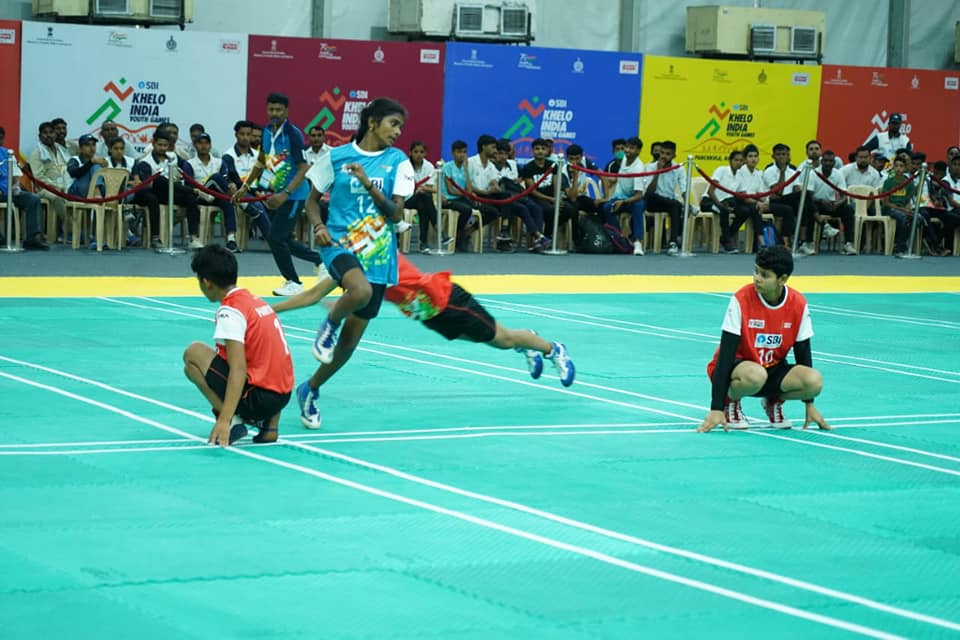
Fourteen-year-old Navya traveled over 2,700 km from Jammu & Kashmir to Bengaluru for the 44th Junior National Kho Kho Championship. Her mother, a housemaid earning ₹5,000 monthly, tells her never to give up playing while her father battles mental health issues. Navya’s story represents countless grassroots athletes transforming hardship into hope through sport.
Table of Contents

From Border Villages to National Championships
Hailing from Haripur village in R.S. Pura area near the international border, Navya dreams of becoming an ace sportsperson representing India globally. “My mother works as a cook in houses. There are considerable expenses on medicines for my father. She tells me to continue Kho Kho and studies. I want to be like Nazia Bibi,” said Navya, referring to Jammu & Kashmir’s first Kho Kho World Cup representative.
| Athlete Profiles | Background |
|---|---|
| Navya (14) | Mother: housemaid (₹5,000/month), J&K |
| Kamal (15) | Mother: coffee shop worker, lost father 3 years ago |
| Rachna Singh (12) | Father: bus operator counter staff, Jaipur |
| Dev Raj Mali (18) | Father: marginal farmer (sends ₹1,500/month), Rajasthan |
| M. Stephen (16) | Mother: daily-wage laborer (₹6,000/month), Puducherry |
| V. Mangaiyarkarasi (16) | Father: paddy field laborer, Puducherry |
| Championship | 44th Junior Nationals, Dec 31-Jan 4, Bengaluru |
| Career Opportunities | 3,500+ athletes employed via sports quota |
Kamal, 15, from Tali Morh, Jammu, is making his national debut. He lost his father three years ago, leaving his mother Praveen Kumari, a coffee shop worker, as sole breadwinner. “I want to secure a government job through sports quota to support my mother. I also want to stay away from drug abuse,” said Kamal.
Dreams Spanning India’s Geographic Diversity
Over 800 km from Jammu is Jaipur, home to 12-year-old Rachna Singh competing for the first time. Her father Ranveer Singh works at a bus operator’s office counter with unsteady income. “Sometimes we have money, sometimes we don’t. I’ve been playing four years and want to represent India at the next World Cup,” Rachna said confidently.
According to Kho Kho Federation of India, over 3,500 Kho Kho players across India have benefitted from employment opportunities under sports quota schemes in Railways, Income Tax, Banks, Postal Services, paramilitary forces, and state governments.
Eighteen-year-old Dev Raj Mali from Kekri, Rajasthan, is the son of marginal farmer Amba Lal Mali, who struggles to send ₹1,500 monthly for room rent in Ajmer where Dev practices on DAV College ground. “I want to play in senior nationals and end my family’s hardships,” Dev Raj stated.
Coastal Region Athletes Balance Studies and Sport
More than 2,100 km from Rajasthan’s Thar Desert lies Puducherry’s coastal region, home to 16-year-old M. Stephen. His father died over a decade ago; his mother, a daily-wage laborer earning about ₹6,000 monthly, supports three family members. This is Stephen’s third Junior Nationals; he aims for international representation.
For more on grassroots sports development, Sudhanshu Mittal, KKFI President, emphasized that Kho Kho is now a modern sport offering opportunities and recognition. “Youth are inclined towards making a career in it. Their dreams are our dreams, and it’s our obligation to ensure every athlete receives best-in-class training, support, and handholding to realize dreams,” Mittal said.
The championship features teams from states and UTs nationwide, concluding January 4 in Bengaluru.
FAQs
How many Kho Kho players have secured government jobs through sports quota?
Over 3,500 players have secured employment in Railways, Banks, Postal Services, and paramilitary forces.
What inspired Navya from J&K to pursue Kho Kho professionally?
Nazia Bibi, J&K’s first Kho Kho World Cup representative, inspired her despite family financial struggles.