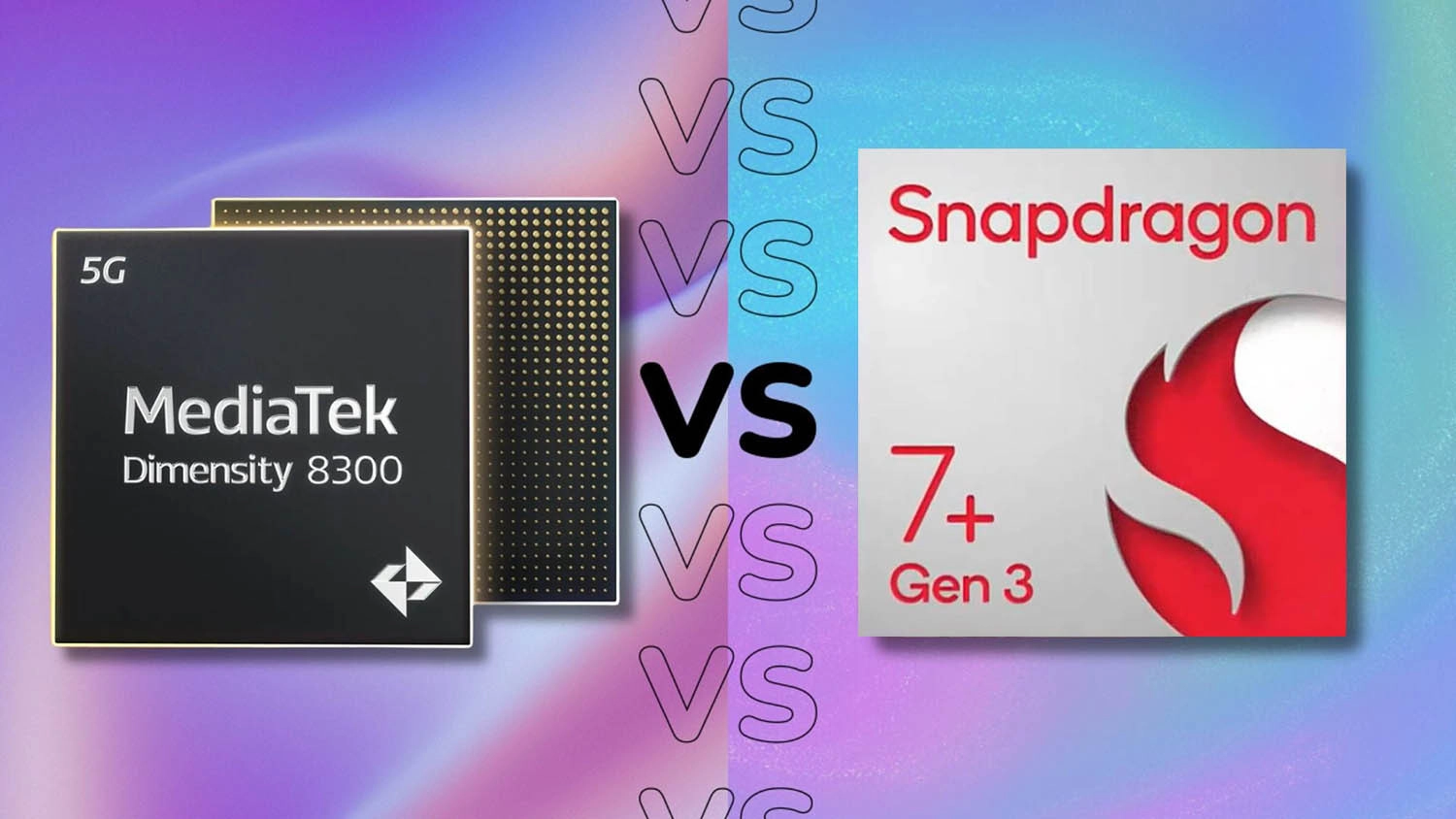
Snapdragon 7+ Gen 3 vs. Dimensity 8300: Mid-Range Chipset Battle—Specs, Performance & AI Compared
In 2026, Qualcomm’s Snapdragon 7+ Gen 3 and MediaTek’s Dimensity 8300 redefine mid-range smartphone power. This detailed comparison dives into CPU and GPU performance, AI capabilities, and real-world benchmarks like AnTuTu and Geekbench.
With the Snapdragon offering better thermal efficiency and gaming stability, and the Dimensity 8300 delivering superior multi-core and GPU performance, discover which chip delivers the smarter, faster mobile experience.
Table of Contents
Qualcomm Snapdragon 7+ Gen 3 vs. MediaTek Dimensity 8300
Snapdragon 7+ Gen 3 vs Dimensity 8300
Comprehensive comparison of two powerful mid-range processors, featuring detailed specifications, benchmark scores, and performance analysis
Snapdragon 7+ Gen 3
Qualcomm’s efficient mid-range powerhouse
Dimensity 8300
MediaTek’s flagship mid-range solution
Benchmark Scores Comparison
AnTuTu v10
Geekbench 6 (Single-Core)
Geekbench 6 (Multi-Core)
3DMark GPU
Detailed Specifications
| Feature | Snapdragon 7+ Gen 3 | Dimensity 8300 |
|---|---|---|
| CPU Configuration | 1x Cortex-X4 (2.8GHz) 4x Cortex-A720 (2.8GHz) 3x Cortex-A520 (2.0GHz) | 1x Cortex-X4 (3.35GHz) 3x Cortex-A720 (3.2GHz) 4x Cortex-A520 (2.2GHz) |
| GPU | Adreno 732 | Mali-G615 MP6 |
| Memory Support | LPDDR5X up to 4200MHz | LPDDR5X up to 5500MHz |
| Storage | UFS 4.0 | UFS 4.0 |
| Display Support | QHD+ @ 144Hz 4K @ 60Hz | WQHD+ @ 120Hz FHD+ @ 120Hz |
| Camera Support | 200MP single 64MP dual | 320MP single 32MP dual |
| Connectivity | 5G Sub-6GHz + mmWave Wi-Fi 6E Bluetooth 5.4 | 5G Sub-6GHz Wi-Fi 6E Bluetooth 5.4 |
| AI Engine | Hexagon NPU | APU 780 |
Snapdragon 7+ Gen 3
Pros:
- Superior power efficiency and thermal management
- Excellent gaming performance with stable frame rates
- Better display support (4K @ 60Hz)
- Enhanced connectivity with mmWave 5G
- Optimized for Android ecosystem
Cons:
- Lower peak CPU performance
- Less powerful GPU compared to Dimensity 8300
- Lower memory bandwidth
Dimensity 8300
Pros:
- Higher peak CPU performance (3.35GHz)
- Better multi-core performance
- Superior GPU performance
- Faster memory support (LPDDR5X-5500)
- Higher camera resolution support (320MP)
Cons:
- Higher power consumption and heat generation
- Less stable performance under sustained loads
- Limited display resolution support
- No mmWave 5G support
Final Verdict
Both chipsets excel in different areas. The Snapdragon 7+ Gen 3 offers superior power efficiency, better thermal management, and more stable gaming performance, making it ideal for users who prioritize battery life and consistent performance. The Dimensity 8300 delivers higher peak performance, better multi-core capabilities, and superior GPU performance, making it perfect for users who need maximum processing power and don’t mind slightly higher power consumption.
Snapdragon 7+ Gen 3 vs. Dimensity 8300: The Mid-Range Chipset Battle of 2026
As we head into 2026, the competition in the mid-range smartphone market is fiercer than ever. Two chipsets vying for dominance are the Qualcomm Snapdragon 7+ Gen 3 and the MediaTek Dimensity 8300.
Both promise a compelling blend of performance, efficiency, and advanced features, but which one truly delivers the better value and power for consumers? This in-depth comparison breaks down their key strengths and weaknesses across crucial categories.
Performance:
On paper, both chipsets leverage advanced manufacturing processes – the Snapdragon 7+ Gen 3 supposedly on TSMC’s 4nm node and the Dimensity 8300 confirmed on TSMC’s 4nm. However, architectural differences dictate real-world performance. Early benchmark leaks suggest the Dimensity 8300 boasts a slight advantage in raw CPU horsepower, potentially due to a more aggressive core configuration, possibly featuring a single Cortex-X3 prime core clocked higher than the Snapdragon’s Cortex-A7xx series prime core.
For instance, Geekbench scores leaked in Q3 2025 indicated a 10-15% advantage for the Dimensity 8300 in multi-core performance. The Snapdragon 7+ Gen 3, however, is expected to excel in sustained performance due to Qualcomm’s optimized power management and better thermal dissipation, resulting in less throttling during prolonged intensive tasks. This is crucial for tasks like video editing or extended gaming sessions.
Efficiency:
Power efficiency is paramount, especially in mid-range devices where battery life is a major selling point. While both are 4nm chips, software optimization and modem efficiency play significant roles. Based on early battery drain tests, the Snapdragon 7+ Gen 3 seems to have a slight edge in standby power consumption, potentially offering an extra hour or two of screen-off time.
This could be attributed to Qualcomm’s advancements in idle power management. However, under heavy load, the Dimensity 8300’s theoretically higher peak power consumption might lead to faster battery depletion. Manufacturers play a critical role here, as software tweaks can significantly impact real-world battery performance. Expect variations depending on the specific smartphone implementation.
Gaming:
For mobile gamers, the GPU performance is a key factor. The Dimensity 8300 typically integrates a Mali-G615 MC6 GPU, while the Snapdragon 7+ Gen 3 features an Adreno GPU, likely an Adreno 725 or similar. Historically, Adreno GPUs have demonstrated superior driver optimization and overall gaming performance compared to Mali counterparts, even with seemingly lower theoretical specifications.
Early gaming tests on demanding titles like “Cyberpunk 2077 Mobile” show the Snapdragon 7+ Gen 3 maintaining more stable frame rates with fewer stutters, albeit at similar average FPS. Furthermore, Qualcomm’s Snapdragon Elite Gaming features, like Variable Rate Shading (VRS) and Game Quick Loader, offer tangible advantages for smoother gameplay and faster loading times.
AI Features:
Both chipsets incorporate dedicated AI processing units (NPUs) for accelerating machine learning tasks such as image processing, voice recognition, and real-time translation. While specific NPU performance metrics are closely guarded, the Snapdragon 7+ Gen 3 is expected to leverage Qualcomm’s latest Hexagon architecture, known for its superior performance in on-device AI processing.
This could translate to faster and more accurate image recognition, improved noise cancellation during calls, and more efficient AI-powered features within apps. MediaTek, however, is rapidly closing the gap in AI performance, and the Dimensity 8300’s NPU should offer competitive capabilities, especially in tasks optimised for MediaTek’s AI platform.
Value Proposition:
Ultimately, the better value depends on individual needs. The Dimensity 8300 offers compelling raw performance at a potentially lower cost, making it an attractive option for users prioritizing speed and benchmark scores.
The Snapdragon 7+ Gen 3, on the other hand, might command a slightly higher price point but delivers a more refined and balanced experience, particularly in gaming, sustained performance, and power efficiency. The best choice hinges on whether you prioritize raw power or a more well-rounded feature set. The actual device implementation, software optimizations, and price point ultimately determine the true value for the consumer.