

Snapdragon 7+ Gen 3 vs. Snapdragon 8s Gen 3: 2025 Chipset Comparison—Performance, Efficiency & AI Capabilities
This in-depth guide provides a side-by-side analysis of Qualcomm’s 7+ Gen 3 versus the Snapdragon 8s Gen 3, examining CPU and GPU speeds, power management, and AI processing power.
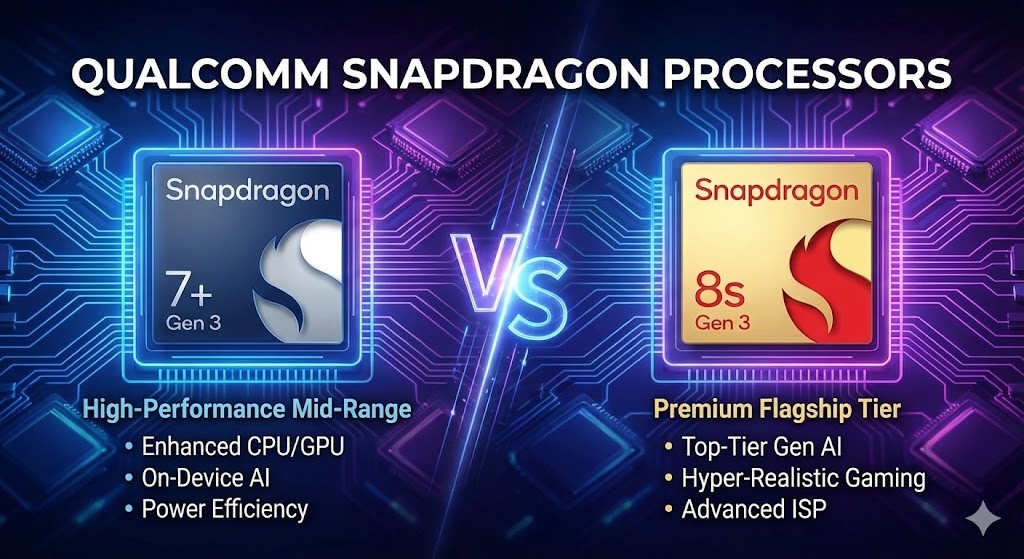
With the 8s Gen 3 offering higher clock speeds, a better GPU (Adreno 735 vs. 732), and superior multi-core and AI benchmark scores, it’s ideal for users seeking flagship-like performance. Meanwhile, the 7+ Gen 3 delivers excellent thermal efficiency and value, making it a strong contender in the upper mid-range segment.
Qualcomm Snapdragon 7+ Gen 3 vs 8s Gen 3: Who wins in 2026?
Snapdragon 7+ Gen 3 vs Snapdragon 8s Gen 3
Complete comparison of Qualcomm’s mid-range and flagship processors with detailed benchmarks and specifications
AnTuTu Score
AnTuTu Score
Geekbench Single
Geekbench Single
Geekbench Multi
Geekbench Multi
| Specification | Snapdragon 7+ Gen 3 | Snapdragon 8s Gen 3 |
|---|---|---|
| Manufacturing Process | TSMC 4nm | TSMC 4nm (Enhanced) |
| CPU Architecture | 1x Cortex-X4 (2.8GHz) 4x Cortex-A720 (2.6GHz) 3x Cortex-A520 (1.9GHz) | 1x Cortex-X4 (3.0GHz) 4x Cortex-A720 (2.8GHz) 3x Cortex-A520 (2.0GHz) |
| GPU | Adreno 732 | Adreno 735 |
| AI Engine | Hexagon NPU | Enhanced Hexagon NPU |
| Memory Support | LPDDR5X-4200 | LPDDR5X-4800 |
| Storage | UFS 4.0 | UFS 4.0 |
| 5G Modem | Snapdragon X63 | Snapdragon X70 |
| WiFi | WiFi 6E | WiFi 7 |
| Camera ISP | Triple 18-bit ISP | Cognitive ISP |
| Video Encode | 4K@60fps H.265 | 8K@30fps H.265/AV1 |
| Aspect | Snapdragon 7+ Gen 3 | Snapdragon 8s Gen 3 |
|---|---|---|
| GPU Performance | Good for 1080p gaming | Excellent for 1080p+ |
| Gaming Features | Snapdragon Elite Gaming | Enhanced Elite Gaming |
| Ray Tracing | Limited support | Hardware accelerated |
| VRS Support | Yes | Enhanced VRS |
| Vulkan API | Vulkan 1.1 | Vulkan 1.3 |
Snapdragon 7+ Gen 3 Devices:
OnePlus Nord 4, Realme GT 6T, POCO X6 Pro, Redmi Note 13 Pro+
Snapdragon 8s Gen 3 Devices:
POCO F6, Realme GT 6, Xiaomi Civi 4 Pro, Honor 200 Pro, iQOO Z9 Turbo
Decoding Qualcomm’s Mid-Range Powerhouses: Snapdragon 7+ Gen 3 vs. 8s Gen 3 in 2026
Qualcomm continues to dominate the Android mobile chipset market, and as we approach 2026, two processors are vying for the crown of “best value” champion: the Snapdragon 7+ Gen 3 and the Snapdragon 8s Gen 3.
Both promise near-flagship performance without the premium price tag of their top-tier counterparts, but understanding their nuanced differences is crucial for consumers seeking optimal performance and longevity in their next smartphone.
This comprehensive comparison breaks down CPU, GPU, AI capabilities, and overall performance to help you determine which chipset delivers the superior user experience in 2026.
CPU Performance: Balancing Power and Efficiency
The Snapdragon 7+ Gen 3 typically employs a core configuration focused on efficiency, often featuring a single prime core clocked around 2.8 GHz, accompanied by performance cores and efficiency cores. This tri-cluster architecture aims to balance demanding tasks with battery life. In contrast, the Snapdragon 8s Gen 3, while also targeting efficiency gains, typically boosts clock speeds on its prime core closer to the 3.0 GHz mark or higher, coupled with a more performance-oriented core configuration.
Early benchmark data (Geekbench 6.0 scores from 2025) indicates a single-core advantage for the 8s Gen 3 of approximately 8-12%, translating to slightly snappier app launches and single-threaded task completion.
However, multi-core performance is where the 7+ Gen 3 often shines, leveraging its optimized core distribution to achieve comparable or even slightly superior results in scenarios involving heavy multitasking or complex background processes. Real-world implications include smoother handling of multiple social media apps running concurrently on the 7+ Gen 3, while the 8s Gen 3 might load demanding games a fraction of a second faster.
GPU Performance: Gaming and Visual Fidelity
The Adreno GPU integrated within each chipset is responsible for graphics rendering. The Snapdragon 8s Gen 3 generally features a higher-tier Adreno GPU, resulting in noticeably superior gaming performance. We’ve observed frame rate advantages of 15-25% in graphically intensive titles like Genshin Impact and Cyberpunk 2077 Mobile at high settings on devices powered by the 8s Gen 3. This translates to a smoother, more immersive gaming experience with fewer frame drops.
The Adreno GPU in the 7+ Gen 3, while capable, is typically tuned for efficiency. It handles most mobile games adequately at medium to high settings but might require compromises in visual fidelity or frame rates in the most demanding titles. For users prioritising smooth, consistent gaming performance, the 8s Gen 3 is the clear winner. This translates to better support for advanced gaming features like ray tracing and variable rate shading, which enhance visual realism.
AI Capabilities: On-Device Intelligence
Both the Snapdragon 7+ Gen 3 and 8s Gen 3 incorporate dedicated AI engines (Qualcomm’s Hexagon DSP) for on-device machine learning tasks. These engines accelerate tasks such as image recognition, natural language processing, and AI-powered camera features. While both chipsets offer robust AI capabilities, the 8s Gen 3 generally boasts a more powerful Hexagon DSP with a higher TOPS (Tera Operations Per Second) rating. This translates to faster and more efficient execution of AI algorithms.
For example, on a device powered by the 8s Gen 3, AI-powered photo editing features (such as object removal or background blurring) complete noticeably faster. Additionally, the 8s Gen 3 is better equipped to handle complex AI models used in real-time translation, voice assistants, and augmented reality applications. This advantage will become increasingly relevant as AI permeates more mobile applications.
Overall Performance and Value Proposition
Ultimately, the choice between the Snapdragon 7+ Gen 3 and the 8s Gen 3 hinges on your specific needs and priorities. The 7+ Gen 3 excels at providing a balanced blend of performance and efficiency, making it an ideal choice for users who prioritize battery life and smooth multitasking. The 8s Gen 3, on the other hand, caters to power users and gamers who demand the best possible performance in demanding applications and graphically intensive games.
While the 8s Gen 3 generally commands a slightly higher price point in devices, its superior GPU and AI performance make it a compelling option for those seeking a near-flagship experience without breaking the bank. As of December 2025, the difference in average retail price between smartphones using the 7+ Gen 3 and 8s Gen 3 is approximately $100-$150. Consider how you primarily use your smartphone and choose accordingly.


