
 NZ
 IND
 NAM
 IRE
 MOZ
 UGA
 Aston Villa
 Man City
 Rayo
 Elche
 GMB
 ZMB
 NGA
 LES
 Cagliari
 Bologna
 IPS1
 NFO1
 ALA1
 MCF1
 TOR3
 MON2
 BRE1
 NICE2
 TAS67/4 (15.4/50 ov, target 305)
 VIC304/7
 NZ-A135/3 (41 ov)
 IND-A113
 DHA
 RAJ
 MYMS
 CHATT
 RAN
 BAR
 SYL
 KHU
 UAE
 NED
 PAK
 ENG
 IND-W
 ZIM-W
 AFG170/3 (34.3/50 ov, target 170)
 ZIM169
 DOLPH56/0 (3.5/8 ov, target 56)
 SWD51/4 (8/8 ov)
 WSW1
 BRI1
 Como
 Sassuolo
 Augsburg
 Union Berlin
 Cologne
 Schalke
 Mainz
 Bremen
 RB Leipzig
 Elversberg
 VFB2
 BMG3
 AHL4
 KHA1
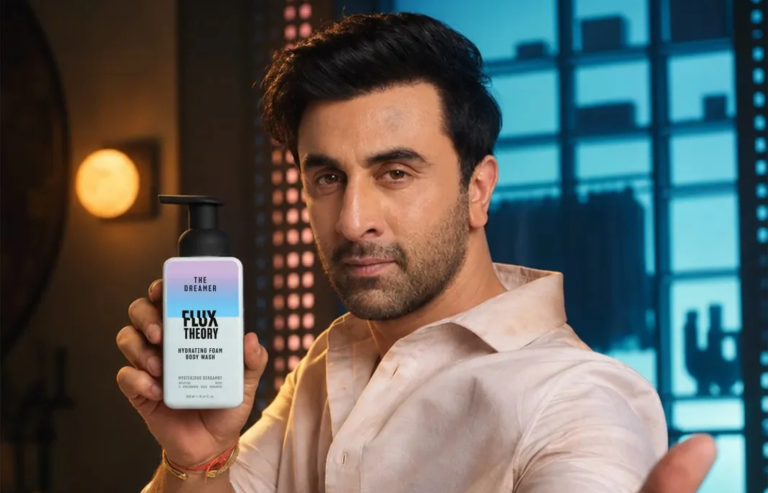
Ranbir Kapoor has made his first major foray beyond acting, launching Flux Theory, a new shower and body-care brand created alongside Advay Jhunjhunwala and venture-building platform Think9. The Mumbai-launched brand marks Kapoor’s official entry into India’s fast-moving consumer goods (FMCG) sector as Founder.
The Concept Behind Flux Theory
Flux Theory is built around the idea that a daily shower can be more than a functional ritual — it’s positioned as a moment to reflect on “who you want to be today.” Kapoor drew inspiration from his own acting career, where he has embodied multiple distinct personas over the years. “Every character I have played has stayed with me in some way… We change with the day, the mood and the moment, and that is the idea I wanted to build Flux Theory around,” Kapoor said.
Ranbir Kapoor’s Five Personality-Led Products
The brand has launched with five body washes, each tied to a distinct personality and skin benefit:
| Variant | Benefit |
|---|---|
| Lover | Moisturising, gold leaf & argan oil |
| Rebel | Exfoliating, charcoal-based |
| Dreamer | Hydrating foaming wash |
| Sport | Refreshing, detan gel |
| Sage | Purifying, deep-cleansing |
A Star-Studded Launch Film
The brand’s launch campaign features Ranbir Kapoor reprising five of his most iconic screen characters — Barfi, Bunny, Jordan, Ayan, and Shiva — brought together in one film to visually represent the brand’s core idea of embracing different sides of oneself.
Where to Buy
Flux Theory products are available on the brand’s own website, as well as major platforms including Amazon, Flipkart, Myntra, Tira, Zepto, and Instamart.
Why It Matters
With this launch, Kapoor joins a growing wave of Bollywood celebrities stepping into India’s booming personal-care and FMCG space, betting that star power combined with a fresh brand narrative can carve out space in a category traditionally driven by function over personality.
For more entertainment and celebrity business updates, check out our Entertainment section on TechnoSports.





During his lifetime, Raj Kapoor’s actual real estate holdings consisted solely of the historic properties in Chembur (RK Studio and Deonar Cottage) and the farm in Pune (Loni)—which was donated to MIT.
The raw facts and the timeline are as follows, dispelling the myth of a dynastically inherited freehold plot:
1. 1980 – Rishi Kapoor acquired only the building
The Pali Hill bungalow was purchased by Rishi Kapoor and Neetu Singh in 1980—the year of their marriage—entirely independently of his father, Raj. They named it “Krishna Raj” solely as a tribute to Rishi’s parents (Raj and Krishna Kapoor); this gesture misled the press, creating the false impression that the land had come from Ranbir’s grandfather.
2. Why they do NOT hold freehold title
As is well documented, the property lacks clear freehold status:
• In 1980, whether due to a lack of sufficient capital or because the original owner of the Pali Hill plot refused to sell the land rights, the transaction was executed according to a system specific to Mumbai: the physical structure (the bricks/footprint) was purchased, while the arrangement regarding the land itself was a leasehold or limited right-of-use agreement.
• Consequently, following Rishi Kapoor’s passing in 2020, the land deeds could not be produced, simply because they do not possess them. 3. Why it is a scheme built on a web of lies
The PR machine artificially linked Raj Kapoor’s Chembur home with Rishi’s Pali Hill residence to fabricate an “80-year ancestral legacy” that looks good in luxury magazines. In reality:
• Raj Kapoor’s actual Chembur estate (studios, house, and 3.2 acres of land) was sold off piecemeal in recent years to Godrej Properties for approximately ₹180–220 crore; the proceeds were split among the family’s five branches (Randhir, Rishi, Rajiv, Ritu, Rima), all of whom were in dire need of cash.
• Since Raj’s properties had vanished through sales, the PR team had to invent a narrative claiming the Pali Hill apartment complex—a 6–8 story building (though a boastful Rishi claimed it would be 15 stories, he lacked the funds)—was the “dynasty’s palace.” This obscured the fact that there was **no documented proof** of ownership or purchase for the underlying land—no records regarding price, neighbors, boundaries, cadastral surveys, or land registry entries.
P.S. Actual assets held:
Ranbir Kapoor & Alia Bhatt (RKAB) Portfolio
A record of their fixed assets, excluding the *Krishna Raj* building structure (which is a government leasehold property and cost ₹40 crore to redevelop into a 2+6 story complex):
• ₹35.00 crore – Ranbir Kapoor’s apartment (*Vastu*, 7th floor).
• ₹37.80 crore – Alia Bhatt’s apartment (*Vastu*, 5th floor). • ₹16.42 crore – 25.7-acre plot of land outside city limits in Mulshi (near Pune), acquired in April 2026.
• ₹13.00 crore – Apartment in the luxury Trump Towers complex in Pune.
• ₹3.31 crore – ~198 sq. m plot of land in Ayodhya, purchased in early 2026.
• ₹7.20 crore – Active office and production premises owned by Alia Bhatt in Mumbai.
TOTAL RECORDED VALUE (RKAB): ₹112.73 crore.
OTHERS HOLD ASSETS EXCEEDING ₹100 CRORE FROM JUST ONE OR TWO TRANSACTIONS—FULLY DOCUMENTED, FREEHOLD LAND ( USD/UFD LEGAL RIGHTS/ENTIRE FLOORS), WITH REGISTERED TITLE, CADASTRAL SURVEY, TAXES PAID, AND LAND REGISTRY RECORDING.
• Loss of privacy and visual comfort: Replacing a sea view with an 8-to-9-story concrete wall turns the home into a claustrophobic space.
• Lack of infrastructure: Narrow streets and poor street lighting (only a single lamppost) indicate that the area has developed haphazardly, without a coherent urban plan to ensure residents’ comfort.
• Devaluation of the property: A home that loses its “sea view” due to a building erected far too close automatically loses a significant portion of its market value.
The liar, the braggart, and the envious one of Bollywood—let them disappear! Why don’t the mobsters threaten him? Raj kisses the mobsters’ feet, while Rishi kisses their asses. Does RK do everything for the mobsters?