NAM321/6 (50 ov)
 IRE
IRE FCA
FCA FCU
FCU KOE
KOE S04
S04 M05
M05 SVW
SVW RBL
RBL ELV
ELV SCP
SCP HSV
HSV MEX-W
MEX-W ARG-W
ARG-W ARS
ARS EVE
EVE COV
COV FUL
FUL MOZ19
MOZ19 UGA23/0 (0.5/20 ov, target 20)
 NZ180/5
 IND181/6 (19.5/20 ov, target 181)
 Ipswich1
 Nottm Forest1
 Alavés1
 Málaga1
 WA105/3 (18.5/50 ov, target 372)
 NSW371/8
 DEN
DEN KUW
KUW KENYA
KENYA QAT
QAT SWD-W
SWD-W EPR-W
EPR-W TTN-W
TTN-W WPR-W
WPR-W BOR
BOR WAR15/1 (2.5/20 ov)
 LIONS
LIONS Limpo21/1 (2.5/20 ov)
 NZ-A135/3 (41 ov)
 IND-A113
 DHA293/3 (84.1 ov)
 RAJ
RAJ MYMS
MYMS CHATT
CHATT RAN320/5 (80 ov)
 BAR
BAR UAE
UAE NED
NED PAK
PAK ENG
ENG IND-W
IND-W ZIM-W
ZIM-W GMB
GMB LES
LES ZMB
ZMB NGA
NGA AFG170/3 (34.3/50 ov, target 170)
 ZIM169
 OFC
OFC NEU
NEU Torino3
 Monza2
 Brest1
 Nice2
Nice2 Stuttgart2
 Gladbach3
 Al Ahli4
 Al Khaleej1
When Pep Guardiola eventually walks away from Manchester City this summer, after a decade in English football, the tributes will focus on trophies. And the trophies are extraordinary: six Premier League titles — one with a record 100 points — five League Cups, three FA Cups, three Community Shields, and one historic Champions League title as part of the 2022-23 treble. Potentially a seventh league title still to come at the time of writing.
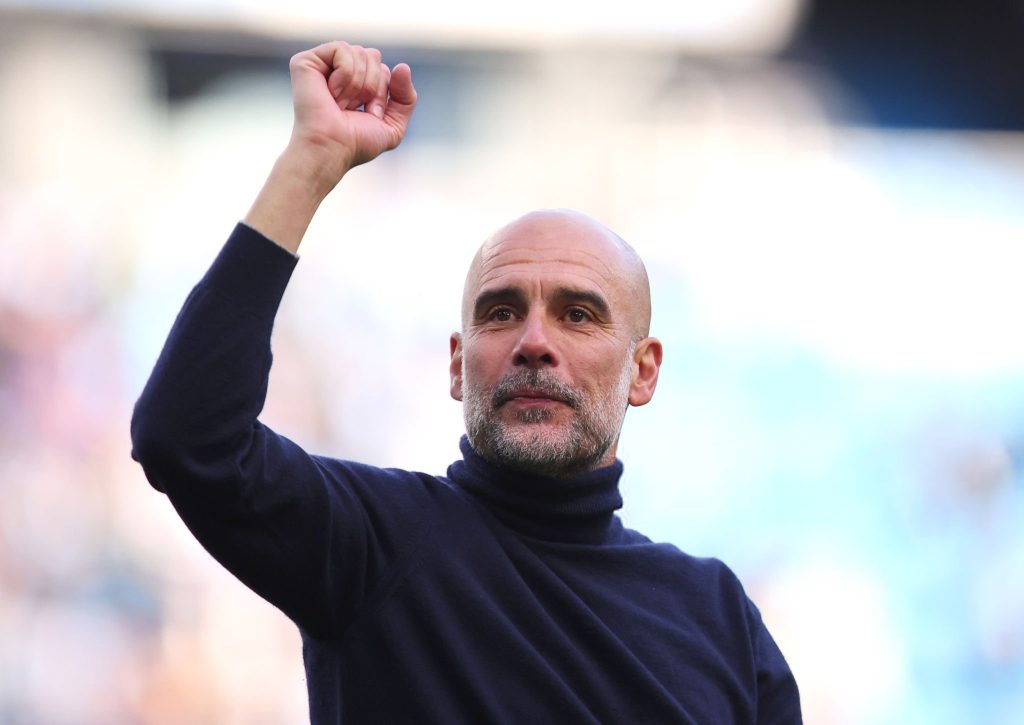
But the trophy count, impressive as it is, does not fully capture what is being lost. What Guardiola has done to football itself — to how the game is played at every level, from the Premier League to Sunday League — is a transformation without precedent in English football history.
He is not merely the most successful manager in the competition’s modern era. He is the single most influential figure the Premier League has ever seen.
The Beginning: Failure as a Foundation
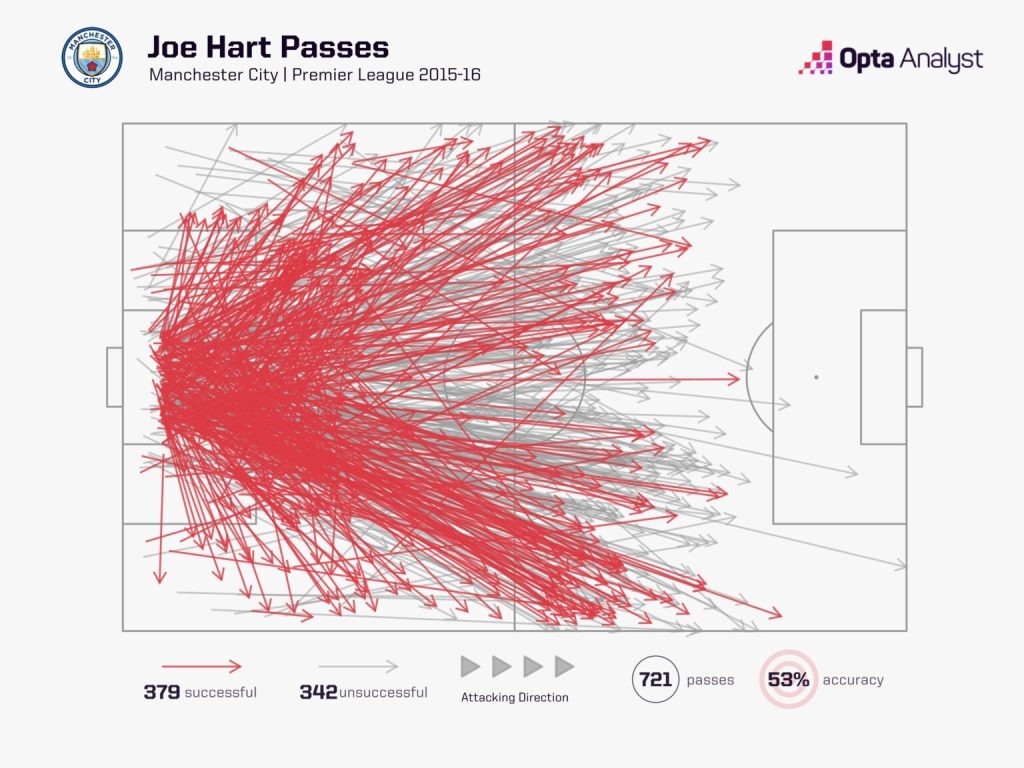
When Guardiola arrived in 2016, he immediately set about transforming Manchester City’s identity. The face of that transformation was, controversially, Joe Hart. Hugely popular with the fans, England’s first-choice goalkeeper, and a commanding presence — Hart was discarded almost entirely because he could not play the short passing game Guardiola demanded from his goalkeeper.
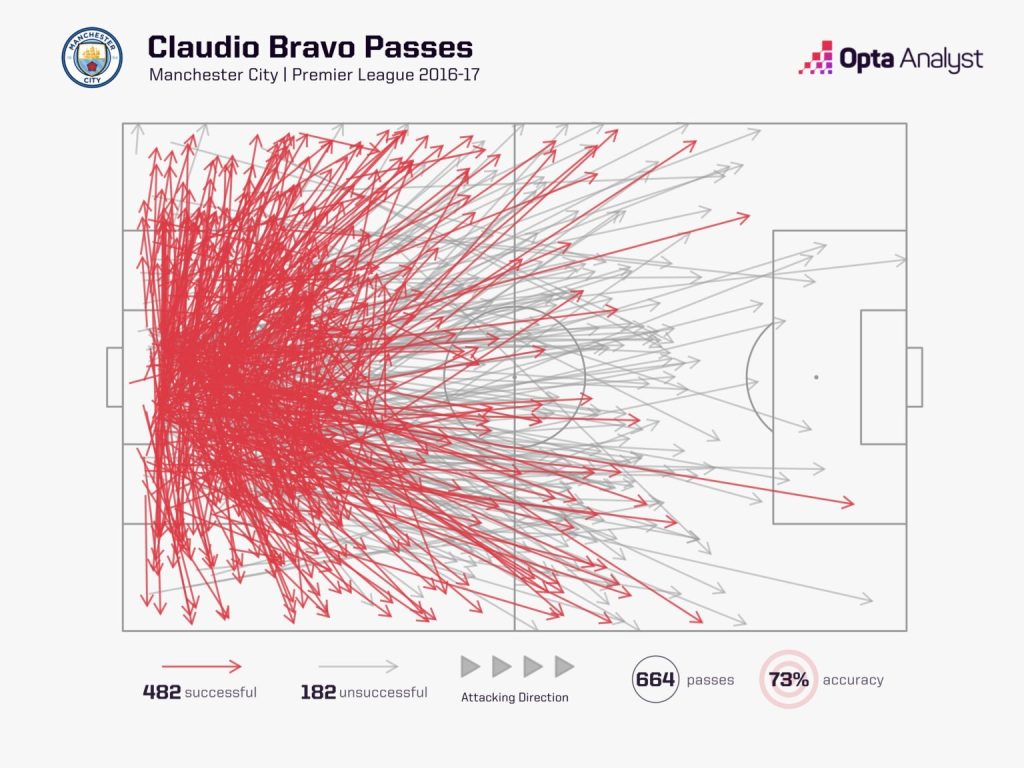
Claudio Bravo came in from Barcelona. He was, by any objective measure, a disaster. His save success rate of 55.9% was by far the lowest of any goalkeeper to play at least 10 games in that Premier League season. Guardiola was ridiculed. His football, the critics said, worked when he had Xavi, Andrés Iniesta, and Lionel Messi. It worked in Germany. In the Premier League, he had been “found out.”
He ended his first season in England trophyless.
What followed was one of the most complete responses in football management history.
The Turnaround: Ederson and the Record Season
Guardiola spent big the following summer on a new goalkeeper: Ederson. It is arguably the single most transformative signing of his entire reign — not because of what Ederson delivered individually, but because of what his arrival enabled City to do structurally. A goalkeeper who could genuinely function as an eleventh outfielder changed the geometry of City’s build-up play entirely.
The results were immediate and historic. City won the League Cup and the Premier League title in Guardiola’s second season — and they did so in a manner that had never been seen before.
| Manchester City — Record-Setting 2017-18 Season | Stat |
|---|---|
| Premier League points | 100 (all-time record) |
| Average successful passes per game | 661.6 (most by any team in PL history since 2008-09) |
| Average possession | 71.9% (highest by any team in PL history since 2008-09) |
No team has passed more successfully per game in a Premier League season. No team has had more possession on average across a full campaign. The records set that season remain untouched.
The Ripple Effect: How Guardiola Rewired English Football
But the story of Guardiola’s impact does not begin and end with Manchester City’s results. It extends across the entire Premier League and far beyond.
Passing out from the back became increasingly common after his arrival, before eventually becoming the norm. Inverted full-backs moved from curiosity to standard tactical practice. Playmakers in central midfield positions became expected rather than unconventional.
Perhaps most visible of all has been the transformation of the goalkeeper position.
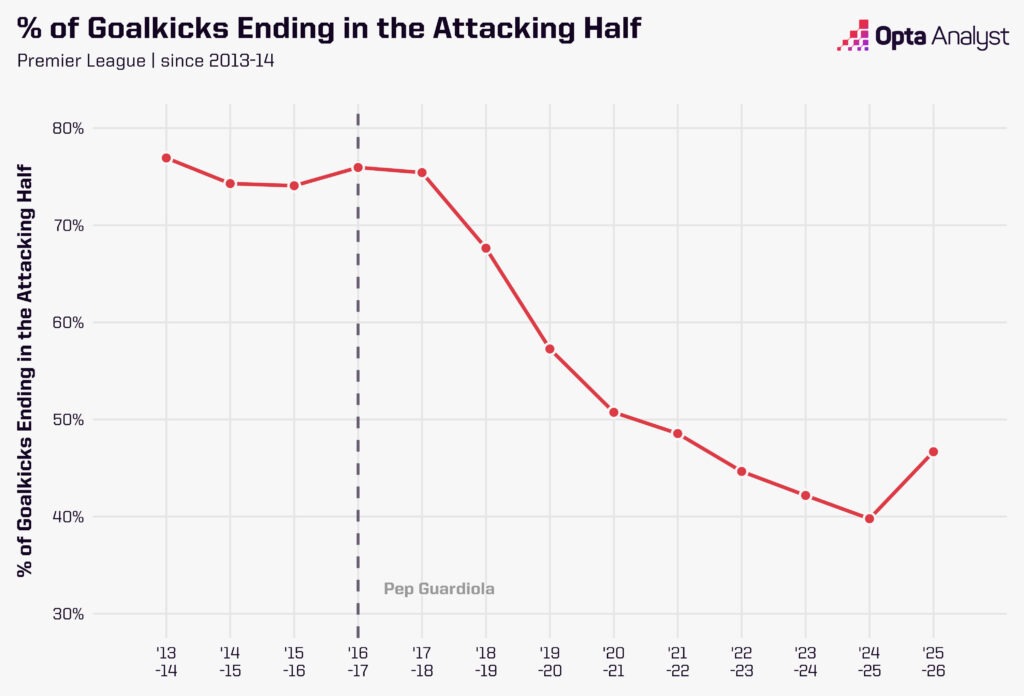
Guardiola was among the first — and certainly the most prominent and most successful — to use a goalkeeper as a genuine extra outfielder in build-up play, creating a numerical overload when his team had possession. The concept was not entirely new, but his success in implementing it at the highest level of football forced every other club to reconsider what they required from the position.
| Premier League Goal-Kick Trends Since Guardiola’s Arrival | Direction of Change |
|---|---|
| Average goal-kick distance | Consistently shorter |
| Proportion of goal-kicks reaching the opposition half | Declining |
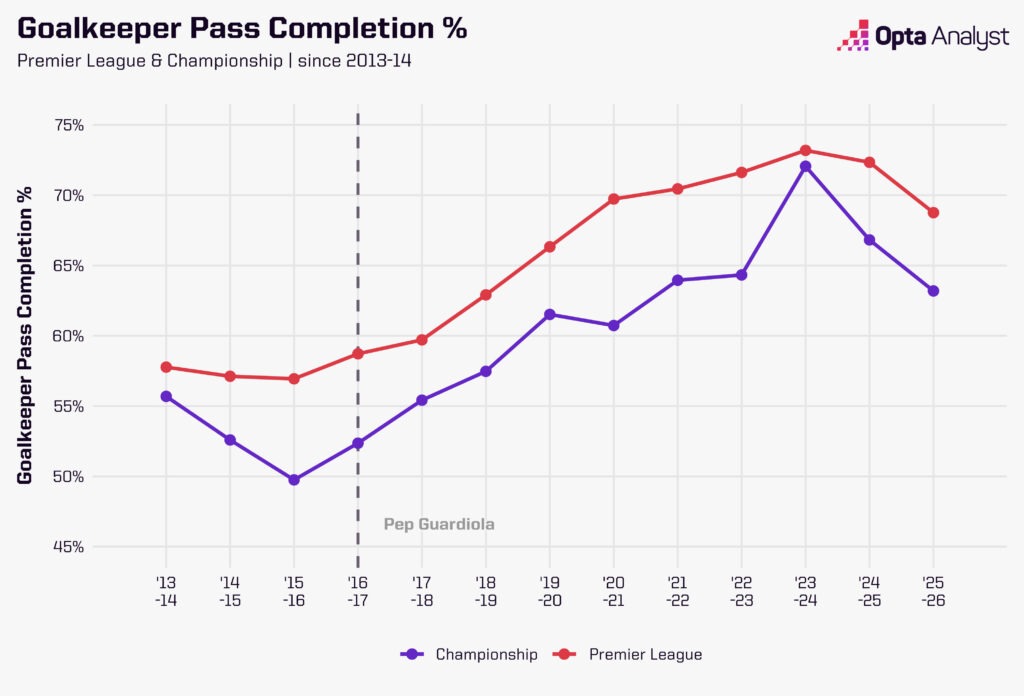
| Goalkeeper pass completion rates (PL and Championship) | Rising significantly |
Goalkeeper pass completion rates have risen across both the Premier League and the Championship — the result of both more short passes being played and the genuine improvement in technical ability of those between the sticks. The idea of a budding goalkeeper growing up without the ability to play with the ball at their feet is now essentially unthinkable — at any level of the game.
Guardiola made it happen.
The Passing Revolution: Numbers That Tell the Story
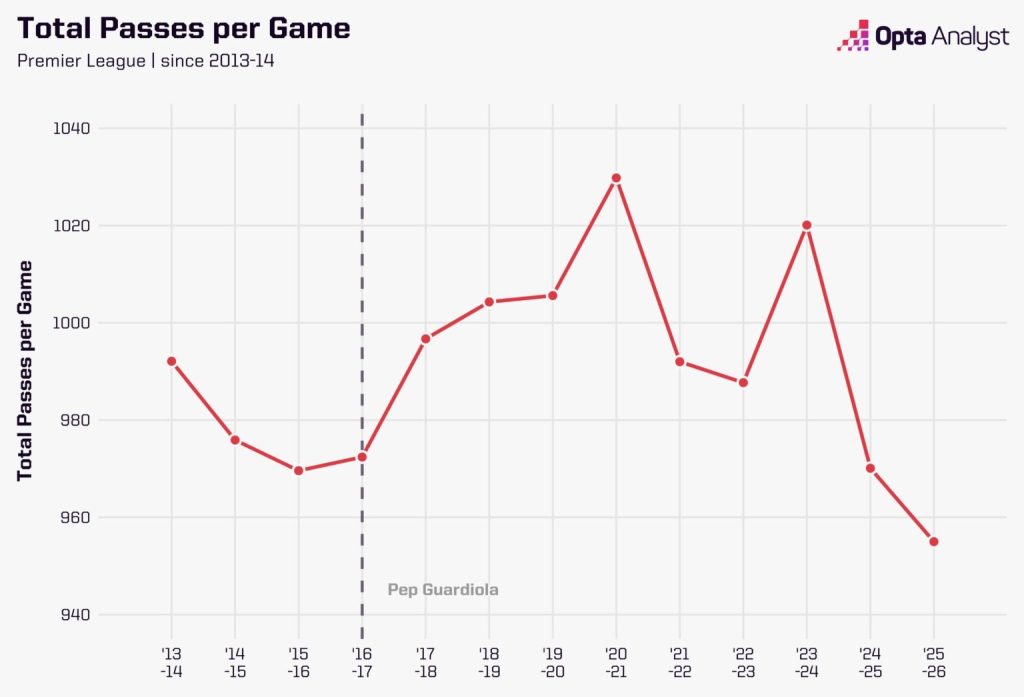
The data on passing in the Premier League since Guardiola’s arrival is unambiguous. The number of passes per game rose sharply in the years following 2016 and stayed elevated for much of his reign, before a modest dip in the most recent two seasons.
When ranking all managers’ individual seasons in the Premier League since 2008-09 by successful passes per game, Guardiola’s City hold each of the top seven positions. The other three seasons under him fall within the top 21. Of the top 26 seasons by passing volume in the competition’s history, all but one occurred after Guardiola arrived in England.
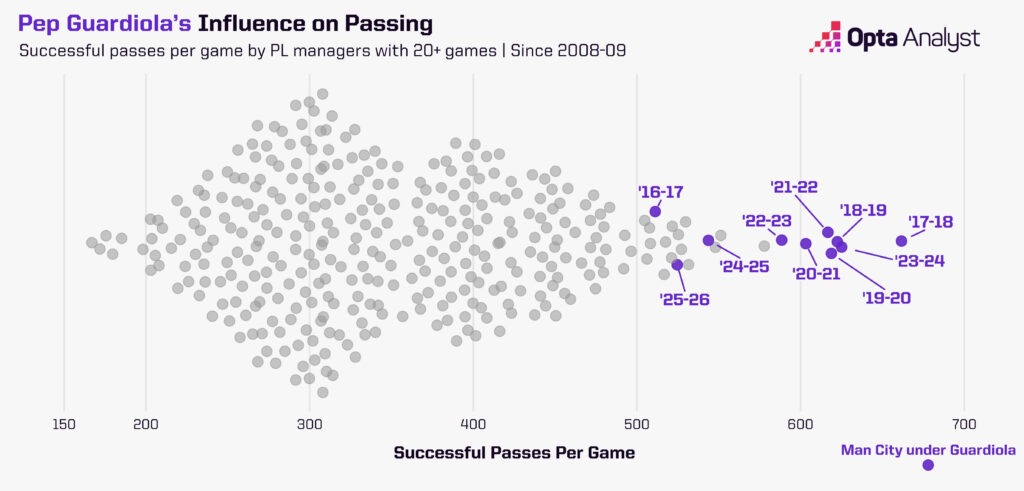
The sole exception is Michael Laudrup’s Swansea City in 2013-14 — a reminder that the game was already drifting toward a more possession-focused style before Guardiola’s arrival. It is a fair point. Modern football was always evolving in this direction.
But would it have evolved this dramatically, this quickly, this completely — without Pep Guardiola driving it forward from the most scrutinised football stage in the world?
Almost certainly not.
The Critics and the Counterfactuals
Guardiola’s detractors have always had a ready-made argument: the resources. Manchester City, backed by Abu Dhabi ownership, have been able to spend at a level that few clubs can match on transfers and wages. Others, the argument goes, could have won as much with the same budget.
It is a line of reasoning that conveniently ignores the managers who were given similar resources and did not come close to what Guardiola achieved. It also ignores his first season — trophyless, operating with the same extraordinary budget, and derided as an idealist who had been exposed.
What Guardiola brought to Manchester City was not merely spending power. It was a footballing vision so clear and so consistent that it reshaped an entire sport. His commitment to his principles in the face of that difficult first season — rather than compromising or adapting into something more conventional — is precisely why the game looks the way it does today.
A Legacy Beyond Trophies
As Manchester City prepare to say goodbye to their most successful manager, the sense of loss extends far beyond one club.
The Premier League has been transformed. Goalkeeping has been transformed. Tactical thinking across English football — at every level — has been transformed. A generation of managers, coaches, and players have grown up in a football environment shaped irrevocably by what Pep Guardiola built at the Etihad Stadium.
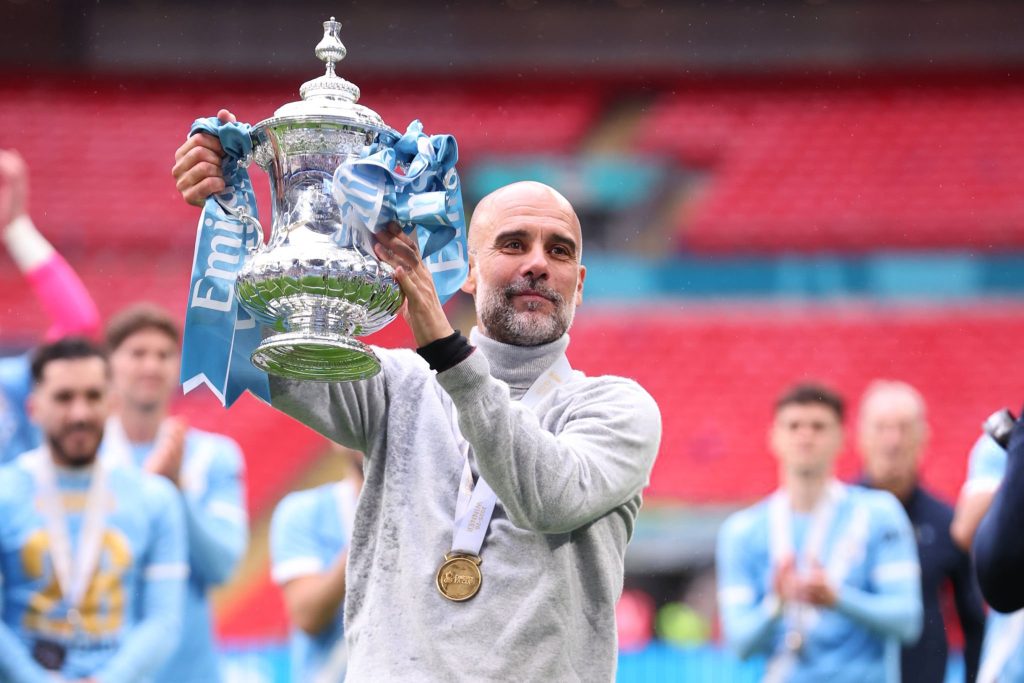
Whether the game would have eventually arrived at the same place without him is an interesting question. That it arrived here so dramatically, so decisively, and so completely — that is his.
It is not just Manchester City who should feel the weight of this departure. It is English football itself.
Read More: Southampton Expelled From Championship Playoffs After Admitting Multiple Spying Breaches