

Not just a chatbot anymore. ChatGPT Work can stay on a task for hours — and deliver finished results.
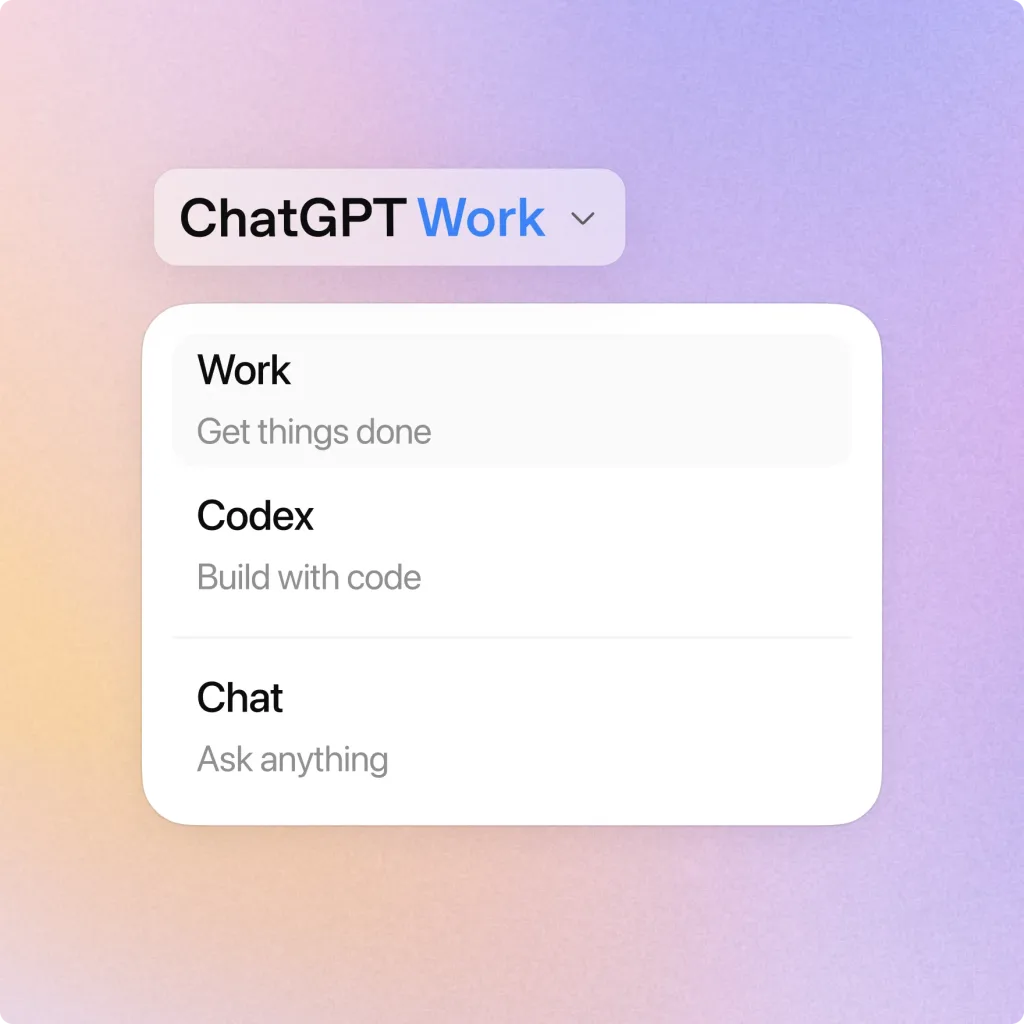
OpenAI has just unveiled ChatGPT Work, a new AI agent built directly into ChatGPT and powered by a combination of Codex and GPT-5.6. It’s not an incremental update. It’s a fundamental shift in what ChatGPT is designed to do — moving from answering questions to actually completing work.
What Is ChatGPT Work?
ChatGPT Work is an autonomous AI agent that can take actions across your apps and files, run for extended periods without hand-holding, and convert a high-level goal into a finished, usable output.
The key distinction from regular ChatGPT: it doesn’t just respond — it executes.
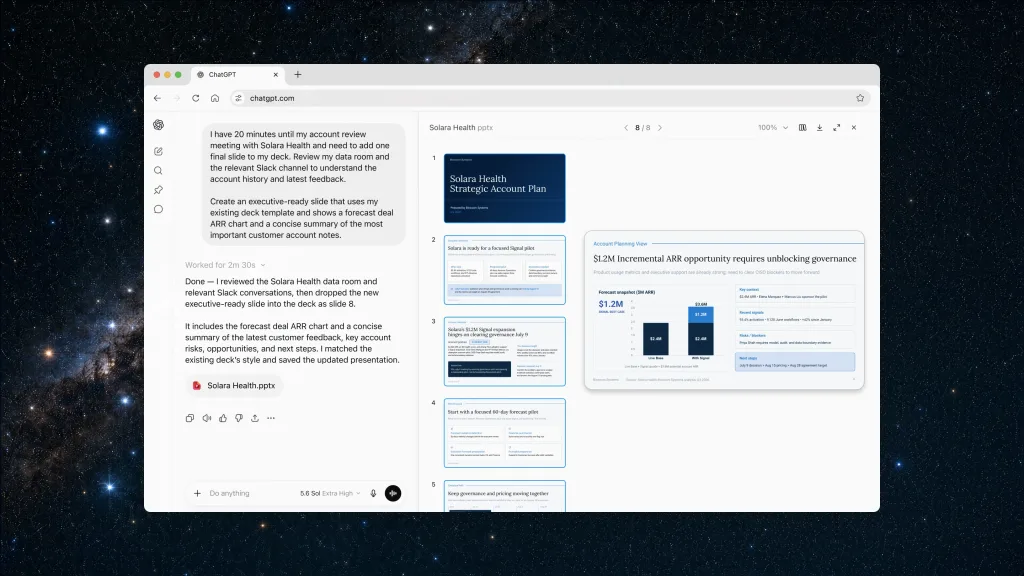
Where a standard AI chat session requires you to prompt, review, prompt again, and stitch everything together yourself, ChatGPT Work is designed to take a goal, plan steps autonomously, work across your tools, and come back with something done.
Think of it less like a smart assistant and more like delegating to a capable colleague — one who doesn’t need to be micromanaged every five minutes.
Key Features at a Glance
| Feature | Details |
|---|---|
| Powered by | Codex + GPT-5.6 |
| Task Duration | Hours-long autonomous runs |
| App Integration | Acts across connected apps and files |
| Input | A goal or brief — in plain language |
| Output | Finished, actionable work |
| Interface | Built into ChatGPT |
What Makes This Different
It Works Across Apps and Files
ChatGPT Work isn’t confined to a chat window. It can reach into your connected applications and files — reading, writing, and taking action across them as needed to complete a task. That’s a meaningful leap from a conversational AI that can only tell you what to do.
It Can Run for Hours
Most AI tools today are built for short bursts — a quick answer, a draft, a code snippet. ChatGPT Work is explicitly designed for long-horizon tasks that require sustained effort. Research, multi-step coding projects, document workflows — the kind of work that previously required you to stay in the loop the entire time.
Codex + GPT-5.6 as the Engine
Pairing OpenAI’s Codex — already known for its strong performance on software and structured tasks — with GPT-5.6 gives ChatGPT Work both reasoning depth and execution capability. Codex handles the action layer; GPT-5.6 handles the thinking. Together, they’re designed to bridge the gap between understanding a goal and actually delivering on it.
This is very much in line with where the broader AI industry is heading. If you’ve been following how AI tools are reshaping productivity workflows in 2026, ChatGPT Work is the most direct consumer-facing example of that shift yet.
How Does It Compare to the Competition?
ChatGPT Work enters a space that’s getting crowded fast. Google has its own agentic ambitions with Gemini, Anthropic has been building long-context, multi-step capabilities into Claude, and Microsoft’s Copilot is deeply embedded in the Office ecosystem.
But OpenAI’s advantage here is distribution. ChatGPT already has hundreds of millions of users. Putting a capable long-running agent directly inside that interface — rather than as a separate product — lowers the barrier to adoption considerably. You can check out our comparison of the best AI tools for productivity in India to see how the landscape is stacking up right now.
What This Means for Everyday Users
For most people, ChatGPT Work represents the first genuinely practical AI agent — not a demo, not a developer tool, but something built for real work inside a product they already use. The promise is simple: give it a goal, walk away, come back to something finished.
Whether it delivers on that promise consistently will depend on real-world testing. But the direction is clear — AI is moving from assistant to executor, and OpenAI wants ChatGPT Work to be where that shift becomes mainstream.
Availability and pricing details are expected to follow the announcement shortly.
Source: OpenAI


