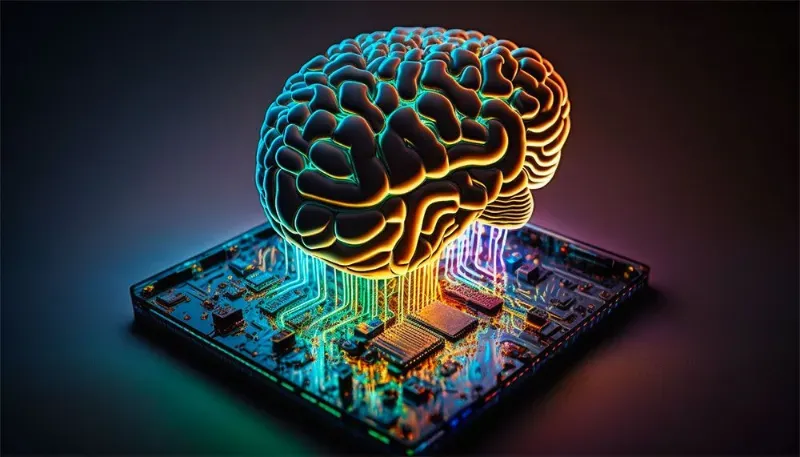
Neuromorphic chips are fundamentally changing how artificial intelligence processes information at the hardware level. Unlike traditional processors that rely on sequential computing, these brain-inspired architectures process data in parallel, consuming a fraction of the energy while delivering faster results. The shift represents one of the most significant hardware breakthroughs in AI since the rise of GPUs, and major tech companies are racing to commercialize the technology.
Why Neuromorphic Chips Are Winning
Traditional AI processors hit a wall. They’re power-hungry, generate excessive heat, and struggle with real-time inference on edge devices. Neuromorphic chips solve this by mimicking how biological neurons actually fire—using event-driven computation instead of processing every bit in every cycle.
Intel’s Loihi 2, released in 2024, demonstrated what’s possible. It achieved 15 times faster performance on certain workloads while consuming 100 times less power than conventional CPUs. That’s not incremental improvement—that’s a category shift. According to The Verge, the architecture enables AI models to run on devices with minimal battery drain, opening possibilities for autonomous robotics and wearable intelligence that weren’t feasible before.
The Power Efficiency Story
Energy consumption is the hidden cost of modern AI. Data centers running large language models consume roughly 15 megawatt-hours annually—equivalent to powering thousands of homes. Neuromorphic chips attack this directly. Their event-driven design means transistors only activate when needed, not during every clock cycle.
IBM’s TrueNorth chip, with 1 million programmable neurons, consumes just 70 milliwatts under full load. Compare that to a GPU pulling 300+ watts, and the advantage becomes obvious. TechCrunch reported that companies deploying neuromorphic technology in edge AI applications are seeing operational costs drop by 40-60%. For enterprises running thousands of inference servers, that’s millions in annual savings.
Here’s the thing: why aren’t neuromorphic chips everywhere yet? The answer is software. Neural networks were built for conventional architectures. Retraining models for spiking neural networks requires new frameworks and expertise most teams don’t have.
Real-World Deployment Today
Neuromorphic chips are moving from labs into production. Samsung, Intel, and BrainScaleS are shipping hardware. Robotics companies are the early adopters—autonomous drones and industrial robots need fast inference with minimal power draw.
Healthcare imaging systems are another hotbed. Real-time analysis of medical scans demands both speed and energy efficiency, where next-gen chips enable breakthrough performance.
The challenge isn’t capability—it’s adoption velocity. Developers need training. Frameworks need to mature. But momentum is building. Universities are launching neuromorphic computing programs. Open-source projects are proliferating. By 2026, we’re seeing the first wave of production deployments in autonomous vehicles and edge AI systems.
What Industry Leaders Are Saying
Q: Will it replace GPUs entirely?
No. GPUs excel at parallel matrix operations. Neuromorphic chips dominate in real-time, low-power inference. The future is heterogeneous—systems using both for different tasks.
Q: What’s the biggest barrier to adoption?
Software ecosystem maturity. Hardware is ready. Developers need better tools and pre-trained models optimized for spiking architectures.
Q: When will mainstream devices use the technology?
Expect edge devices and IoT systems within 12-18 months. Smartphones may follow in 2-3 years as frameworks mature.
Q: Are these tools only for AI?
Initially, yes. But the architecture has applications in signal processing, robotics control, and real-time sensor fusion.
Neuromorphic chips represent a genuine inflection point in AI hardware. They’re not hype—they’re physics. The brain-inspired approach to computation solves real problems: power, latency, and scalability. As software tools mature and adoption accelerates, this platform will become standard infrastructure for edge AI, autonomous systems, and any application demanding real-time intelligence with minimal power overhead. The transition has begun.