NZ121/3 (15.1/20 ov)
 IND
IND NAM49/2 (10.5/50 ov)
 IRE
IRE MOZ
MOZ UGA
UGA AVL
AVL MNC
MNC RAY
RAY ELC
ELC GMB
GMB ZMB
ZMB NGA
NGA LES
LES CAG
CAG BOL
BOL COMO
COMO SAS
SAS FCA
FCA FCU
FCU Ipswich1
 Nottm Forest1
 Alavés1
 Málaga1
 Torino3
 Monza2
 Brest1
 Nice2
Nice2 WA
WA NSW199/3 (31/50 ov)
 DEN
DEN KUW
KUW KENYA
KENYA QAT
QAT SWD-W
SWD-W EPR-W
EPR-W TTN-W
TTN-W WPR-W
WPR-W NZ-A135/3 (41 ov)
 IND-A113
 DHA
DHA RAJ
RAJ MYMS
MYMS CHATT
CHATT RAN
RAN BAR
BAR SYL
SYL KHU
KHU MEX-W
MEX-W ARG-W
ARG-W UAE
UAE NED
NED PAK
PAK ENG
ENG IND-W
IND-W ZIM-W
ZIM-W AFG170/3 (34.3/50 ov, target 170)
 ZIM169
 TAS137 (25.2/35 ov, target 276)
 VIC304/7 (50 ov)
 CHE0
CHE0 DYI0
DYI0 CHO1
CHO1 QIN0
QIN0 HEN1
HEN1 BEI0
BEI0 LIA1
LIA1 ZHE0
ZHE0 QWC1
QWC1 YUN0
YUN0 SHX0
SHX0 Shanghai Shenh0
 TIG0
TIG0 SHP0
SHP0 WTT1
WTT1 SHT3
SHT3 KOE
KOE S04
S04 M05
M05 SVW
SVW RBL
RBL ELV
ELV Stuttgart2
 Gladbach3
 Al Ahli4
 Al Khaleej1
Less than three months ago, an out-of-sorts Morgan Rogers faced jeers from a section of his own supporters during Aston Villa’s Europa League match against Bologna. Fast forward to today, and the 23-year-old England international is driving Aston Villa towards an unexpected Premier League title challenge, producing match-winning performances that have transformed both his season and his club’s fortunes.
Ahead of Sunday’s home encounter with Manchester United, Morgan Rogers is now on fire—quite literally burning up the pitch with a series of influential displays that have helped Aston Villa win 10 of their last 11 Premier League matches. His remarkable turnaround represents one of the season’s most compelling narratives and provides valuable lessons about resilience, tactical adaptation, and the marginal gains that separate good players from great ones.
The Difficult Start: Early Season Struggles
In the first five matchdays of 2025-26, Morgan Rogers struggled to find his best form, but this malaise reflected Aston Villa’s collective difficulties. The team failed to score a single goal until their fifth game, when Matty Cash netted in the 1-1 draw at Sunderland.
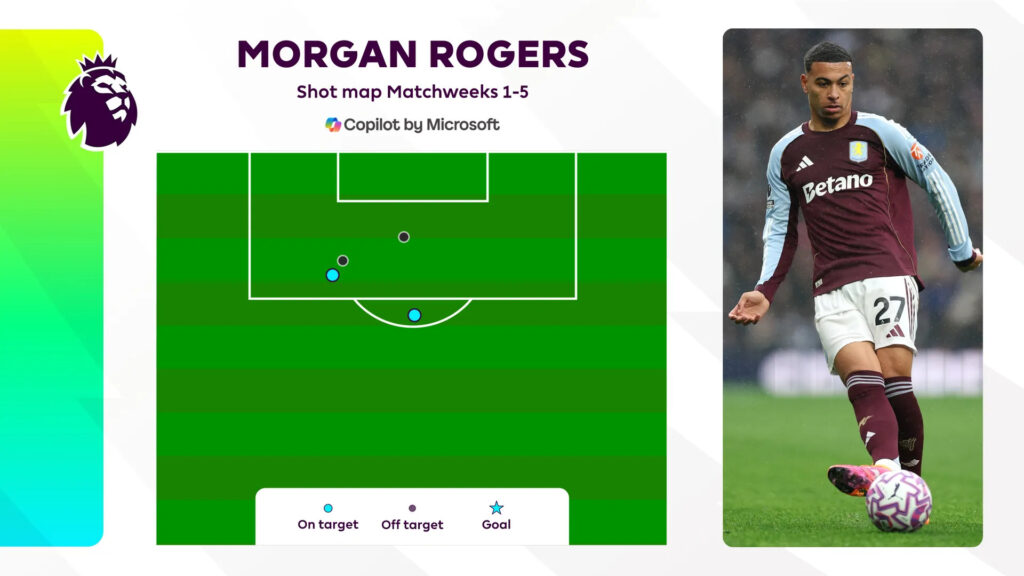
Rogers looked a shadow of the attacking midfielder who had been crowned PFA Young Player of the Year at the end of the previous campaign. He appeared to lack his usual energy, strength, and quality on the ball, producing only four attempts on goal in the opening five matches, with just two hitting the target.
| Morgan Rogers – Early Season Stats (MW1-5) | Figure |
|---|---|
| Shot Attempts | 4 total |
| Shots on Target | 2 |
| Average Shots per 90 | 0.8 |
| Expected Goals (xG) per 90 | 0.05 |
| Sprints per 90 | 13.6 |
| Distance Covered per 90 | 10.7km |
The nadir arrived during Aston Villa’s 1-0 UEFA Europa League victory against Bologna in late September. Rogers completed just 10 of 24 passes on the night, with some frustrated Villa fans even sarcastically cheering him when he found a team-mate—a humiliating moment for any professional footballer, let alone a reigning individual award winner.
Emery’s Response: Backing His Star
Responding to the criticism his star turn faced that evening, head coach Unai Emery hinted that the experience would ultimately help Morgan Rogers grow in the long term. His measured response demonstrated the understanding of a coach who has guided numerous young talents to fulfillment.
“Morgan is young and needs time for experiences,” said Emery. “I kept him on the field because I wanted to see his reaction, how he was accepting everything. He didn’t play well and wasn’t clinical in the attacking third, but I wanted to keep him on.”
“He needs to take experiences [like] today, not playing every game well, the crowd not being happy with him. It’s [about] getting his experiences and growing up through it.“
That low point proved to be the crucial turning moment for the 23-year-old. Since then, Morgan Rogers has responded with a string of highly influential performances that have not only silenced his critics but established him as Aston Villa’s most important attacking player.
Tactical Evolution: Less Possession, More Threat
From a tactical perspective, there was not significant difference from Aston Villa’s normal setup during that poor start. Emery lined his team up in a familiar 4-2-3-1, with largely the same personnel they have deployed during their stunning recent run.
The critical difference was perhaps the fact they were facing opponents who sacrificed possession to remain in compact low blocks against them. Aston Villa boasted 76.4% of the ball in their 1-0 defeat at Brentford, while they controlled 71.4% when they drew 1-1 at Sunderland. Their average of 59.56% possession across the first five games suggested teams were inviting pressure.
From Matchweek 6 onwards, Emery’s men have not exceeded 60% possession in a single game, with their average dramatically lowered to 50.02%. Indeed, in six of their last 11 fixtures, they have held the minority share of the ball.
| Aston Villa Possession Comparison | MW1-5 | MW6-16 |
|---|---|---|
| Average Possession | 59.56% | 50.02% |
With so many powerful, athletic runners looking to drive into space—like Morgan Rogers himself—those types of matches play to Aston Villa’s strengths. They thrive when turning the ball over and attacking at speed, rather than showing patience inside the final third. This stylistic shift has unlocked Rogers’ full potential.
Rogers the Risk-Taker: Statistical Profile
Wherever Emery deploys Morgan Rogers, he will always try ambitious, creative actions. This season, he has attempted the most through balls (11) at Aston Villa, completed the highest number of dribbles (22), and registered a team-high 12 shots on target by playing with adventure and audacity.
However, this attacking freedom comes with a trade-off. Rogers also loses possession more often than anyone else at Villa, giving the ball away 255 times while attempting to hurt rival teams. This can cause some frustration among supporters and teammates, but the positives far outweigh the negatives.
| Most Possession Lost – Aston Villa 2025-26 | Times |
|---|---|
| Morgan Rogers | 255 |
| Matty Cash | 206 |
| John McGinn | 179 |
| Lucas Digne | 157 |
| Ollie Watkins | 120 |
Crowding Rogers’ space and forcing him to work in tight areas represents perhaps the best method for opposing sides to limit his influence. Villa’s improved form and more transitional style of play has helped create the space he craves so much.
Physical Recovery: Finding Full Fitness
Morgan Rogers did pick up an ankle injury in a pre-season friendly against Roma, and the after-effects of that knock may have hindered him early in the campaign. He was noticeably less mobile during that winless run, and the data confirms he was indeed running shorter distances with less intensity.
Since Aston Villa’s 3-1 win against Fulham on September 28—when Rogers created his first assist of the season—his power and athleticism have returned to the fore. His sprint count per 90 minutes has increased from 13.6 to 15.4, while his distance covered has risen from 10.7km to 11.1km. These improvements may seem marginal, but at elite level they make an enormous difference.
The Stunning Shooting Technique
Morgan Rogers’ shot count has soared in recent months. Pushing himself to get into goalscoring positions more frequently, his output has been fantastic since Matchweek 6. His shot map reveals improved positioning and decision-making, though finding the target when cutting inside from the left side of the penalty area remains an area for improvement.
Developing a fantastic new shooting technique has made a tremendous difference to both Rogers and Aston Villa’s results. He has fizzed dipping side-foot, top-spin strikes into the corner on three separate occasions this season.
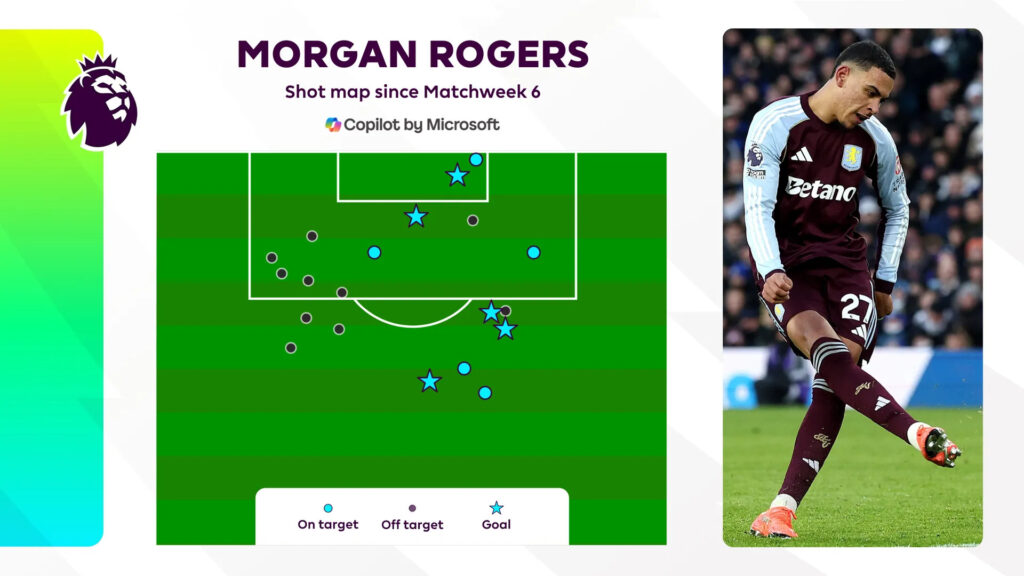
The technique for his goals against Tottenham Hotspur and Leeds United, plus his second strike at West Ham United, demonstrates how hard Morgan Rogers has worked on the training ground. These aren’t fortunate strikes—they’re the product of dedicated practice and technical refinement.
Finding the target when cutting inside from the left penalty area has presented challenges (several attempts have missed), indicating this remains a focus area for future development.
Comprehensive Statistical Improvement
We often discuss footballers finding an extra five to 10 percent to fulfill their potential, and Morgan Rogers has clearly achieved precisely that across the last two-and-a-half months. He has made across-the-board improvements by finding small marginal gains in almost every aspect of his attacking endeavors since Matchweek 6.
This comprehensive development has helped him score five goals while creating three assists during Villa’s exceptional run of form.
| Morgan Rogers – Attacking Influence Per 90 | MW1-5 | MW6-16 | Improvement |
|---|---|---|---|
| Total Shots (inc. blocks) | 0.8 | 1.8 | +125% |
| Expected Goals (xG) | 0.05 | 0.13 | +160% |
| Chances Created (inc. assists) | 0.81 | 1.1 | +36% |
| Touches in Opposition Box | 3.5 | 4.1 | +17% |
| Total Touches | 41.3 | 46.1 | +12% |
| Duels Won | 3.5 | 4.7 | +34% |
| Successful Passes Ending in Final Third | 7.9 | 8.4 | +6% |
| Passing Accuracy | 69.7% | 75.0% | +5.3% |
| Dribbles Completed | 1.2 | 1.5 | +25% |
These numbers reveal a player operating at a significantly higher level across every meaningful metric. The improvements in expected goals (+160%), total shots (+125%), and duels won (+34%) are particularly striking.
Tactical Flexibility: Freedom to Roam
With the 2026 World Cup on the horizon, this represents a hugely important campaign for Morgan Rogers, who would love to cement his place as Thomas Tuchel’s starting number 10 for England. With competition from Jude Bellingham, Cole Palmer, and Phil Foden, he knows his standards must remain sky-high.
Emery has demonstrated flexibility in his deployment of Rogers, starting him seven times on the left, twice as part of a front two, and seven times in that central number 10 slot. Wherever Emery uses Rogers, however, he proves most effective when given license to roam, popping up in different areas to utilize his power and pace.
Morgan Rogers’ pass reception map since Matchweek 6 tells the story of a player who needs freedom to perform at his very best. He will drop deep, run in behind, find pockets between the lines, and pull out wide. This positional versatility and intelligence makes Rogers such a difficult attacking midfielder for rival defenders to contain for 90 minutes.
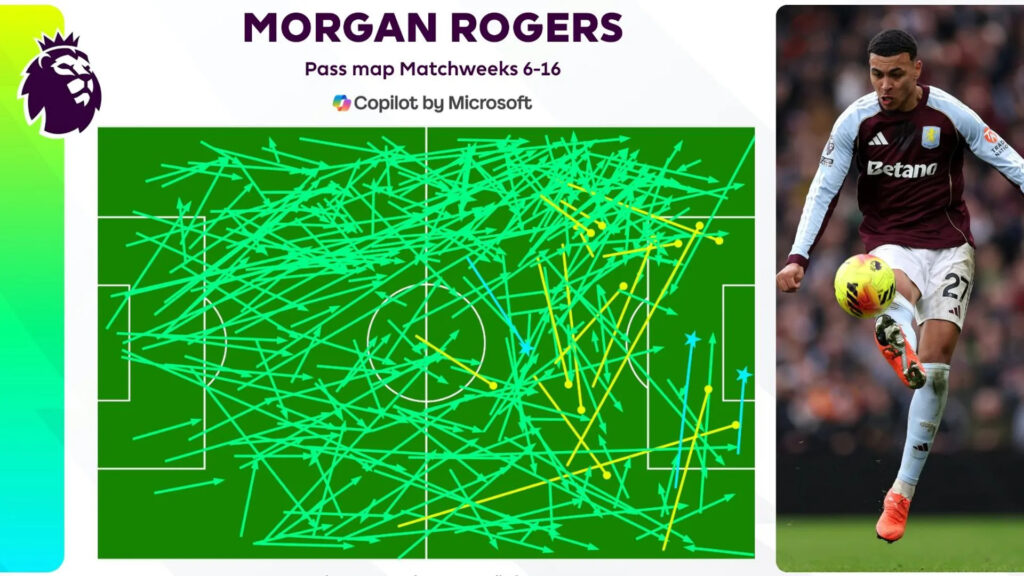
If his current form continues, Rogers certainly has potential to drive Aston Villa towards a very special campaign. He is their talisman, which is why his own form has mirrored that of the side. The lesson is abundantly clear: if Emery gets the best out of Morgan Rogers, his team have a significantly better chance of securing positive results.
Impact on Villa’s Title Challenge
The transformation of Morgan Rogers has coincided perfectly with Aston Villa’s surge up the Premier League table. Their record of 10 wins from 11 matches has propelled them into genuine title contention, with the club now sitting just points behind the leaders and establishing a gap to fourth place.
Rogers’ five goals and three assists during this period have directly contributed to crucial victories. More importantly, his ability to carry the ball forward, create space for teammates, and provide a goal threat from midfield has given Aston Villa a dimension they lacked during their difficult start.
His stunning strikes—particularly the technique he’s developed for those dipping side-foot efforts—have provided Villa with a potent weapon from distance. Opposing teams can no longer sit deep and compact without consequence, as Rogers has demonstrated the ability to punish them from 20-25 yards.
Looking Ahead
Morgan Rogers’ journey from jeered substitute to Aston Villa’s talisman represents more than just personal redemption—it exemplifies the mental strength required to succeed at the highest level. His response to criticism, commitment to physical conditioning, and dedication to technical improvement have elevated him from promising talent to genuine difference-maker.
For Aston Villa, maintaining this form through the congested festive period will prove crucial to their title aspirations. Rogers’ fitness, confidence, and tactical understanding are all at peak levels, but consistency over the coming months will determine whether Villa can genuinely challenge Arsenal and Manchester City at the summit.
As Unai Emery noted, the difficult experiences early in the season have contributed to Rogers’ growth. Now fully fit, tactically liberated, and technically refined, the England international has all the tools to drive his club toward an extraordinary achievement while simultaneously cementing his place in Thomas Tuchel’s World Cup plans.
Read More: Why Hugo Ekitiké Deserves to Be Liverpool’s First-Choice Striker Over Alexander Isak