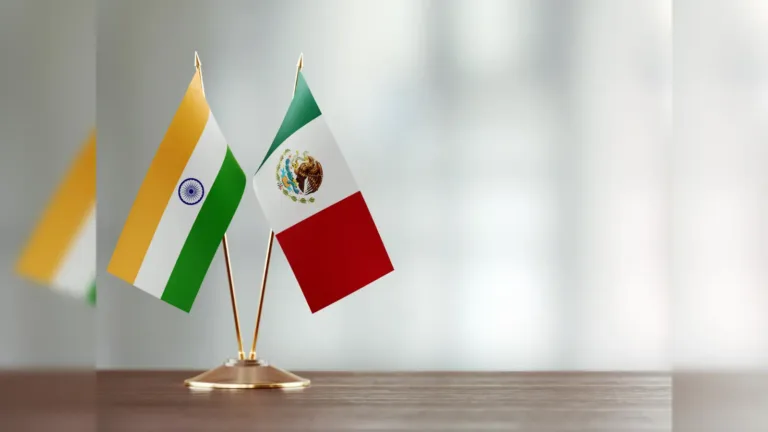
In a landmark shift for a nation long committed to free trade, Mexico’s Senate has given final approval to a bill that will impose new and increased tariffs ranging from 5% to 50% on a vast array of imports from Asian countries. The legislation, which passed on December 10, 2025, is primarily aimed at protecting Mexico’s domestic industry from what officials term unfair competition, and it is set to take effect on January 1, 2026.
The new duties will apply to more than 1,400 product categories originating from Asian nations that do not have a standing Free Trade Agreement (FTA) with Mexico. The move has drawn immediate and sharp criticism from affected governments, most notably China, and signals a more protectionist trade posture for the North American country.
Mexico Tariffs India: Geopolitical Alignment and Domestic Protection
The legislative action is framed by the government of President Claudia Sheinbaum as a necessary measure to shield local employment and manufacturing sectors, particularly in the face of massive output from overseas factories. However, trade analysts widely view the tariffs as an alignment with mounting pressure from the United States.
The US Factor: Easing Trade Tensions
Passage of the bill comes amid high-stakes trade talks and considerable pressure from Washington, which has been urging Mexico to curb the flow of low-cost Chinese goods that are increasingly suspected of being “trans-shipped” through Mexico to circumvent US tariffs. The hope among Mexican policymakers is that this action could ease the threat of punitive US tariffs, such as those targeting Mexican steel and aluminum, ahead of the critical 2026 review of the United States-Mexico-Canada Agreement (USMCA).
While President Sheinbaum has publicly denied any direct coordination with the US tariff strategy, the new import levies closely resemble Washington’s aggressive approach toward the Asian giant.

Who and What Will Be Hit the Hardest?
The new tariff regime targets a wide cross-section of manufacturing, with the steepest duties reserved for high-value finished products. The list of affected countries includes key economies such as:
- China
- India
- South Korea
- Thailand
- Indonesia
Key Sectors Facing New Tariffs
The legislation’s most significant impact will be felt across several major industrial sectors, which face rates up to 50%.
- Automobiles and Auto Parts: Chinese cars, which have rapidly captured up to 20% of the Mexican market, will face tariffs as high as 50%. Exporters from India, a major source of auto and auto parts shipments to Mexico, also face considerable disruption.
- Textiles and Clothing: This sector, along with footwear, is a core area for domestic protection, with many products facing duties of up to 35%.
- Metals and Plastics: Imports of steel, aluminum, and various plastic goods are included in the new tariff lines, reflecting an effort to support local primary material production.
To prevent undue harm to local assembly plants, certain essential inputs and specific components were subject to lower, “softened” rates, sometimes falling between 5% and 10%.
Economic Fallout and International Response
The tariffs are projected by Mexico’s Finance Ministry to generate an additional revenue stream of approximately 52 billion pesos (about $2.8 billion to $3.8 billion) in the first year alone. Yet, the economic ramifications are complex, generating concern both at home and abroad.
Warnings from Mexican Business
Despite the official rationale of protection, domestic manufacturers who rely on cost-effective inputs from Asia—particularly China, India, and South Korea—have voiced strong opposition. They warn that the increased costs will inevitably lead to higher operational expenses and could ultimately fuel consumer inflation across Mexico.
China’s Caution and Global Trade Impact
China’s Ministry of Commerce has already responded, condemning the tariffs as “unilateral” and “protectionist.” Beijing confirmed it would closely monitor the new regime and warned that the measures could “significantly harm the interests of trade,” leaving the possibility of retaliatory actions on the table. For India, whose annual auto exports to Mexico are valued in the billions, industry groups are now lobbying for the commencement of formal Free Trade Agreement talks to mitigate the looming financial impact.
The introduction of this sweeping tariff package marks a definitive turning point in Mexican trade policy, moving away from its decades-long embrace of broad free trade and towards a more assertive role in the global geopolitical trade standoff.