Intel’s next-generation workstation processor, the Xeon 696X (codename Granite Rapids-WS), has surfaced in the PassMark benchmark database, revealing impressive specifications that signal Intel’s commitment to competing in the high-end workstation market. The processor delivers massive computing power targeting professionals in content creation, scientific computing, and enterprise applications.
Specifications: A Powerhouse on Paper
The Xeon 696X features 64 cores and 128 threads built on Intel’s Redwood Cove architecture. The chip boasts a massive 336 MB of L3 cache and 128 MB of L2 cache—delivering the data throughput necessary for demanding workloads. Base clock sits at 2.4 GHz, while boost frequencies reach 4.6 GHz under optimal conditions.
Power consumption reflects its performance tier: a base thermal design power (TDP) of 350W, scaling to 450-500W under maximum turbo power (MTP) conditions. This positions it as a high-performance but power-hungry solution requiring robust cooling infrastructure.
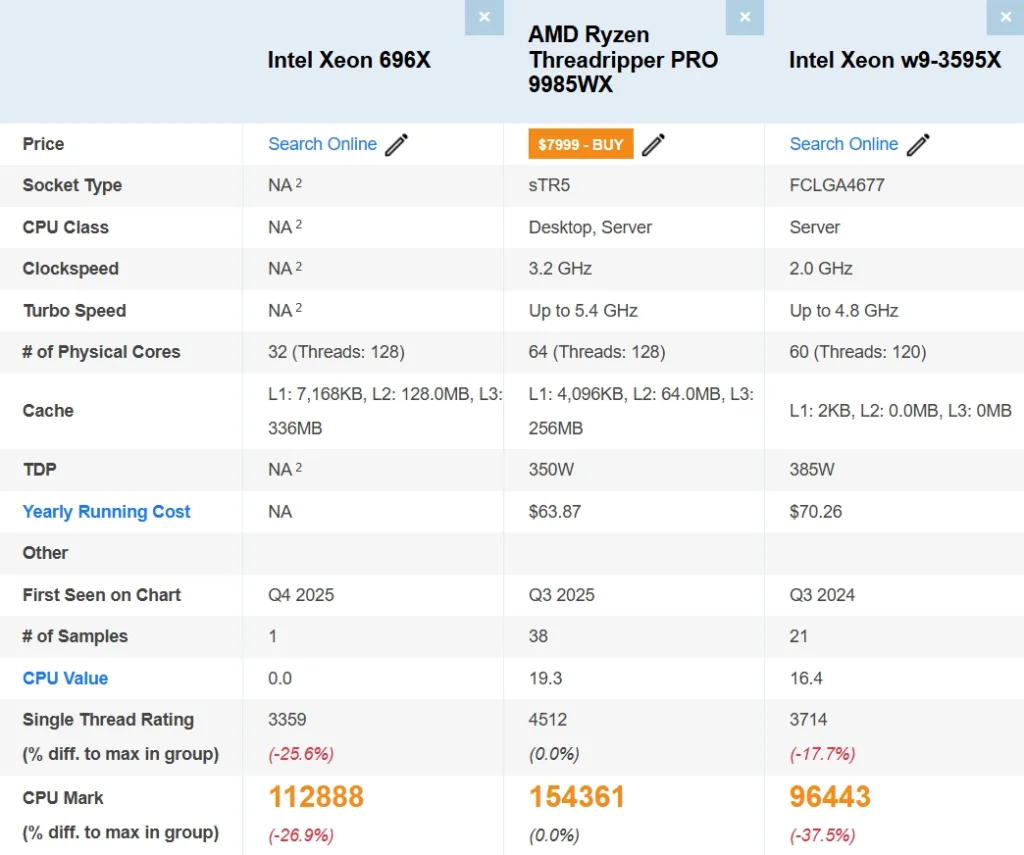
PassMark Performance Results
Benchmark results show the 696X achieving single-core scores of 3,359 and multi-core scores of 112,888. While respectable, these numbers reveal a competitive challenge: AMD’s Threadripper PRO 9985WX (also 64-core, Zen 5 architecture) outperforms Intel by approximately 27% in multi-core performance—a significant gap for workstation professionals.
However, comparing against Intel’s previous flagship Xeon W9-3595X (60 cores), the 696X demonstrates 17% multi-core performance improvement, showing generational progress within Intel’s lineup.
Engineering Sample Status Signals Future Potential
Interestingly, the 696X’s single-core performance underperforms its predecessor—an anomaly suggesting the leaked benchmark data originates from engineering samples (ES) rather than final retail versions. This discovery is encouraging, as it implies firmware optimization and final production tuning could boost performance further.

Granite Rapids Series Complete Lineup
The 696X sits within Intel’s comprehensive Granite Rapids workstation family, which includes the flagship 86-core Xeon 698X and entry-level 18-core Xeon 654. The full stack addresses workstation requirements across price points and performance tiers.
| Processor | Cores/Threads | Base/Boost | L3 Cache | TDP |
|---|---|---|---|---|
| Xeon 698X | 86/172 | 2.0/Unknown | 336 MB | 350W |
| Xeon 696X | 64/128 | 2.4/4.6 | 336 MB | 350W |
| Xeon 654 | 18/36 | 3.1/4.6 | 72 MB | Unknown |
Market Implications
While Intel trails AMD in multi-core performance, the Xeon 696X represents solid generational improvement. For professionals locked into Intel ecosystems, the performance gains justify considering upgrades. For new workstation purchases, the 27% performance gap versus AMD warrants careful evaluation based on specific application requirements and software optimization.
The engineering sample status offers hope for improved final performance, making 2026 a critical year for Intel’s workstation competitiveness.
Learn More:
For processor benchmarks and enterprise hardware news, follow TechnoSports.
Last Updated: December 2025 | Final specifications subject to Intel’s official announcement.