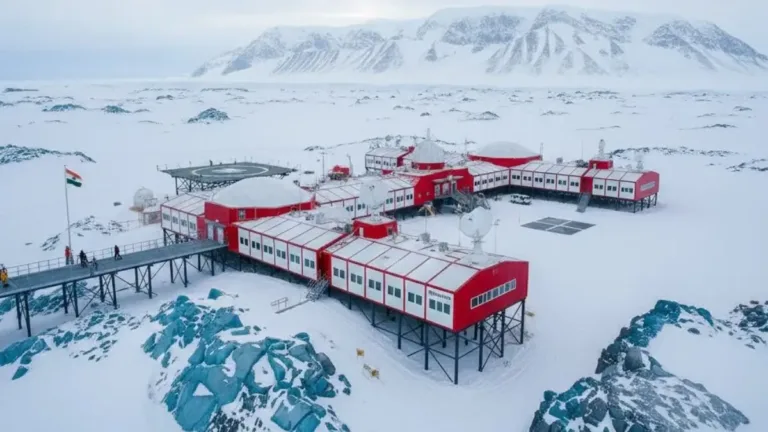
India’s polar research expansion faces a timeline adjustment. The Centre informed Parliament that Maitri II, the next-generation Antarctic research station, won’t be operational until 2032—three years beyond the original 2029 target. While polar infrastructure delays are common due to extreme logistics, this postponement impacts India’s strategic positioning in Antarctic research.
Maitri II Project Timeline and Budget Allocation
The Ministry of Earth Sciences has approved ₹29.2 crore for pre-investment activities, including architectural design and detailed project reports. The total project cost is estimated at approximately ₹1,250 crore, reflecting the complexity of building state-of-the-art infrastructure in one of Earth’s most hostile environments.

| Project Phase | Duration | Key Activities |
|---|---|---|
| Design & Planning | 18 months | Master plan, consultant appointment |
| Procurement | 18 months | Mainland purchase, pre-fabrication |
| Transportation | 18 months | Cape Town to Antarctica site |
| Construction | 12 months | On-site assembly in Antarctica |
| Total Timeline | 7 years | Completion by 2032 |
Why Maitri II Matters for India’s Scientific Future
The current Maitri station, operational since 1989, has exceeded its 10-year design life by over three decades. It faces structural issues and waste management challenges that modern environmental protocols cannot accommodate. Maitri II represents a quantum leap positioning India among top-tier Antarctic research nations.
According to the National Centre for Polar and Ocean Research (NCPOR), Maitri II will enhance India’s capabilities in biology, earth sciences, glaciology, atmospheric sciences, and climate studies. The station accommodates 90 personnel—double Maitri’s capacity—operating year-round with modern laboratories, ice-core storage, biological research units, and atmospheric observation infrastructure. It will be powered entirely by solar and wind energy, complying with the Antarctic Treaty Environmental Protocol.

India’s Growing Antarctic Footprint
India operates two Antarctic research stations: Maitri (since 1989) and Bharati (since 2012). Dakshin Gangotri (1983) was decommissioned after ice burial. Maitri II will be India’s fourth facility, strengthening its position as a Consultative Party to the Antarctic Treaty.
This expansion is strategically significant as China aggressively expands its Antarctic presence with dual-use infrastructure. India’s Maitri II investment demonstrates commitment to scientific parity and contributing climate data. For those tracking frontier science and technology, Maitri II secures India’s voice in climate negotiations, showcasing technological competence in a geopolitically sensitive region.
Frequently Asked Questions
Q: Why is the Maitri II project delayed from 2029 to 2032?
The delay is attributed to the extreme logistical challenges inherent in polar infrastructure development, including procurement timelines, weather-dependent transportation windows, and the complexity of constructing modern facilities in Antarctica’s harsh conditions while meeting strict environmental protocols.