India is no longer just talking about chips — it’s building them. Under the India Semiconductor Mission, a wave of approved investments worth well over $18 billion is transforming states like Gujarat, Assam, Odisha, and Uttar Pradesh into genuine semiconductor manufacturing hubs. From memory chips to compound semiconductors, here’s a complete breakdown of every major approved project — and what each one actually means for India’s tech future.
Table of Contents
Why This Matters
Semiconductors quietly power everything around us — smartphones, cars, data centres, defence systems, and the AI boom reshaping global technology. For decades, India imported nearly all its chips, leaving it exposed to global supply shocks. Now, as manufacturers diversify away from a handful of concentrated hubs, India is positioning itself as a serious alternative — starting with assembly, testing, and packaging, and building steadily toward full-scale chip fabrication.
Approved Semiconductor Investments in India
| Company | Investment (Approx.) | Location |
|---|---|---|
| Tata Electronics (with PSMC) | ~$10.52 billion | Dholera, Gujarat |
| Tata Semiconductor Assembly | ~$3.12 billion | Morigaon, Assam |
| Micron Technology | ~$2.60 billion | Sanand, Gujarat |
| CG Power (with Renesas & Stars) | ~$879 million | Sanand, Gujarat |
| Crystal Matrix Limited (CML) | ~$355 million | Dholera, Gujarat |
| Kaynes Semiconductor | ~$383 million | Sanand, Gujarat |
| HCL–Foxconn JV | ~$428 million | Jewar, Uttar Pradesh |
| SicSem Private Limited | ~$239 million | Bhubaneswar, Odisha |
| 3D Glass Solutions Inc. | ~$224 million | Bhubaneswar, Odisha |
| Suchi Semicon Pvt Ltd (SSPL) | ~$101 million | Surat, Gujarat |
| ASIP | ~$54 million | Andhra Pradesh |
| Sahasra Semiconductors | ~$17 million | Bhiwadi, Rajasthan |
| CDIL (Continental Device) | ~$14 million | Mohali, Punjab |
A Closer Look at Each Project

Tata Electronics (with PSMC) — ~$10.52 billion, Dholera, Gujarat
This is the crown jewel of India’s semiconductor push. Tata’s partnership with Taiwan’s Powerchip Semiconductor Manufacturing Corporation (PSMC) is building India’s first true wafer fabrication facility — the step where raw silicon is actually turned into functioning chips. At this scale of investment, it’s not just India’s biggest chip project, it’s one of the largest industrial investments in the country’s history.
Tata Semiconductor Assembly — ~$3.12 billion, Morigaon, Assam
Tata’s second major bet takes the mission far beyond western India. This assembly and test facility in Assam is a deliberate move to spread semiconductor manufacturing into the Northeast, creating high-skill jobs in a region that has historically seen far less large-scale industrial investment.
Micron Technology — ~$2.60 billion, Sanand, Gujarat
One of the world’s biggest memory chip makers, Micron’s Sanand facility handles assembly, testing, and packaging for DRAM and NAND flash chips used in phones, data centres, and vehicles. It holds the distinction of being among the first facilities under this mission to reach commercial production — proof the strategy is actually working.

CG Power (with Renesas and Stars) — ~$879 million, Sanand, Gujarat
A three-way partnership between India’s CG Power, Japan’s Renesas, and Thailand’s Stars Microelectronics, this ATMP facility adds serious international credibility to Sanand’s growing cluster, blending Indian manufacturing scale with established Japanese and Southeast Asian chip expertise.
Crystal Matrix Limited (CML) — ~$355 million, Dholera, Gujarat
Sitting alongside the Tata-PSMC fab, CML is building an integrated compound semiconductor and ATMP facility focused on Mini and Micro-LED displays — a fast-growing niche as screens across devices get thinner, brighter, and more energy-efficient.
Kaynes Semiconductor — ~$383 million, Sanand, Gujarat
Kaynes runs a compact but strategically important OSAT (outsourced semiconductor assembly and test) unit. Like Micron, it has already moved into commercial production, reinforcing Sanand’s reputation as India’s most active packaging hub.
HCL–Foxconn JV — ~$428 million, Jewar, Uttar Pradesh
This joint venture between Indian IT giant HCL and Taiwanese electronics major Foxconn taps into Uttar Pradesh’s rapidly expanding electronics manufacturing corridor, conveniently positioned near the upcoming Jewar international airport for smoother logistics and exports.

SicSem Private Limited — ~$239 million, Bhubaneswar, Odisha
SicSem is setting up India’s first commercial Silicon Carbide (SiC) fabrication facility. SiC chips are increasingly essential for electric vehicles, power electronics, and renewable energy systems, where they significantly outperform traditional silicon-based chips.
3D Glass Solutions Inc. — ~$224 million, Bhubaneswar, Odisha
Working alongside SicSem in Odisha’s emerging cluster, 3D Glass Solutions focuses on advanced heterogeneous packaging technology — a critical capability for building compact, high-performance chip modules used in 5G and next-generation electronics.
Suchi Semicon Pvt Ltd (SSPL) — ~$101 million, Surat, Gujarat
Adding another node to Gujarat’s dominance, Suchi Semicon’s OSAT facility in Surat further strengthens the state’s position as the country’s semiconductor packaging heartland.
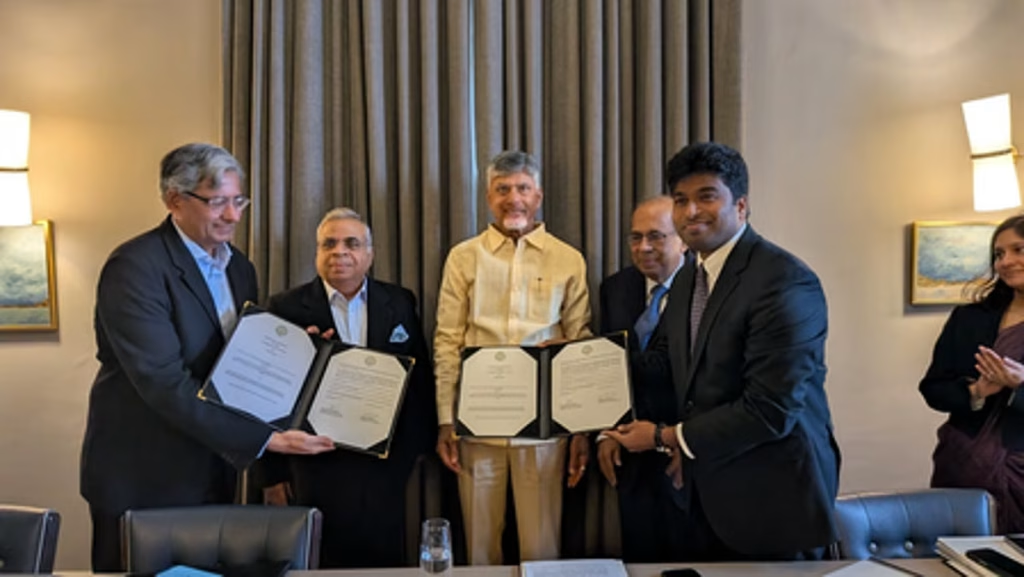
ASIP — ~$54 million, Andhra Pradesh
ASIP brings semiconductor investment into Andhra Pradesh’s growing tech corridor, signalling that the mission’s footprint is steadily widening beyond the established hubs.
Sahasra Semiconductors — ~$17 million, Bhiwadi, Rajasthan
A smaller but meaningful investment, Sahasra’s Rajasthan facility shows that even modest-scale projects are finding a home under India’s semiconductor push, diversifying the map further.
CDIL (Continental Device) — ~$14 million, Mohali, Punjab
Rounding off the list, CDIL’s Mohali facility proves the mission isn’t just about mega-billion-dollar fabs — smaller, established players are also expanding their semiconductor capabilities across India.
The Bigger Picture
Together, these approvals mark a fundamental shift: India moving from being a chip importer to becoming a genuine chip manufacturer. It’s no accident that packaging and testing facilities came online first — they’re faster to build and less capital-intensive than fabrication. Full-scale chip fabrication, the hardest and most complex step in the entire process, is now following at Dholera, where officials have targeted first output by late 2026.
For a country that spends tens of billions of dollars importing chips every year, this isn’t just industrial policy on paper — it’s a long-term, multi-state bet on self-reliance in one of the most strategically critical technologies of this century. As more of these facilities move from groundbreaking to commercial production, India’s role in the global semiconductor supply chain is set to grow substantially over the next few years.
Want more deep dives into India’s biggest industrial, tech, and business developments? Explore more insightful coverage on TechnoSports.
FAQs
Q1. Which is India’s biggest approved semiconductor investment?
Tata Electronics’ fab with PSMC in Dholera, Gujarat, leads at roughly $10.52 billion — India’s first true wafer fabrication facility.
Q2. Which state has the most semiconductor projects approved?
Gujarat leads by far, hosting major projects across both Dholera and Sanand, making it India’s largest semiconductor investment hub.