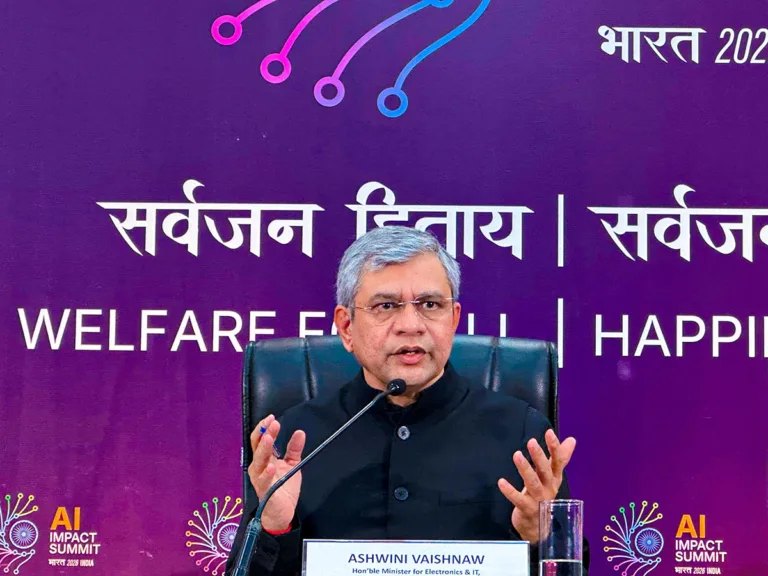
India is scaling its national AI compute infrastructure faster than almost any other country. At the India AI Impact Summit 2026, Union IT Minister Ashwini Vaishnaw announced that orders for 20,000 new GPUs will be placed within a week, with deployment expected over the next six months — taking India’s total sovereign compute base from 38,000 to over 58,000 high-end GPUs under AI Mission 2.0.
India AI Mission 2.0: Key Numbers at a Glance
What makes India’s compute approach genuinely different from most countries: access is democratised. These GPUs are available to startups, researchers, and students at approximately ₹65 per hour — roughly one-third of the global average cloud compute rate.
| Detail | Figure |
|---|---|
| Existing GPU Base | 38,000 high-end GPUs (IndiaAI Mission) |
| New GPUs Being Added | 20,000 — orders placed within 1 week |
| Total After Expansion | 58,000+ GPUs |
| Deployment Timeline | Within 6 months of order |
| Access Cost | ~₹65/hour — ~⅓ of global average |
| Expected AI Investment (2 years) | $200B across five layers of AI stack |
| VC Commitment (deep-tech) | $70M confirmed; more expected |
| Total Investment Projection | Up to $400B+ across AI stack layers |
| Deep-tech Startups Expected | 50+ in coming years |
| Countries in AI Policy Dialogue | ~30 nations |
| Energy Efficiency Target | 35% reduction in AI infra energy use |
| Clean Energy Share | 51% of India’s power generation capacity |
| Tech Sector Revenue (2026) | $280B projected |
| AI GDP Contribution by 2035 | $1.7 trillion |

What AI Mission 2.0 Means Beyond the GPU Count
The original IndiaAI Mission was about building the foundation — getting GPUs onboarded and making them accessible. Mission 2.0 shifts focus to R&D, innovation, and diffusion — turning raw compute into competitive IP and globally relevant AI products.
Vaishnaw described this as the “fifth industrial revolution” and framed India’s approach as structurally different from Western models. In most countries, AI infrastructure is controlled by a handful of corporations — Meta, Google, Microsoft, Amazon. India’s model puts sovereign compute in a common pool, accessible at subsidised rates to anyone in the ecosystem.
The semiconductor angle is equally significant. Semiconductor 2.0 will focus on chip design rather than fabrication — a pragmatic choice given the capital intensity of fabs, and one that plays to India’s existing engineering talent base. At least 50 deep-tech startups are expected to emerge from this focus in the coming years.

On AI governance, Vaishnaw confirmed India is in dialogue with approximately 30 countries on policy and regulatory frameworks, pushing for a “techno-legal” approach — and called for much stronger global regulation on deepfakes, particularly to protect children.
For the official government statement, visit the Press Information Bureau release.
Check our India AI Mission coverage on TechnoSports and India AI Impact Summit 2026 full roundup.