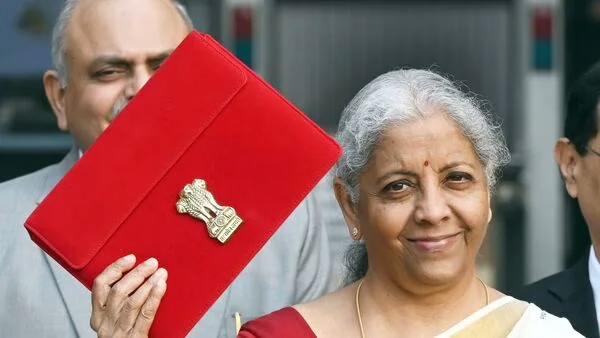
Finance Minister Nirmala Sitharaman presented India’s Union Budget 2026-27 on February 1, 2026—making history as the first budget ever tabled on a Sunday and her ninth consecutive budget presentation. Packed with decisions affecting every Indian household, the budget can feel overwhelming. Don’t worry. Here’s everything broken down in the simplest terms possible.
What Is the Union Budget 2026? (For Those Who Aren’t Sure)
Think of the Union Budget as the government’s annual financial plan. Every year, the government collects money through taxes and spends it on things like roads, schools, hospitals, defence, and welfare schemes. The budget tells us how much money comes in, how much goes out, and where exactly it’s being spent.
The budget covers April 2026 to March 2027—what the government calls “FY27.”
💰 The Big Numbers at a Glance
| What | How Much | What It Means |
|---|---|---|
| Capital Expenditure | ₹12.2 lakh crore | Government spending on infrastructure—up 9% from last year |
| Fiscal Deficit Target | 4.3% of GDP | The gap between what govt earns and spends—slightly improved |
| Transport Allocation | ₹5.98 lakh crore | Highest allocation of any sector this year |
| Defence Allocation | ₹5.94 lath crore | Second highest—close to transport |
| Rural Development | ₹2.73 lakh crore | Major push for village-level improvements |
| Agriculture | ₹1.62 lakh crore | Supporting India’s farming backbone |
| Electronics Manufacturing | ₹40,000 crore | Big push to make India a global electronics hub |
🏦 Income Tax: Did Anything Change for You?
Short answer: No major changes this year.
Finance Minister Sitharaman confirmed there are no changes in income tax slabs. The good news? The zero-tax limit up to ₹12 lakh (₹12.75 lakh for salaried taxpayers including standard deduction) introduced last year continues.
What DID change:
- The deadline for filing revised income-tax returns has been extended from December 31 to March 31. Taxpayers can now make corrections by paying a nominal fee.
- The new Income Tax Act will be implemented from April 1, 2026, with simplified rules and tax return forms to be notified shortly.
- The government proposed to reduce TCS rate on the sale of overseas tour program packages from the current 5% and 20% to 2% without any stipulation of amount.
In simple terms: If you earn under ₹12.75 lakh annually, you pay zero tax. Filing returns just got easier with more time and simpler forms.
🚂 Infrastructure: Roads, Rails, and Connectivity
This is where the budget gets exciting. Seven high-speed rail corridors are coming up as part of efforts to boost connectivity, with key routes including Mumbai to Pune, Pune to Hyderabad, Hyderabad to Bengaluru, and Bengaluru to Chennai.
Why does this matter?
- Faster travel between major cities
- Massive job creation during construction
- Boost to local economies along the routes
- Reduced carbon emissions compared to air travel
A dedicated freight corridor from Dankuni in West Bengal to Surat in Gujarat has been announced to promote environmentally sustainable passenger and cargo movement.
Capital expenditure—money spent on building things like highways, railways, and power plants—has been raised to ₹12.2 lakh crore, a 9% increase. This is the government’s way of saying: “We’re investing heavily in India’s future infrastructure.”
🛡️ Defence: Strengthening National Security
Defence received ₹5.94 lakh crore—the second highest allocation after transport. This money goes toward:
- Modernizing military equipment
- Indigenous defence manufacturing (buying Indian-made weapons instead of importing)
- Soldier welfare and pensions
- Cybersecurity and technology upgrades
The push toward “Atmanirbhar Bharat” (self-reliant India) in defence continues, with greater emphasis on domestic manufacturing reducing dependence on foreign suppliers.
👨🌾 Agriculture: Supporting India’s Farmers
With nearly half of India’s workforce involved in farming, agricultural support remains critical:
- ₹1.62 lakh crore allocated for agriculture and allied activities
- Continued support for crop insurance schemes
- Enhanced irrigation infrastructure
- Focus on making farming more profitable and sustainable
In simple terms: The government continues ensuring farmers earn better and face fewer risks from unpredictable weather and market fluctuations.
💊 Healthcare and Education
Healthcare:
- Three new All India Institute of Ayurveda have been proposed.
- Around ₹10,000 crore has been allocated for the biopharma sector.
- Five regional medical hubs to promote medical tourism
Education:
- One girls’ hostel will be established in every district of the country.
- New interventions have been proposed to create skilled career pathways for youth.
- Continued focus on skill development and employment generation
🏭 Manufacturing and Technology: Making India a Global Hub
The outlay on electronics manufacturing has been raised to ₹40,000 crore in FY27, signalling a continued push to make India a global manufacturing hub.
Other big announcements:
- India Semiconductor Mission 2.0 has been launched with a focus on industry-led R&D and training centres for chips.
- Mineral-rich states of Odisha, Kerala, Andhra Pradesh, and Tamil Nadu will establish dedicated rare earth corridors to promote mining, processing, research and manufacturing.
- Basic customs duty exemption has been given on capital goods used for manufacturing Lithium-Ion Cells for batteries and battery energy storage systems.
Why this matters: India currently imports most of its electronics and semiconductors. These moves aim to build domestic capability, create jobs, and reduce import dependency—especially critical in an era of global supply chain disruptions.
♻️ Green Energy and Climate
The budget continues India’s commitment to clean energy:
- Customs duty exemptions on battery manufacturing components
- Support for solar and renewable energy infrastructure
- Nuclear power project imports exempted from duty until 2035
- Rare earth corridors enabling domestic processing of critical minerals
👩 Women and Social Welfare
Building on the success of the Lakhpati Didi program, the government proposed helping women take the next step from credit-linked livelihoods to being owners of enterprises. Self-help entrepreneur outlets will be set up as community-owned retail outlets within cluster-level federations through enhanced and innovative financing instruments.
Additionally, girls’ hostels in every district and expanded social security coverage signal continued focus on gender equality and inclusive growth.
📊 Customs Duty Changes: What Gets Cheaper and More Expensive?
Getting Cheaper (Duty Reduced/Exempted):
- Battery manufacturing components
- Nuclear power project equipment
- Aircraft parts and components
- Capital goods for lithium-ion cell manufacturing
- Overseas tour packages (TCS reduced)
Getting More Expensive (Exemptions Removed):
- Customs duty exemptions on items manufactured in India or where the imports are negligible will be removed. This encourages buying Indian-made products over imports.
🤔 What Does This Budget 2026 Mean for YOU?
| If You Are… | What Changes for You |
|---|---|
| Salaried employee (under ₹12.75L) | Zero income tax continues. Filing returns gets easier |
| Farmer | Continued support through insurance, irrigation, and credit |
| Young professional | Job creation through infrastructure, manufacturing, and tech |
| Traveler | Overseas tour packages become slightly cheaper |
| Homeowner | Infrastructure improvements increase property values |
| Business owner | Manufacturing incentives and simplified compliance |
| Student | Better hostel facilities and career pathway programs |
The Bottom Line
Budget 2026-27 prioritises infrastructure, manufacturing self-reliance, and steady economic growth while maintaining fiscal discipline. There’s no dramatic income tax overhaul—the government is keeping things stable after last year’s significant reforms. The big story is massive investment in railways, electronics manufacturing, semiconductors, and green energy—building the foundations for India’s next decade of growth.
The fiscal deficit target of 4.3% shows the government is borrowing slightly less relative to the economy, signaling confidence in revenue growth and sustained economic momentum toward the “Viksit Bharat 2047” vision.
Stay updated on how Budget 2026-27 impacts India’s technology and EV sectors at TechnoSports.co.in.