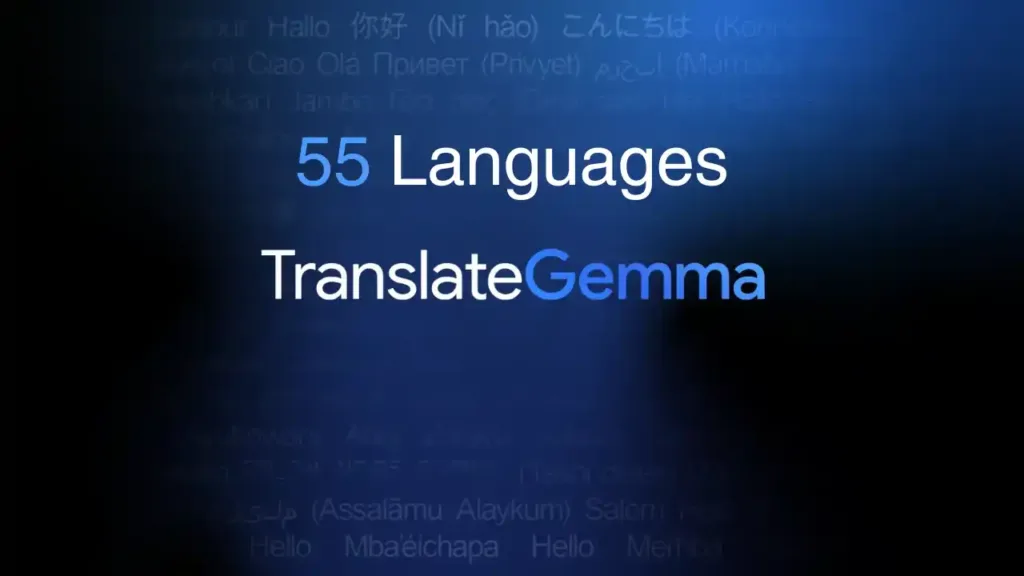
Google unveiled TranslateGemma on January 15, 2026, a groundbreaking suite of open translation models built on Gemma 3 architecture supporting 55 languages. Available in 4B, 12B, and 27B parameter sizes, these models run locally on devices from smartphones to cloud servers, offering developers unprecedented control over translation without relying on closed-source systems like ChatGPT Translate.
The release represents a significant efficiency breakthrough: the 12B model outperforms the larger 27B Gemma 3 baseline on the WMT24++ benchmark, delivering high-fidelity translation with less than half the parameters.
Table of Contents
Open Weights vs. Closed Systems
TranslateGemma’s biggest differentiator is openness. Unlike ChatGPT Translate, which operates exclusively through cloud APIs, TranslateGemma provides downloadable model weights that developers can run on private servers, custom hardware, or edge devices without sending data to external servers. This matters tremendously for companies handling sensitive information or operating in regions with unreliable internet connectivity.
The timing is strategic—Google released TranslateGemma just hours after OpenAI launched ChatGPT Translate, positioning it as the privacy-focused, developer-friendly alternative. Where ChatGPT excels at contextual tone, TranslateGemma emphasizes transparency, local deployment, and data sovereignty.
| Model Size | Target Device | Performance |
|---|---|---|
| 4B parameters | Mobile phones, edge devices | Rivals 12B baseline quality |
| 12B parameters | Consumer laptops | Outperforms 27B baseline |
| 27B parameters | Single NVIDIA H100 GPU/TPU | Maximum translation quality |

Two-Stage Training Process
Google achieved this density through specialized training combining supervised fine-tuning and reinforcement learning. First, TranslateGemma learns from high-quality human translations and synthetic data generated by Gemini models. Second, reinforcement learning with advanced metrics like MetricX-QE and AutoMQM guides the models toward natural, contextually accurate translations.
Importantly, 30% of training data maintains general instruction-following capabilities from Gemma 3, preventing over-specialization. This means TranslateGemma retains reasoning abilities and follows instructions beyond pure translation tasks.
Multimodal Translation Without Extra Training
TranslateGemma inherited Gemma 3’s multimodal capabilities, enabling text translation within images without additional fine-tuning. Testing on the Vistra image translation benchmark showed strong performance translating signs, menus, and scanned documents captured by cameras—critical for real-world applications like travel assistants and document scanning.
This zero-shot image translation capability emerged naturally from improved text translation quality, demonstrating how foundational language understanding transfers across modalities.
Deployment Flexibility Across Devices
The 4B model is optimized specifically for mobile inference, allowing smartphones and edge hardware to perform high-quality translation locally. The 12B model runs smoothly on consumer laptops, enabling researchers and small development teams to experiment without cloud costs. The 27B model targets enterprise deployments requiring maximum quality with single-GPU efficiency.
This tiered approach democratizes access—hobbyists can prototype on laptops while enterprises scale to cloud infrastructure using the same open architecture.

Tested on 55 Languages, Trained on 500
While TranslateGemma has been rigorously evaluated on 55 core language pairs covering high-, mid-, and low-resource languages, Google trained the models on nearly 500 additional pairs for future research. Testing showed TranslateGemma considerably reduced error rates compared to baseline Gemma models across all language families, including underserved languages where training data is traditionally limited.
Available Now on Major Platforms
Developers can download TranslateGemma immediately through Kaggle, Hugging Face, and Vertex AI with complete technical documentation. The open licensing encourages experimentation, fine-tuning for specialized domains, and integration into existing workflows without vendor lock-in.
Google’s push toward open translation models reflects broader industry trends favoring transparency and local deployment over proprietary cloud services. For developers building multilingual applications, TranslateGemma offers research-grade translation without industrial-scale hardware or ongoing API costs.
For more updates on AI translation and language models, visit TechnoSports. Access TranslateGemma on Google’s official blog.
FAQs
What makes TranslateGemma different from ChatGPT Translate?
TranslateGemma provides open model weights for local deployment on any device, while ChatGPT Translate requires cloud connectivity and keeps its architecture closed.
Can TranslateGemma run on smartphones?
Yes, the 4B parameter model is specifically optimized for mobile and edge devices, enabling high-quality translation directly on smartphones.