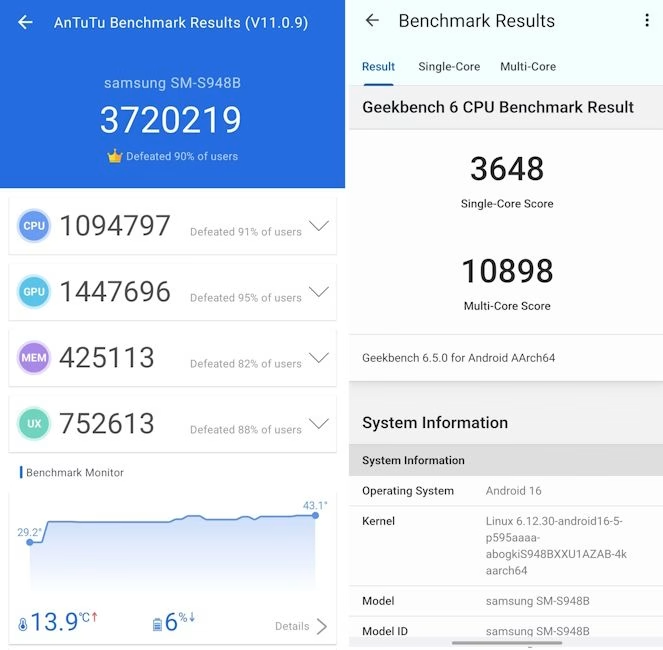
The Galaxy S26 Ultra has been benchmarked in the wild — and two of the three numbers are exactly what Samsung needed. A production unit posted by tipster Sahil Karoul on X shows an AnTuTu score of 3,720,219, Geekbench 6 single-core of 3,648 and multi-core of 10,898, and a 3DMark Wild Life Extreme Stress Test stability of 53.2% with a 34°C–44°C temperature range. That last result is the headline: the S25 Ultra hit 70% stability but ran nearly 20°C hotter under the same test — meaning the S26 Ultra is running cooler in sustained load despite the more powerful chip.
Table of Contents
Galaxy S26 Ultra vs S25 Ultra: Benchmark Comparison
The Snapdragon 8 Elite Gen 5 for Galaxy is a custom Samsung-tuned version with prime cores overclocked to 4.74GHz — higher than the standard chip used by other Android flagships.
| Benchmark | Galaxy S26 Ultra | Galaxy S25 Ultra | Change |
|---|---|---|---|
| AnTuTu | 3,720,219 | 2,441,258 | +52% |
| Geekbench 6 Single-Core | 3,648 | 3,057 | +19% |
| Geekbench 6 Multi-Core | 10,898 | 9,846 | +11% |
| 3DMark WLE Stability | 53.2% | ~70% | Lower stability |
| Peak Temperature (3DMark) | 44°C | ~63°C | 19°C cooler |
| Temperature Rise | 34°C → 44°C (+10°C) | ~43°C → 63°C (+20°C) | Half the rise |
| Chipset | Snapdragon 8 Elite Gen 5 for Galaxy | Snapdragon 8 Elite for Galaxy | Gen bump |
| Prime Core Clock | 4.74GHz (×2) | 4.47GHz (×2) | +6% |
| Perf Core Clock | 3.63GHz (×6) | 3.53GHz (×6) | +3% |
| GPU | Adreno 840 | Adreno 830 | One generation |
| Cooling | Larger vapor chamber (confirmed) | Standard vapor chamber | Bigger |
| RAM | Up to 16GB | Up to 12GB | +4GB top tier |

What 53.2% Stability Actually Means
The 3DMark stability number looks worse on paper — the S25 Ultra’s 70% is a higher percentage. But stability in this context measures how consistently the device maintains peak GPU output across the full stress test. A lower stability with a much lower temperature tells a different story: the S26 Ultra’s Adreno 840 is being allowed to push higher GPU frames early in the test, which then drops more as thermals accumulate — but it’s doing all of this at 44°C peak, not 63°C.
The practical implication: in 15–20 minute gaming sessions, the S26 Ultra runs meaningfully cooler and more comfortably in hand. The larger vapor chamber Samsung confirmed is doing real work — halving the temperature rise from 20°C delta to 10°C delta is a significant engineering achievement given the prime cores are running 6% faster than the S25 Ultra’s.
The AnTuTu jump of 52% over the S25 Ultra is the biggest single-generation gain in the Galaxy S Ultra line in at least three years. The multi-core Geekbench crossing 10,000 for the first time in Galaxy history is a milestone Samsung will lean into heavily in its Unpacked marketing.
The one caveat: these are pre-launch results from a production unit sold early at a Dubai retail store. Software optimisation isn’t final, and launch-day One UI 8.5 tuning could shift any of these numbers in either direction.
Check our Samsung Galaxy S26 Ultra India review on TechnoSports and our Snapdragon 8 Elite Gen 5 vs Dimensity 9400 performance comparison.
FAQs
What are the Galaxy S26 Ultra AnTuTu and Geekbench scores?
The Galaxy S26 Ultra scored 3,720,219 on AnTuTu — up 52% from the S25 Ultra — and 3,648 single-core / 10,898 multi-core on Geekbench 6, the first Samsung Ultra to cross 10,000 multi-core.
Has Samsung fixed the Galaxy S26 Ultra thermal throttling problem?
Yes — the S26 Ultra peaks at 44°C during sustained GPU load, versus ~63°C on the S25 Ultra under the same test, a 19°C improvement attributed to a larger confirmed vapor chamber and One UI thermal tuning.