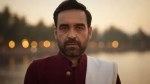
Nearly four hours of Ranveer Singh at his raw, relentless best — and Dhurandhar: The Revenge still leaves you sitting in your seat, staring at the screen, quietly processing what just happened. Director Aditya Dhar didn’t give audiences a tidy resolution. He gave them something far more unsettling: the truth about what it costs a man to become someone else entirely.
Table of Contents
Dhurandhar: The Revenge — Key Details
| Detail | Info |
|---|---|
| Film | Dhurandhar: The Revenge |
| Director | Aditya Dhar |
| Lead Actor | Ranveer Singh |
| Runtime | 3 hours 49 minutes |
| Key Cast | R. Madhavan, Arjun Rampal, Sara Arjun, Rakesh Bedi, Manav Gohil |
| Ranveer’s Character | Jaskirat Singh Rangi / Hamza Ali Mazari |
| Genre | Spy Action Thriller |
| Box Office | ₹800 Cr+ in Hindi in 2 weeks |
The Ending, Unpacked
Throughout the film, Ranveer Singh’s character Hamza Ali Mazari — whose real identity is Jaskirat Singh Rangi — infiltrates deep into Pakistan’s camps as part of a state-funded operation targeting the masterminds behind brutal attacks against India.
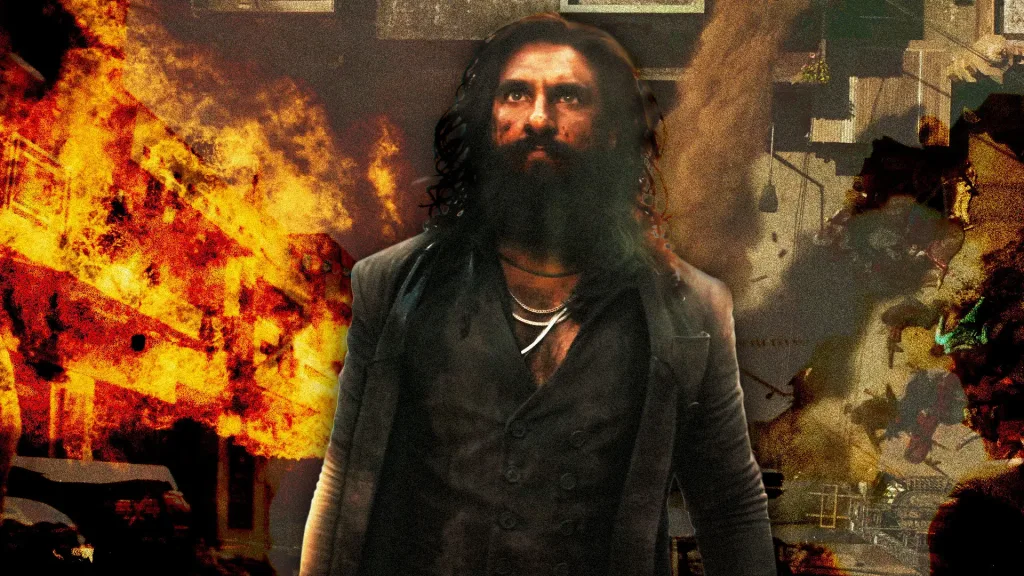
Things unravel dramatically when his cover is blown after ASP Omar Haider confronts Yalina Jamali and discovers that Hamza is in fact an Indian agent — information that reaches the dangerous Major Iqbal, played by Arjun Rampal. In the climactic confrontation, Hamza gets his revenge on Iqbal, but is subsequently taken hostage by the ISI.
Here’s where it gets emotionally complex. Thanks to Ajay Sanyal (R. Madhavan) and a critical mistake by the ISI Chief, Jaskirat manages to return home to India with the help of spy Jameel Jamali. Before his official debriefing, he quietly escapes to his family in Pathankot, Punjab — but something has fundamentally shifted inside him when he finally sees them together.
The Real Question: Did He Ever Come Back?
This is the emotional gut-punch of the film. The final chapter — titled ‘Dhurandhar’ — shows Sushant Bansal and Sanyal teaching new recruits the code of ‘Balidaan Parmo Dharma’ (Sacrifice is the highest duty), and Jaskirat’s RAW training binds the conclusion together. He is now a key national asset conditioned to make sacrifices for his country.
The film’s ending suggests that even though Jaskirat survived the physical and psychological exhaustion of being a deep-cover spy, he has lost his original identity. The conclusion reflects the enormous psychological toll Operation Dhurandhar took on a man who once actively resisted joining the Indian Army.
He reached his family’s doorstep — but couldn’t walk through it as himself anymore. That’s the tragedy, and the brilliance, of Aditya Dhar’s storytelling.
Aditya Dhar previously directed Uri: The Surgical Strike — one of the most celebrated spy-action films in Indian cinema — and with Dhurandhar: The Revenge, he cements his reputation for crafting patriotic narratives with genuine emotional weight.
For more Bollywood movie breakdowns and box office updates, check out our latest Bollywood news on Technosports and our movie reviews section for more detailed coverage.
FAQs
Q: Does Jaskirat Singh Rangi return to his family at the end of Dhurandhar: The Revenge?
He physically reaches his family in Pathankot, but emotionally and psychologically, the film suggests he can no longer return to his old life — having been irrevocably changed by his deep-cover operation.
Q: What does ‘Balidaan Parmo Dharma’ mean in Dhurandhar: The Revenge?
It translates to “Sacrifice is the highest duty” — a RAW training principle that forms the thematic backbone of the film’s ending, explaining Jaskirat’s choice to stay in service rather than reclaim his personal life.