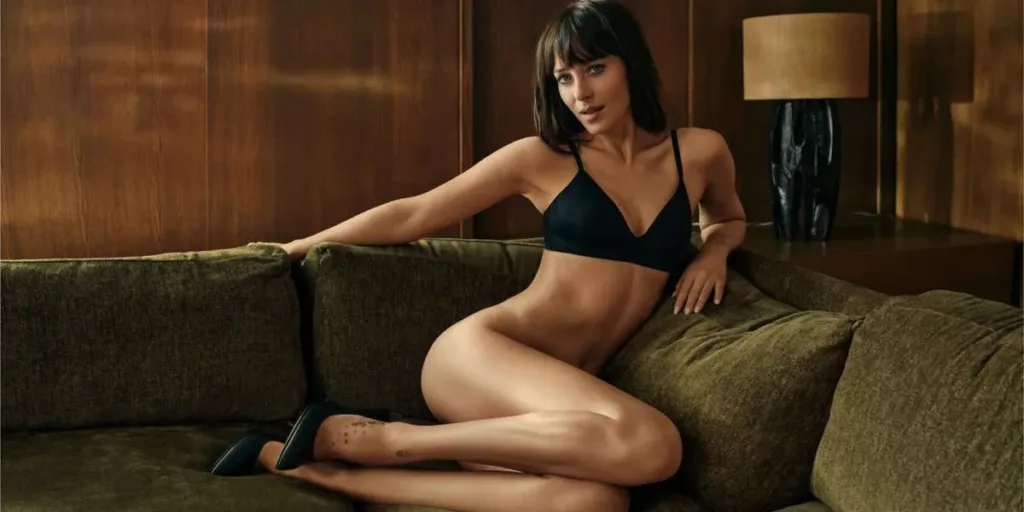
No filters. No agenda. No retouching. Just a woman looking directly into the camera, completely comfortable in her own skin. Calvin Klein’s 2026 campaign with Dakota Johnson dropped on March 10 and the internet hasn’t stopped talking since.
What the Campaign Actually Shows
Photographed by the legendary duo Mert Alas and Marcus Piggott in stark black and white, the images feature Johnson in basic black underwear — a bra and matching thong. What makes it remarkable is what isn’t there: no aggressive retouching, no hidden stretch marks, no softened curves. The tagline reads “Just Be You,” but the real message is far simpler — nothing here is hidden.
The response was immediate. Within hours, screenshots and reaction videos flooded X, TikTok and Instagram. The overwhelming verdict? People loved it. As one viral comment put it: “Finally a campaign that doesn’t tell us how we should look — it just shows someone comfortable being herself.”
For more fashion, celebrity and pop culture updates, head to TechnoSports.
A Sharp Pivot from Years of “Woke” Campaigns
The campaign’s impact is inseparable from its context. Between 2020 and 2024, Calvin Klein leaned heavily into explicit inclusion messaging — body positivity, queer and non-binary representation, racial diversity, empowerment slogans. Some faces from that era included:
| Campaign Face | Year | Focus |
|---|---|---|
| Billie Eilish | 2022 | Body acceptance, beauty standards |
| Jungkook (BTS) | 2023–2024 | Global youth, K-pop reach |
| Jacob Elordi | 2023 | Masculine sensuality, queer aesthetics |
| Various non-binary & trans models | 2021–2023 | Gender and identity inclusion |
While celebrated in progressive circles, many of those campaigns were also criticised for feeling performative — especially when paired with high price points and limited sizing. Johnson’s campaign strips all of that away.
Why It’s Hitting Different in 2026
Calvin Klein has a long history of choosing era-defining faces — from Mark Wahlberg’s iconic 1992 boxer ads to Kate Moss in the heroin-chic 1990s to Justin Bieber’s #MyCalvins selfie explosion in 2015. Johnson’s campaign echoes those provocative roots without going overboard.
The difference here is Dakota Johnson herself. Known for candid interviews, rejecting Hollywood games, and a refreshingly natural public presence, she brings credibility that makes the “Just Be You” tagline feel earned rather than manufactured. She’s not selling an ideal or a cause. She’s selling underwear while looking powerful and comfortable. In 2026, after years of filter culture and performative brand messaging, that simplicity has become genuinely radical.
At a Glance — Calvin Klein’s Most Iconic Campaign Faces
| Face | Era | Why It Worked |
|---|---|---|
| Mark Wahlberg + Kate Moss | 1992 | Defined CK underwear’s cultural status |
| Kate Moss | 1990s–2000s | Shaped the minimalist aesthetic |
| Justin Bieber | 2015 | Social media selfie culture explosion |
| Billie Eilish | 2022 | Body positivity mainstream moment |
| Dakota Johnson | 2026 | Raw authenticity, zero performativity |