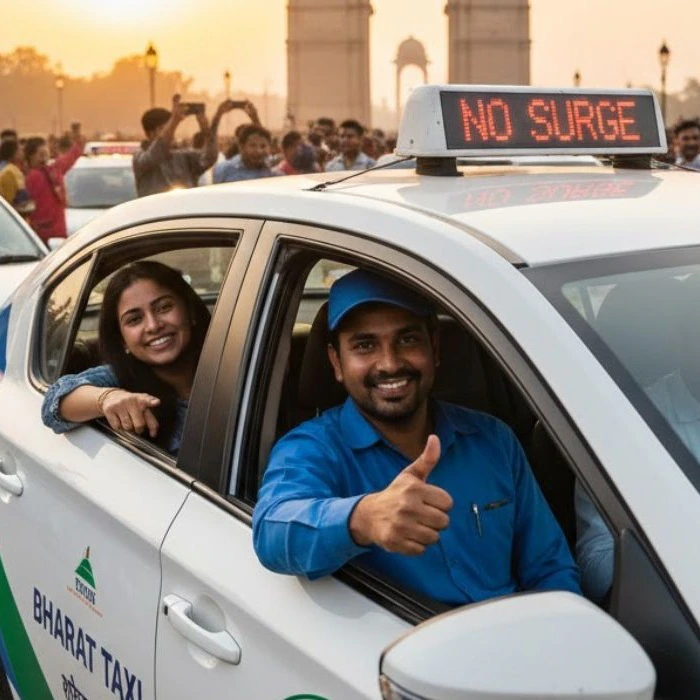
India’s ride-hailing market faces its biggest disruption yet as Bharat Taxi officially launches January 1, 2026, bringing a driver-owned cooperative model that challenges the commission-heavy structures of Uber, Ola, and Rapido. Backed by the Union Ministry of Cooperation and operated by Sahakar Taxi Cooperative Limited, this government-supported platform promises zero commissions, no surge pricing, and democratic driver control.
Often called the “Amul of cabs,” Bharat Taxi follows a member-led structure where drivers collectively own operations and decision-making, marking India’s first large-scale experiment with cooperative ride-hailing at a national level.
Table of Contents
Zero Commission Changes the Economics
Unlike traditional platforms that deduct significant percentages from each ride, Bharat Taxi allows drivers to retain 80-100% of their daily earnings. While drivers may pay a nominal platform fee to cover operational costs, this represents a dramatic shift from commission structures that often take 20-30% of fares.
For passengers, this model eliminates surge pricing and offers more stable, predictable fares—especially for routine commutes between home and office. The platform provides transparent pre-booking prices before ride confirmation, addressing one of the biggest pain points with existing services.
| Feature | Bharat Taxi | Uber/Ola |
|---|---|---|
| Driver Earnings | 80-100% retention | 70-80% after commission |
| Surge Pricing | Eliminated or minimal | Up to 3x during peak hours |
| Ownership Model | Driver cooperative | Private venture capital |
| Registered Drivers | 56,000+ pre-launch | Millions nationwide |

Beta Testing Shows Strong Response
The app is already available on Google Play Store and Apple App Store, though currently in beta with limited availability in Delhi and parts of Gujarat. Over 56,000 drivers registered ahead of the official launch, signaling strong acceptance among the driver community tired of high commissions and unpredictable earnings.
India Today Tech tested the beta version, confirming the app functions largely as intended, though improvements are expected as it transitions from beta to nationwide rollout across major metros including Mumbai, Bengaluru, Kolkata, Delhi, and Chennai.
Technology Backbone: ONDC and Namma Yatri
Bharat Taxi uses the same backend technology powering the ONDC-backed Namma Yatri app, developed by Moving Tech Innovations. This proven open-network infrastructure supports large-scale ride-hailing operations, addressing concerns about whether a cooperative can compete with the sophisticated ride-matching algorithms and navigation systems that private companies spent years refining.
Integration with the National e-Governance Division provides institutional credibility while maintaining the cooperative’s driver-first philosophy. The platform connects with local law enforcement for emergencies and includes safety features like real-time vehicle tracking and ride-sharing with trusted contacts.
The Amul Connection and Leadership
Managing Director Jayen Mehta, who serves as chairman of Amul, leads the initiative with backing from major cooperative institutions including IFFCO and NABARD. This leadership pedigree brings decades of cooperative management experience to India’s mobility sector.
Just as Amul empowered millions of small dairy farmers against private players, Bharat Taxi aims to demonstrate that cooperative economics can work in app-based services. The question isn’t whether it can outperform Uber financially, but whether it’s sustainable for drivers and beneficial for passengers.
Global Precedents Exist
Driver-owned ride-hailing cooperatives aren’t unprecedented globally. The Drivers Cooperative in New York City, launched in 2021, operates as a worker-owned alternative to Uber and Lyft and remains one of the largest cooperatives of its kind in the United States. However, Bharat Taxi represents the first attempt at this model in India at national scale.
Challenges Ahead
Success depends on scale, trust, and consistent service quality. If drivers earn even a few hundred rupees more daily and passengers save on surge pricing, organic growth through retention and word-of-mouth becomes possible. Technology refinement remains crucial as the platform competes against apps perfected over years of operation.
The real test comes post-launch when demand spikes during peak hours and festivals—scenarios where surge pricing traditionally helped balance supply and demand. How Bharat Taxi manages these situations without compromising driver earnings or passenger wait times will determine long-term viability.
For more updates on India’s mobility and tech ecosystem, visit TechnoSports. Download Bharat Taxi from Google Play Store or Apple App Store.
FAQs
When does Bharat Taxi officially launch nationwide?
Bharat Taxi launches January 1, 2026, initially in Delhi, Mumbai, Bengaluru, Chennai, and Kolkata, with nationwide expansion planned.
How is Bharat Taxi different from Uber and Ola?
Bharat Taxi operates as a driver-owned cooperative with zero commissions (drivers keep 80-100% of fares), no surge pricing, and democratic governance.