Anthropic just closed one of the biggest performance gaps in its model lineup. Claude Sonnet 5, launched June 30, 2026, brings agentic capabilities that until recently required the more expensive Opus-class models — and it does so at a fraction of the cost.
Table of Contents
What Is Claude Sonnet 5?
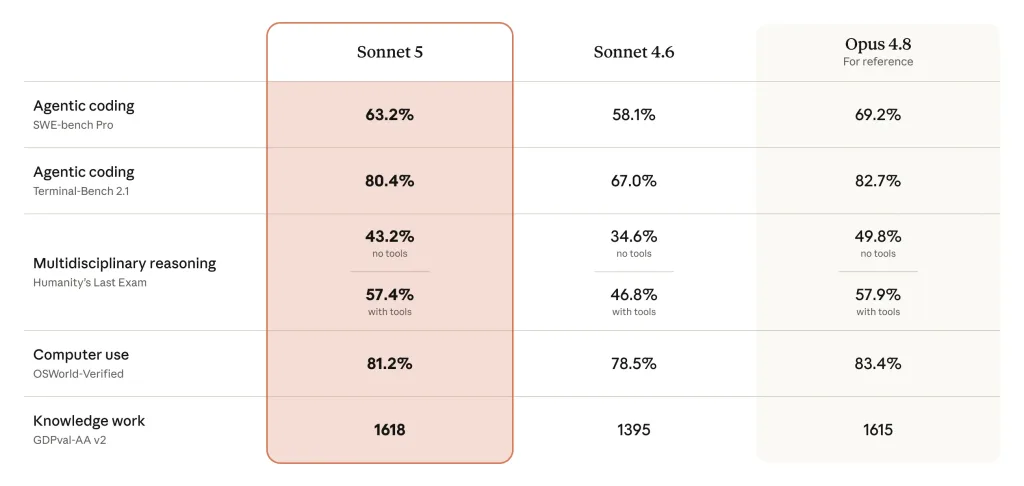
According to Anthropic’s official announcement, Claude Sonnet 5 is designed to be the most agentic Sonnet model yet — capable of making multi-step plans, using tools like browsers and terminals, and running autonomously through complex tasks where previous Sonnet models would stall halfway. The key claim: its performance is now close to Claude Opus 4.8, but at significantly lower pricing.
Pricing and Availability
| Plan | Status |
|---|---|
| Free | Default model from today |
| Pro | Default model from today |
| Max / Team / Enterprise | Available now |
| Claude Code | Available now |
| Claude Platform (API) | Available now |
| Pricing Tier | Input (per 1M tokens) | Output (per 1M tokens) |
|---|---|---|
| Introductory (until Aug 31, 2026) | $2 | $10 |
| Standard (from Sep 1, 2026) | $3 | $15 |
| Claude Opus 4.8 (for reference) | $5 | $25 |
Developers can access it via the Claude API using the model string claude-sonnet-5.
Key Improvements Over Sonnet 4.6
Sonnet 5 marks a substantial jump over its predecessor across every metric Anthropic tracks for agentic work:
| Capability | Sonnet 4.6 | Sonnet 5 | Opus 4.8 |
|---|---|---|---|
| Reasoning | Baseline | Major improvement | Best-in-class |
| Tool use & coding | Good | Near Opus-level | Best-in-class |
| Agentic follow-through | Often stalls | Completes complex tasks | Best-in-class |
| Hallucination rate | Baseline | Lower | Lower |
| Sycophancy | Baseline | Lower | Lower |
| Cybersecurity risk | Lower | Slightly higher partial success | Higher |
Early access partners consistently noted that Sonnet 5 finishes complex multi-step tasks without being prompted to continue, checks its own output unprompted, and does all of this at a cost point that makes autonomous agents economically viable for real-world workflows.
Safety: Better Than Sonnet 4.6, But Below Opus
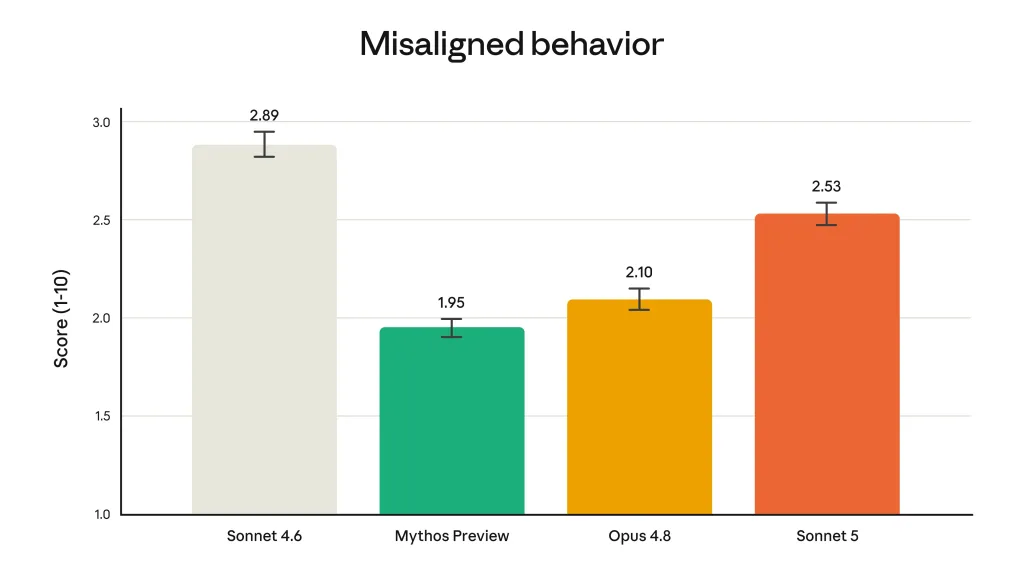
Anthropic’s pre-deployment safety evaluations found Sonnet 5 is an overall improvement on Sonnet 4.6 — lower hallucination, better resistance to prompt injection, and fewer misaligned behaviors on their automated behavioral audit. However, it sits below Opus 4.8 and Claude Mythos Preview on overall safety scores.
On cybersecurity specifically, Sonnet 5 cannot develop working software exploits (it scored 0% on that benchmark), though its slight improvement in partial success rates led Anthropic to enable real-time cyber safeguards by default — the same safeguards present in Opus 4.7 and 4.8.
Why This Matters for Developers and Businesses
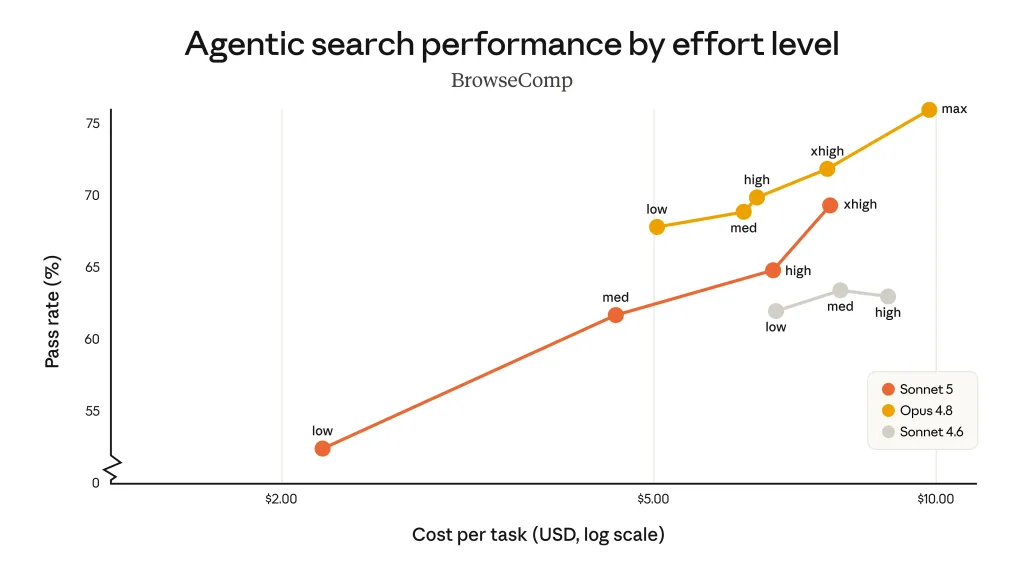
The Sonnet series has historically been the workhorse of AI development — it’s what most developers default to for production deployments where cost matters. The fact that Sonnet 5 now covers a continuous performance-cost curve with Opus 4.8 means teams can tune their effort level and spending without jumping between fundamentally different model tiers.
For AutoArticle AI and similar AI-powered platforms, this kind of cost-performance convergence is a meaningful shift — more capable autonomous agents at prices that scale sustainably. We explored similar dynamics in our recent coverage of Gemini 3.5 Flash’s computer use feature and the OpenAI GPT-5.6 Sol launch, both of which reflect the same industry trend of closing the gap between mid-tier and flagship AI models.
The Bottom Line
Claude Sonnet 5 is the most significant Sonnet upgrade Anthropic has shipped. Near-Opus performance, lower hallucination rates, improved safety, and introductory pricing that makes the transition roughly cost-neutral for existing Sonnet 4.6 users — this one is easy to recommend for any team currently running production AI workloads.