Anthropic has added a new small model to its lineup. Claude Haiku 5.5 is built for high-volume, cost-sensitive work, and the company says it is its fastest model so far. It also costs about 75% less to run than Haiku 4.5 on average, according to Anthropic.
Here is what the model does, how its pricing compares, and which claims you should take with some caution. More coverage is on our Claude Haiku 5.5 tag page.
Claude Haiku 5.5 API Pricing
| Per million tokens (USD) | Haiku 5.5 (up to 100k / over 100k input) | Haiku 4.5 | Sonnet 5.5 |
|---|---|---|---|
| Input | $0.10 / $0.50 | $1.00 | $2.00 |
| Output | $0.50 / $2.50 | $5.00 | $10.00 |
| Cache reads | $0.01 / $0.05 | $0.10 | $0.10 |
| Cache writes | $0.125 / $0.625 | $1.25 | $2.50 |
Prompts up to 100,000 tokens made up about 90% of requests to the previous Haiku model, so the lower tier will apply to most users.
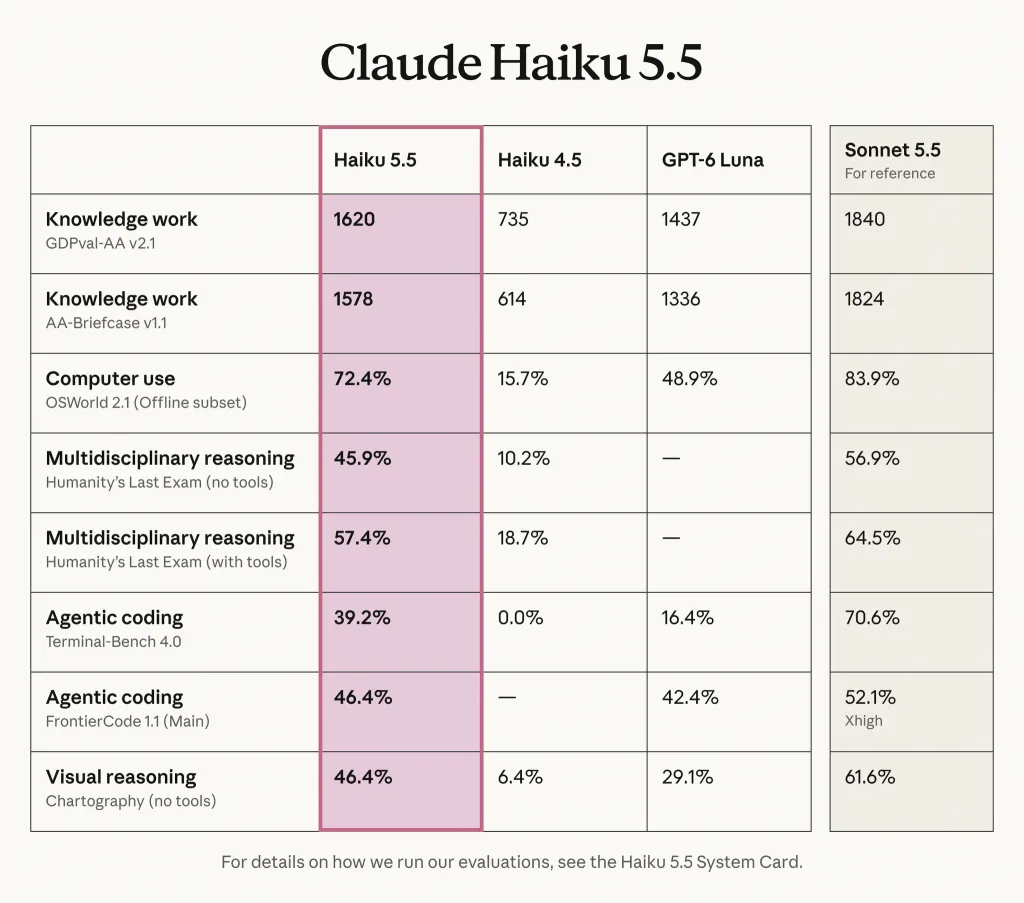
What Is New
Haiku 5.5 is the first Haiku-class model with an adjustable effort setting. Developers can choose how much thinking the model does, trading cost against intelligence. That makes it easier to use the same model for both quick checks and slightly harder jobs.
Best Use Cases
Anthropic points to quick, repetitive work such as summaries, compactions, database queries and classification. It is also positioned as a subagent for coding alongside Claude Opus 5.5 and Claude Sonnet 5.5, and as a fit for speed-sensitive uses such as live customer support and browser use. For complex agentic coding, Anthropic says Sonnet 5.5 and Opus 5.5 remain the better picks, based on its Terminal-Bench 4.0 chart.
Safety and Safeguards
Anthropic reports major gains over Haiku 4.5 across almost all alignment evaluations. Cyber safeguards are stricter than Haiku 4.5 but less restrictive than those on other recent models, allowing a wider range of defensive tasks than Sonnet 5.5 while blocking penetration testing and other attacker-style techniques. Biology safeguards match Sonnet 5, Sonnet 5.5 and Opus 5. Organizations that need broader work can apply to the Life Sciences Verification Program or the Cyber Verification Program.
Other Updates
Anthropic cut the Sonnet 5.5 cache-read price by 50%, from $0.20 to $0.10 per million tokens, which it says lowers Sonnet 5.5 costs by about 20% on most agentic tasks. Monthly API credits are also arriving this week: $100 for Max 5x, $200 for Max 20x and up to $500 pooled for Team. The Python and TypeScript SDKs add beta support for computer use and browser use.
Availability
Haiku 5.5 is available now on all platforms, including Amazon Web Services, Google Cloud and Microsoft Azure. The API identifier is claude-haiku-5-5. Learn more about the company at Anthropic or Wikipedia.
What Is Not Confirmed
Benchmark results are shown only as charts, with no numeric scores for the three named tests. The fastest-model claim and the 75% and 20% savings are Anthropic’s own figures and were not independently verified. The 75% average also looks smaller than the per-token cuts in the table, so it likely reflects a particular workload mix. How the Team credit is shared among users was not explained.
Quick Answers
What Is Not Confirmed?
Benchmark results are shown only as charts, with no numeric scores for the three named tests. The fastest-model claim and the 75% and 20% savings are Anthropic’s own figures and were not independently verified.
Which Claude Model Should You Pick?
For simple, high-volume jobs where cost and speed matter most, Haiku 5.5 is the new starting point. For harder agentic coding, Anthropic itself points to Sonnet 5.5 and Opus 5.5. A sensible approach is to use Haiku 5.5 as a fast helper, then hand difficult steps to a larger model.
How cheap is Haiku 5.5?
Input starts at $0.10 per million tokens.
What is new?
An adjustable effort setting.
Where can I use it?
On the API and major cloud platforms.
Is it best for coding?
Not for complex work; use Sonnet 5.5 or Opus 5.5.
Which Claude Model Should You Pick?
For simple, high-volume jobs where cost and speed matter most, Haiku 5.5 is the new starting point. For harder agentic coding, Anthropic itself points to Sonnet 5.5 and Opus 5.5. A sensible approach is to use Haiku 5.5 as a fast helper, then hand difficult steps to a larger model. The adjustable effort setting makes that mix easier to manage.